


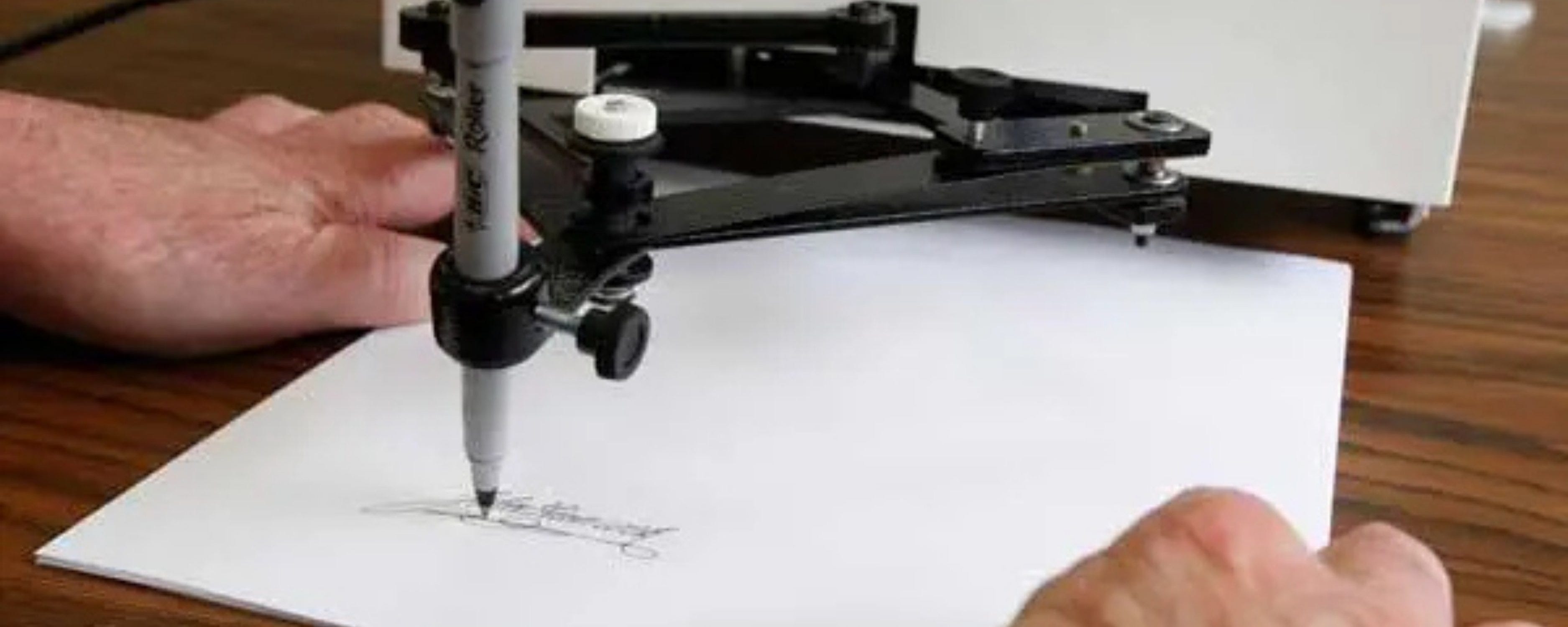
The question of whether President Biden’s frequent use of an autopen to sign legislation violated the Constitution turns on a deceptively simple phrase in Article I, Section 7: “If he approves he shall sign it.” At first glance, this Presentment Clause seems straightforward. A bill passes Congress, reaches the President, and, if he agrees, he signs it into law. Yet Biden’s administration leaned heavily on the autopen, a mechanical device that replicates his signature, often while he was out of state or abroad, raising a worry that gnaws at the foundations of executive responsibility. Was he even aware of what was being signed in his name? The constitutional stakes are high, and the answer is not as obvious as it might appear.
Let’s begin with the core issue: what does it mean to “sign” a bill? Critics of the autopen contend that signing is a personal, deliberate act, an expression of the President’s approval, not a task to be outsourced like mailing a letter. The Framers, they argue, envisioned a direct connection between the executive’s judgment and the physical act of affixing his name. Imagine a judge pronouncing a verdict. We wouldn’t accept a clerk reading the decision while the judge vacations abroad, unaware of the case’s details. Likewise, the President’s signature carries the weight of his office; it’s the final affirmation that a bill aligns with his constitutional duty. If an autopen can stand in for him, detached from his presence or knowledge, then that affirmation risks becoming a hollow gesture.
Historical practice lends credence to this view. Signatures have long been understood as requiring the signer’s proximate presence. The common law treated a signature as evidence of a deciding mind, which is why courts scrutinize wills, deeds, and contracts for capacity and intent rather than merely comparing handwriting. When George W. Bush faced a similar question, he sought guidance from the Office of Legal Counsel in 2005. The OLC opined that an autopen was permissible if authorized by the President, yet Bush hesitated. For significant legislation, like the Terri Schiavo bill, he returned to Washington to sign it himself, pen in hand. His choice suggests a recognition that some acts demand personal engagement. Biden’s approach contrasts sharply. In May 2024, while in San Francisco, his autopen signed a one-week FAA funding extension. The White House acknowledged this, but offered no evidence he directed its use that day. Was he even aware? If not, how can we say he “approved” the bill in any meaningful sense?
This worry deepens when we consider the pattern. Reports, including from the Heritage Foundation’s Oversight Project, suggest Biden’s autopen was used far more often than admitted, perhaps for most legislation, while his personal signature appeared rarely, as with his 2024 campaign withdrawal. A reader might pause here: isn’t this just speculation? Perhaps, but the opacity fuels unease. If aides routinely deployed the autopen without his real-time consent, then executive power drifts from the President to unelected staff. The Constitution vests that power in “a President,” not a shadowy team wielding his name like a rubber stamp. Accountability erodes when the principal is absent from the act.
Proponents of the autopen offer a counterargument. They see it as a modern tool, no different from a fountain pen replacing a quill. The 2005 OLC opinion supports this, claiming “sign” has evolved to include delegated mechanics, provided the President authorizes it. On this view, Biden could issue a standing order, “use the autopen when I’m away,” and still meet the constitutional threshold. But this reasoning falters under scrutiny. Authorization isn’t the same as execution. A general might order troops into battle, but if subordinates decide when and where without his input, the chain of command breaks. Similarly, a blanket directive risks delegating not just the act of signing, but the judgment it embodies. If aides choose when to deploy the autopen, absent Biden’s specific approval, then who truly governs?
There is a further distinction worth drawing out, because it dissolves the strongest version of the proponents’ case. The fountain pen and the quill are both instruments moved by the President’s own hand at the moment of decision. The autopen, by contrast, can operate when the President’s hand, and mind, are elsewhere. The question is not whether technology may assist the act of signing. It is whether the act can occur without the actor. A dictation machine that records the President’s words is an instrument; a machine that composes speeches in his absence and publishes them under his name is a substitute. The Presentment Clause tolerates instruments. It does not tolerate substitutes.
The danger isn’t hypothetical. Barack Obama first used an autopen in 2011, signing a Patriot Act extension from France. Republican critics, like Representative Tom Graves, cried foul, but no court ruled on it. The practice crept into normalcy, untested by judicial review. Biden’s administration took it further, normalizing it to a degree that alarms conservative defenders of constitutional fidelity. If the President can be thousands of miles away, unaware his signature is being affixed, then the Presentment Clause becomes a formality. The Framers intended it as a safeguard, a moment where the executive personally ensures a bill aligns with his vision for the nation. Without that, the presidency shrinks to a ceremonial shell.
A reader might object: doesn’t this exaggerate a technicality? After all, Biden’s staff aren’t rogue actors; they act under his authority. Yet this assumes too much. If he’s uninformed about specific uses, say, during a foreign trip or amid questions about his cognitive decline, then the chain of intent frays. Consider an analogy: a sculptor crafts a statue, but if an assistant swaps it for another while she’s away, can we call it her work? The autopen’s convenience doesn’t justify bypassing the President’s active role. Convenience, in fact, is the problem. It tempts a slide toward automation, where executive power diffuses into a bureaucracy unchecked by the electorate.
This brings us to a broader constitutional worry. The separation of powers hinges on distinct roles. Congress legislates; the President approves or vetoes. If the latter duty can be outsourced without oversight, the balance tilts. Unelected aides gain influence, while the President’s accountability, already strained in a polarized age, weakens further. Imagine a law signed by autopen that Biden later disavows, claiming ignorance. Could Congress override a veto he never intended? The absurdity highlights the stakes. Governance demands clarity, not ambiguity. Nor is the problem confined to legislation. Pardons, executive orders, and commissions all flow through the same signature, and each carries the same requirement of a deciding mind behind the ink. If the signature requirement is hollow for bills, it is hollow everywhere, and the entire apparatus of executive action floats free of the one man the voters actually chose.
What, then, is the remedy? One option is an outright ban on autopen use. The act of signing should remain personal, tethered to the President’s presence and awareness. Alternatively, strict limits could apply: the autopen might be allowed only when he’s in the room, directing its use for each bill. Either way, safeguards are essential. Congress could require a contemporaneous, auditable record of presidential authorization for every mechanical signature, a log that oversight committees and courts could examine after the fact. Without such measures, we risk a presidency where the executive’s hand is absent, yet his name proliferates, a paradox the Framers never envisioned.
A conservative lens sharpens this critique. Republicans champion limited government and personal responsibility. Biden’s autopen habit flouts both. It expands executive latitude through laxity, not intent, and dodges the duty of a leader to stand behind his actions. As President Trump serves his second term with a cabinet of principled conservatives like Marco Rubio and Pete Hegseth, the contrast is stark. Their governance promises accountability, not delegation. Biden’s legacy, by contrast, risks being one of detachment, a cautionary tale for a nation that prizes checks and balances.
The issue transcends partisanship, though. It’s about the Constitution’s endurance. If “sign” can mean a machine acting in the President’s stead, detached from his mind and hand, then other clauses might bend too. “Command” could become a memo; “faithfully execute” a staff directive. The slope is slippery, and the autopen greases it. We must ask: if the President doesn’t personally affirm a law, who does? The answer, left unchecked, is no one, and that’s a governance vacuum no republic can afford.
If you enjoy my work, please subscribe https://x.com/amuse/creator-subscriptions/subscribe
Alexander Muse is a Fellow at the John Milton Freedom Foundation and publishes daily political analysis at amuseonx.com. Primary sources cited in this piece are linked inline; campaign finance figures are drawn from FEC filings, polling data from publicly released crosstabs, and legal claims from filed pleadings. Corrections are posted to the original URL with a dated changelog. Readers who identify errors are invited to contact the author directly. Data in sponsored partnership with Polymarket.
Thank you for another interesting topic and article! The depth and breadth of your topics and research are utterly awe-inspiring.🙌🏾 Who knew that the topic of an auto pen would be so fascinating—and infuriating. I wish there was some way to prove that Biden’s minions “forged” his signature on awful legislation and have some recourse in dealing with it.