


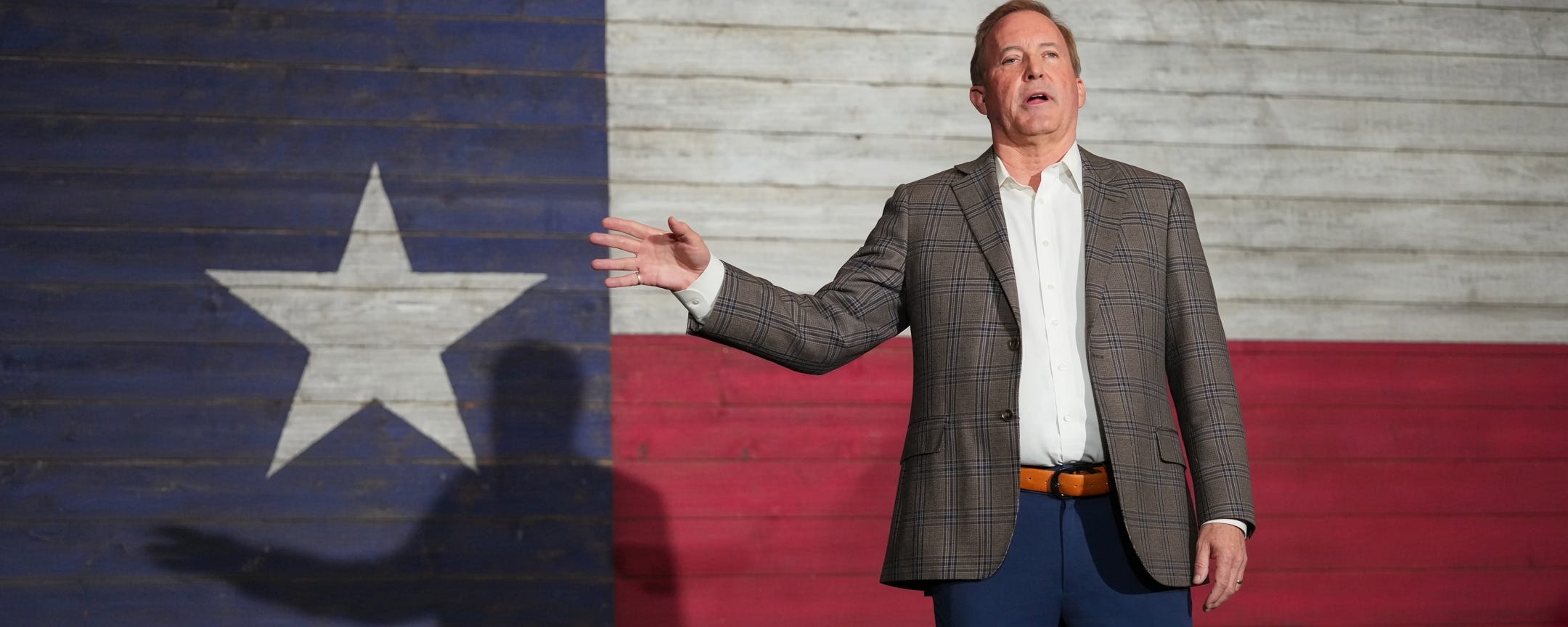
Yesterday, Ken Paxton’s office filed a notice ending Texas’s lawsuit against the Council on American-Islamic Relations (CAIR), its Texas chapters, and the Muslim Brotherhood. Four days earlier, it had dismissed the state’s suit against the NCAA over women’s sports. On November 9th, it ended the charter-forfeiture actions against Annunciation House in El Paso and FIEL Houston, and on November 10th it withdrew the parental-access claims against the medical-records company Epic Systems. Conservatives who cheered each of those lawsuits are confused, and a few are angry. They should be grateful. Nathan Johnson, the Democrat who becomes attorney general in January, would use those cases against the Texans they were filed to protect, and Paxton is taking them out of his hands.


Johnson has not been coy about it. He has promised a top-to-bottom review of everything Paxton filed, and on November 5th he gave the standard: “Those done for political stuntery are going to be terminated.” He has announced that he will not sue out-of-state doctors who mail abortion pills into Texas, and he has singled out the antitrust case against BlackRock and State Street for scrutiny. Governor-elect Gina Hinojosa, for her part, has pledged to rescind Greg Abbott’s designation of CAIR.
Termination is the mild outcome. A lawsuit brought in the name of the State of Texas belongs to whoever holds the office, and on inauguration day Johnson inherits every power Paxton had over a pending case, including the power to reverse the state’s legal position, release a defendant from liability, and sign a settlement on any terms the other side will accept. Think of a pending suit as a half-negotiated contract. The man who opened the talks wanted strict enforcement; his replacement can sit down at the same table and sign a broad release, and the signature binds Texas just the same. The worst version of that release is the consent decree, a settlement that a judge enters as a court order. Texas learned the species in Frew v. Hawkins (2004), where state officials had agreed to a federal decree governing a Medicaid program and later tried to walk away from it; a unanimous Supreme Court held them to it, even while conceding that such decrees may “improperly deprive future officials of their designated legislative and executive powers.” The Court repeated the warning in Horne v. Flores in 2009, and Harris County is living under the proof. Its misdemeanor bail settlement dates to 2019. Paxton intervened to dissolve it, and in October 2026 a federal district court refused. Seven years and several elections later, the decree still governs.
The petition Paxton filed on February 5th asked a Texas court to bar CAIR and the Muslim Brotherhood from operating, owning property, and recruiting in the state under Texas’s terrorist-organization and public-nuisance laws. In Johnson’s hands, that same case could end in an agreed judgment declaring that Texas has no lawful basis for any of it, with a release of the state’s claims attached. The NCAA suit could end with Texas stipulating that the Deceptive Trade Practices Act does not reach the marketing of mixed-sex events as women’s sports. A case filed as a sword would come back as a shield for the defendant, signed by the State of Texas.
Texas law gives the plaintiff a clean exit, and Paxton is using it. Rule 162 of the Texas Rules of Civil Procedure lets a plaintiff take a nonsuit at any time before it has presented all its evidence, and the dismissal is effective the moment it is filed. The judge’s part is ministerial, which is a lawyer’s way of saying he signs the order whether he likes it or not. In Benit v. Primalend (2022), the Dallas Court of Appeals reversed a trial judge who refused to honor a nonsuit filed the day before a summary-judgment hearing; suspicious timing was no ground to ignore it. A nonsuit without prejudice decides nothing on the merits and leaves the claim available to be refiled, subject to limitations. It cannot wipe out a defendant’s independent counterclaims, a pending sanctions motion, or certain requests for attorney’s fees.
The CAIR and NCAA dismissals were both without prejudice. No court found Texas’s allegations false, no release was signed, and a Republican attorney general elected in 2030 can bring the claims again. In the NCAA matter, the substance is already won. After President Trump’s executive order, the NCAA changed its policy effective February 6, 2025, and it now bars male athletes from women’s competition. Dropping a consumer-protection suit in Texas does not repeal that rule. Paxton kept the policy and put the claim in storage.
Annunciation House and FIEL were dismissed with prejudice, and conservatives should say so plainly, because those particular claims are gone for good. What survives is the law Paxton made on the way. In May 2025, the Texas Supreme Court, in Paxton v. Annunciation House, reversed the trial court, vacated its injunction, and confirmed the attorney general’s authority to bring charter-forfeiture proceedings. The Fifteenth Court of Appeals handed him a similar win against FIEL. Had the cases stayed open, Johnson’s lawyers could have confessed error or agreed to judgments built to hollow out those precedents. I read the with-prejudice dismissals as a trade: two claims surrendered, the authority kept.
The same logic tells us what is likely to come before January. The suits against Debra Lynch and Her Safe Harbor, filed January 27, and against Aid Access, Remy Coeytaux, and Rebecca Gomperts, filed February 24, challenge the mailing of abortion drugs into Texas, a category of enforcement Johnson has renounced outright. Left pending, either case invites an agreed judgment holding that Texas law stops at the state line. I expect nonsuits without prejudice in both. The $100,000 judgment and permanent injunction against Margaret Carpenter, final since February 13, 2025, needs no such protection, and neither does the $10 million Texas Children’s Hospital settlement that opened the nation’s first detransition clinic on October 27. The BlackRock and State Street case has its own insurance, since the other plaintiff states can carry on without Texas. EPIC City is the hard call, because a nonsuit there would forfeit the temporary injunction Paxton won in March against the utility district’s purported directors, and he has no power to dismiss the developer’s own claims against the Texas Workforce Commission.
Through all of this, Paxton has said almost nothing, and the Democrats and their willing accomplices in the drive-by media have treated the silence as a confession. It is prudence. Nothing in Rule 162 requires him to stay quiet, and no judge could undo a valid nonsuit because he explained it. The risk lies in what an explanation becomes afterward. In Epps v. Fowler, the Texas Supreme Court held that a defendant can qualify as the prevailing party for fee purposes when a plaintiff nonsuits to avoid an unfavorable judgment. In Cox v. Vanderburg (2021), an appeals court upheld dismissal with prejudice as a sanction against plaintiffs who used a nonsuit and refiling to get around rulings they disliked, and their own lawyer’s admission about the purpose helped sink them.
Protecting the state’s enforcement options is a world away from dodging a court’s orders, but opposing counsel are paid to blur that line, and every press release is a future exhibit. CAIR’s separate federal challenge to Abbott’s designation is still pending, and its lawyers would quote any statement about motive back to that court. Announce the next round of dismissals in advance and the defendants race to the courthouse with counterclaims that a nonsuit cannot touch. Explain the CAIR and NCAA nonsuits as preserving claims, and someone asks why Annunciation House and FIEL went the other way. Before long, the attorney general is litigating his own press conference instead of protecting the state. A careful lawyer says nothing until the last notice is filed.
That leaves the rest of us to explain. Paxton has roughly eight weeks left in an office he has held since 2015, and he could have spent them packing boxes. He is spending them reading the docket line by line and deciding which cases are safer to close than to inherit. Texans who supported those lawsuits should tell their neighbors why they are ending, because the man who ended them should not.
At the end of the day, the lesson reaches past one attorney general. Conservatives spent a decade learning to govern through litigation, and litigation is only as conservative as the lawyer who controls it. Wins that matter should be carried to final judgment or written into statute, where an election cannot sign them away. The Legislature should require legislative approval before any settlement or consent decree restricting the state’s future enforcement power takes effect, as Wisconsin did in 2018. Until then, the nonsuit is the tool the rules provide, and Paxton is right to use it. An election hands the winner the office; it should not hand him his predecessor’s cases to turn against the voters who lost.
If you enjoy my work, subscribe x.com/amuse/creator-subscriptions/subscribe
Alexander Muse is a Fellow at the John Milton Freedom Foundation and publishes political analysis at amuseonx.com. Readers who identify errors are invited to contact me directly. Each op-ed is edited for grammar and clarity using AI in partnership with Grammarly. Data provided in a sponsored partnership with Polymarket.
Thank you for this explanation!