


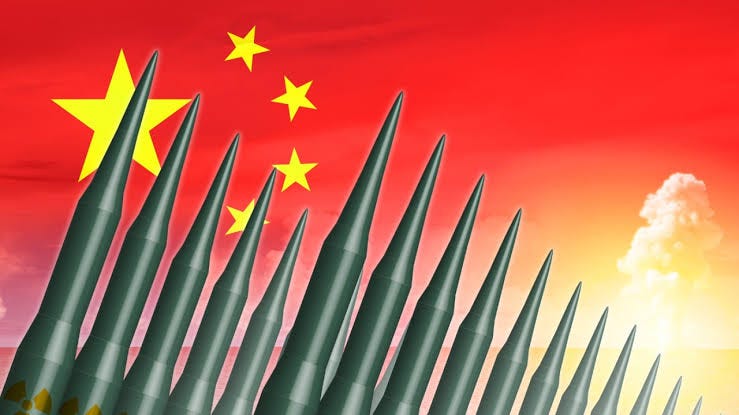
On November 19th in Shenzhen, President Trump met with Xi Jinping and Vladimir Putin and left with a 4-point declaration. The fourth commits the 3 governments to “a dialogue on reducing nuclear risks and preventing the proliferation of nuclear weapons.” China’s foreign ministry published the same text the same day, and the White House featured it in its readout of the trip.
Trump was right to seek that sentence, and he should now convert it into reciprocal, measurable safeguards with China and Russia while protecting the credible, cost-effective American deterrent that makes serious bargaining possible. The declaration contains no warhead ceilings, reductions, inspection system, or timetable. Conservatives should say so without embarrassment. What the president brought home is a public promise from 2 rivals, signed at the top, and that kind of promise can be collected on.
Trump must keep America strong enough that its enemies decline to attack it. He must also shrink the odds that confusion, an unexplained launch, or a misread warning starts a catastrophe nobody chose. The first duty finances the second. A working deterrent lets an American negotiator sit down without desperation, and a practical agreement can remove dangers that additional warheads cannot touch. Robert Peters of the Heritage Foundation has argued that credible capabilities give an adversary a reason to negotiate at all, and that a deterrence hawk need not be an enemy of arms control.
For half a century, nuclear diplomacy was a conversation between Washington and Moscow. New START, the last treaty binding the 2, expired in February 2026. Meanwhile, the US-China Economic and Security Review Commission’s November report cites SIPRI’s June estimate of roughly 620 Chinese warheads, along with the Pentagon’s December 2025 assessment that Beijing is on a trajectory toward 1,000 by 2030. Nobody has inspected either figure. One is an outside estimate, the other a projection, and that uncertainty is the whole trouble. A government whose strategic decisions can put American cities at risk has enjoyed a standing exemption from explaining them.
Richard Weitz of the Hudson Institute has described how a more survivable Chinese force complicates allied confidence in American protection and strains American resources across several regions at once. An ally who doubts the umbrella has every reason to look for other shelter. Deterrence, properly understood, is assurance against coercion; it has never required buying one American weapon for every weapon a rival builds.
Beijing’s own words define the negotiation. In its April 17th national report to the NPT review conference, China wrote that “China’s nuclear force is nowhere near that of the United States or Russia,” and on that basis rejected trilateral disarmament negotiations at this stage, assigning the job of cutting to the 2 largest arsenals. By November, its foreign ministry was publishing a commitment to discuss nuclear risk with those same 2 countries. The positions can coexist, since a government can talk about preventing an accident without accepting a ceiling on its arsenal. The disparity is real, and it excuses nothing. A smaller arsenal can still start a war by mistake.
Picture three neighbors locked in a bitter property dispute. They can agree on who answers the telephone when smoke appears, and they can agree to warn one another before a controlled burn, without anyone moving a fence or conceding a boundary. One route from quarrel to disaster gets closed. There is, of course, no fire department on this street, so each owner keeps his own hose in good repair.
Arms Control Today reported in October that American and Chinese officials had already met at least three times in 2026 on the margins of the five recognized nuclear powers’ discussions, and that Washington had asked for greater advance notice of missile tests. What changed on November 19th is that Xi put his own name on the subject. A request raised by a deputy can be buried by a deputy. A commitment issued by the general secretary is harder to disown, and Washington should start presenting the bill immediately.
The first bargain should be small and checkable. Washington should ask for a dated schedule of talks with named negotiators on each side. It should ask for designated crisis contacts, tested periodically, so a 3 a.m. call reaches someone with authority to answer. It should ask for advance notice of agreed categories of missile activity, sent through an authenticated channel. Every one of these needs the same fine print: who does what, how compliance is recorded, and what follows when a party refuses. None of these three requests asks Beijing to scrap a single warhead, which removes its favorite excuse for saying no. The American offer should be reciprocal and proportionate, with operational secrets kept off the table. If China performs, Americans get a tangible safety gain. If China stalls, we learn something cheaply, before anything valuable is offered.
Hawks worry that China will pocket the prestige of a seat beside the 2 great nuclear powers and keep building while Washington waits on a grand bargain, and that tying every arrangement with Moscow to Chinese consent hands Beijing a veto. Representative John Moolenaar struck the right note before the trip, favoring security discussions while expecting no reduction agreement. The cure is to keep three tracks separate. Risk reduction proceeds with all three governments. Bilateral business with Russia goes forward wherever it serves us. Any numerical treaty comes later and on its own terms, with no pretense that three very different arsenals must accept identical numbers on day 1. Deadlines belong at the next meeting and in published, agreed procedures. Readiness is never a bargaining chip while the talking goes on.
Reagan showed what the end of such a road looks like. In 1987, he signed the Intermediate-Range Nuclear Forces Treaty, which eliminated an entire class of missiles and sent inspection teams onto each side’s territory. “Trust, but verify” meant people physically checking what governments had promised to do. Shenzhen is a long way from that, and the same machinery may not fit 3 parties. The standard survives anyway: a diplomatic achievement eventually changes conduct and lets the change be tested.
Conservatives should apply that standard at home too. In March 2025, I argued for canceling the Sentinel missile and leaning on the submarine force, a case for smarter deterrence and never for disarmament: Relic of the Cold War: The Case for Canceling the Sentinel ICBM Program. In April 2026, I warned against unilateral American restraint while China keeps advancing Beijing’s Trojan Horse: The NGO Network Quietly Strangling American Data Centers & AI. Both arguments rest on one test: whether a force works, survives, and can carry out its mission. A weapons program earns no protection by being expensive, and a summit earns no applause by being photographed. Negotiators and weapons buyers should answer the same question: what security did their work actually buy?
I would write a different column if Washington had surrendered a needed capability merely to fill the chairs, or had accepted limits it cannot check. Nothing in the Shenzhen text does either. The president gave up no missile, no submarine, and no warhead for a sentence that binds Xi to a subject he spent the spring refusing to discuss in any 3-way format.
The Democrats and their willing accomplices in the drive-by media will call Shenzhen a photo op this week, call it appeasement next week, and if a notification agreement is ever signed, they will claim it was their idea all along. None of that should distract the administration. The public is owed something simpler, a way to tell which stage the process has reached. Voters should recieve the names of the negotiators, the date of the next session, and the text of the first procedure, and they should hear promptly if Beijing declines to supply any of them.
At the end of the day, the purpose is ordinary and immense. A father in Dallas or Omaha will never read a notification protocol, but his family’s safety can depend on whether a Chinese duty officer picks up the phone in the worst hour of a crisis. Americans did not spend 8 decades building a nuclear deterrent in order to admire it. We built it so that a president could sit across from men like Xi and Putin, name his terms, and walk out if they were refused. Trump has taken the seat. The terms come next, and conservatives who want this president to succeed should be the first to ask what Beijing has actually done by the time the 3 men meet again.
If you enjoy my work, subscribe https://x.com/amuse/creator-subscriptions/subscribe
Alexander Muse is a Fellow at the John Milton Freedom Foundation and publishes political analysis at amuseonx.com. Readers who identify errors are invited to contact me directly. Each op-ed is edited for grammar and clarity using AI in partnership with Grammarly. Data provided in a sponsored partnership with Polymarket.
Excellent analysis. Thanks for sharing.
Please change “recieve” to “receive.” Thanks.
Great review. Thanks Alexander.