


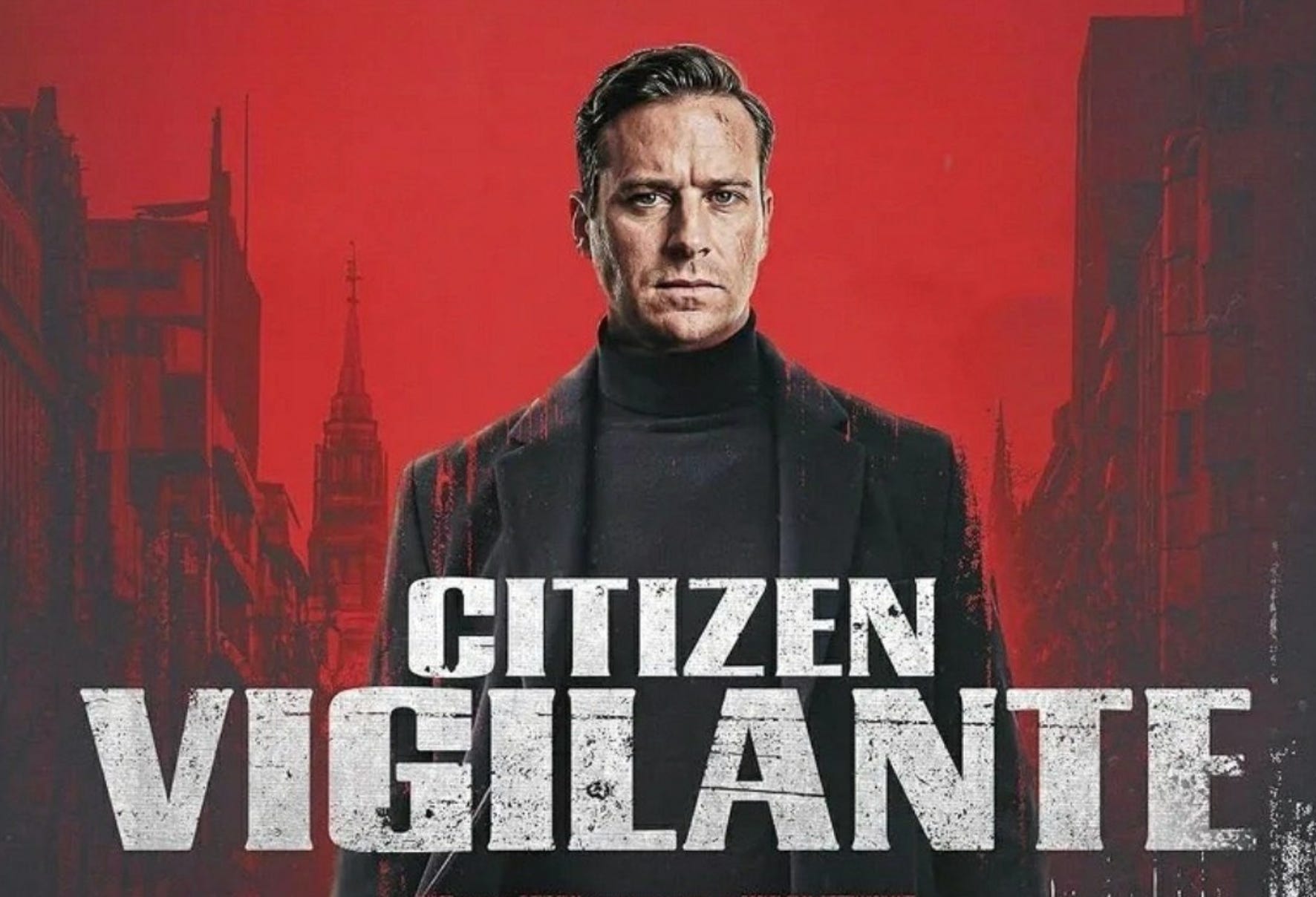
n the landscape of contemporary film, Citizen Vigilante arrives less as entertainment than as a cultural artifact that captures a fracture already visible in official records across Europe. Directed by Uwe Boll and starring Armie Hammer, the movie follows a wealthy American veteran who becomes a masked avenger in European cities. He hunts violent criminals, rapists, and the corrupt officials who shield them. The narrative centers on gang rape and predation tied to unchecked migration from Islamic societies. It portrays indigenous citizens who never consented to the demographic and cultural transformation of their countries. These citizens watch perpetrators from migrant backgrounds receive lenient treatment or escape justice while natives who complain face prosecution or ruin. The film does not invent this world. It dramatizes one that government statistics, independent inquiries, and public polling have documented for years.
The core claim is straightforward. European elites imposed a civilizational transformation without asking the people who would live with the results. Citizen Vigilante gives artistic form to the resulting sense of stolen sovereignty. When the state will not defend the native population, individuals step forward. That premise rests on a factual foundation that begins with specific events and scales to national patterns.
Consider the night of December 31, 2015, in Cologne and other German cities. Coordinated groups of men, predominantly North African and Middle Eastern, many of them asylum seekers or illegal aliens, sexually assaulted approximately 1,200 women. Cologne alone recorded around 650 assaults, including 22 rapes. Police communications initially instructed officers to downplay the ethnic profile of the perpetrators. Media outlets followed suit for days. Only sustained public pressure forced fuller acknowledgment. The attacks were not an isolated outburst. They served as an early, public demonstration that the 2015 open-door policy carried immediate, foreseeable costs to women’s safety. Authorities had been unwilling to discuss those costs honestly beforehand, during or even after.
The United Kingdom presents a longer and more systematic record. Between 1997 and 2013 in Rotherham, hundreds of children, overwhelmingly white British girls as young as eleven, were groomed, gang-raped, trafficked between towns, beaten, and in some cases threatened with guns or petrol by predominantly Pakistani men. Taxi drivers and takeaway workers used alcohol, drugs, and intimidation to control victims. Police and council officials received repeated, detailed reports yet refused to act decisively. The independent inquiry led by Alexis Jay concluded that a widespread perception that authorities should downplay the Islamic dimensions of the abuse, for fear of racism accusations, paralyzed effective response. Similar organized networks operated in Rochdale, Telford, Oxford, Oldham, and elsewhere. Thousands more victims suffered under the same pattern.
Rupert Lowe’s Rape Gang Inquiry Report, released in June 2026, extends this record across the entire country. The 219-page document identifies evidence of identical grooming gang operations in at least 149 local authority areas. It traces the pattern back to documented cases in Bradford as early as 1955. Extrapolating from established local patterns, the report estimates at least 250,000 predominantly white British girls have endured repeated rape, gang rape, trafficking, torture, and in some instances forced Islamic conversion attempts since the middle of the last century. The gangs operated with the active or passive consent of public authorities. Police, social services, the NHS, and local councils treated victims as promiscuous or problematic rather than as targets of organized crime. Warnings were ignored. Files were not pursued. Perpetrators from recent migrant backgrounds were rarely deported even after conviction. The report describes this history as a rotting stain on Britain’s past and states that many citizens no longer trust the government to investigate its own failures without external pressure.
Germany’s Federal Criminal Police Office data reveals a consistent national pattern since the 2015 migrant influx. Non-German nationals, who comprise roughly 15 to 16 percent of the population, account for approximately 35 to 42 percent of crime suspects overall in recent years, excluding pure immigration violations. The disparity sharpens in violent and sexual crime. In 2024, of 11,329 identified suspects in rape and sexual assault cases, 4,437, or about 39 percent, were non-Germans. Asylum seekers and recent arrivals have been overrepresented by factors of 3.9 to 4.2 times or higher in sexual offenses. Certain North African and sub-Saharan groups have recorded rates ten to twenty-one times the German average for rape and sexual assault in some datasets. Rape and serious sexual assault cases rose steadily, reaching 13,320 in 2024 with further increases into 2025 and 2026.
These numbers sit alongside a two-tier system of enforcement. Native citizens who post on social media about crime patterns or criticize migration policy have faced fines, job loss, or prosecution under hate-speech provisions. Meanwhile, many perpetrators from favored migrant groups receive de facto protection through institutional reluctance to name ethnic or cultural patterns. The asymmetry produces the precise sense of inverted justice the film dramatizes. Equal protection under law yields to selective enforcement that shields one set of groups while criminalizing dissent from another.
A reader might reasonably ask whether these disparities simply reflect the youth and maleness of recent migrant cohorts or broader socioeconomic conditions. Official German analyses and age- and gender-adjusted studies still show substantial overrepresentation. The organized grooming cases in Britain display a consistent offender profile tied to specific communities and, according to multiple inquiries, to cultural attitudes toward non-Muslim girls and concepts of consent that clash with host-nation norms. These are not claims that every individual from a given background offends. They are observations of measurable patterns that policy must address rather than deny. Suppressing the ethnic and religious dimensions of the crimes for fear of racism accusations did not make the problems disappear. It multiplied victims and destroyed public trust.
Public opinion data confirms the democratic breach. A 2017 Chatham House survey across ten European countries found an average of 55 percent agreeing that all further migration from mainly Muslim countries should be stopped. Majorities appeared in Poland at 71 percent, Austria at 65 percent, and Germany at 53 percent. Subsequent years of rising support for restrictionist parties across the continent show the sentiment has not dissipated. Citizens did not vote for this outcome in any binding referendum that authorized the transformation of the demographic and cultural character of their countries. When they object, they are labeled, censored, or in some cases prosecuted while the underlying patterns persist.
Viktor Orbán has articulated the civilizational stakes without euphemism. He has stated that Hungary does not see these people as Muslim refugees but as Muslim invaders. Drawing on his nation’s historical experience under Ottoman rule, he warns that large-scale Muslim immigration produces parallel societies that cannot peacefully coexist with Christian Europe. The evidence from crime statistics, grooming inquiries, and the emergence of areas where host-nation norms no longer fully apply lends weight to that assessment. Countries that resisted the 2015 wave, such as Hungary and Poland, maintained far lower rates of these specific crimes and preserved greater social cohesion. Germany and Sweden, which accepted the largest shares relative to population, recorded the sharpest rises in sexual violence and gang-related crime.
The reception of Citizen Vigilante itself illustrates the dynamic at work. Germany’s ratings board denied the film any age classification, effectively blocking theatrical and major streaming release on the grounds that it incited violence against migrants. Director Uwe Boll called the decision deliberate censorship and pursued legal action. On June 25, 2026, the full film became available for free on 𝕏 for forty-eight hours. The platform’s amplification produced millions of views, a sharp spike in German search interest, and a 96 percent audience score on review aggregators. Professional critics offered cooler assessments. The attempt at suppression generated the classic Streisand effect. It confirmed both public appetite for the narrative and the futility of elite information control in the digital age.
This pattern carries practical consequences. Suppressing legitimate grievances about crime, cultural incompatibility, and demographic change does not resolve the underlying issues. It erodes trust in institutions, radicalizes segments of the population, and creates the precise conditions in which vigilante fantasies migrate from screen to street. Lowe’s report includes an explicit pledge that if government fails to take necessary steps, private prosecutions will follow to obtain justice. The film and the report converge on the same point. When the state forfeits its core duty of protection, citizens and elected representatives alike turn to remedies outside official channels.
The moral argument is more fundamental still. The first duty of any legitimate government is the physical protection of its own citizens, especially the most vulnerable. When that duty is deliberately subordinated to ideological experiments in mass migration and multiculturalism, and when criticism is punished while predation is excused, the government forfeits its moral claim to authority. Leaders who expose their own women and children to predation in order to signal virtue commit the ultimate betrayal of both the living and the unborn who will inherit the resulting societies. The data from Cologne, Rotherham, national statistics, and the Lowe inquiry document the costs in concrete terms. The resonance of Citizen Vigilante, despite official resistance, demonstrates that the public recognizes the breach of the social contract.
The film therefore functions as a warning rather than mere entertainment. It shows what happens when the state stops defending the native population and instead shields favored migrant groups while criminalizing native dissent. It dramatizes the artistic expression of stolen sovereignty. The choice now facing European governments is whether they will restore equal protection, honest enforcement, and genuine consent over borders and culture, or whether they will continue down the path that makes the vigilante not an aberration but a predictable response. The record is clear. The public already knows. Further denial only deepens the fracture.
If you enjoy my work, please subscribe https://x.com/amuse/creator-subscriptions/subscribe
Alexander Muse is a Fellow at the John Milton Freedom Foundation and publishes daily political analysis at amuseonx.com. Primary sources cited in this piece are linked inline; campaign finance figures are drawn from FEC filings, polling data from publicly released crosstabs, and legal claims from filed pleadings. Corrections are posted to the original URL with a dated changelog. Readers who identify errors are invited to contact the author directly. Data in sponsored partnership with Polymarket.
It appears that Europe is lost forever, especially the Scandinavian countries. I have hope for Ireland where men are still men and the Catholics and Protestants have joined against the common enemy of Islam.
I can't for the life of me understand why anyone lives in Britain. The City of London, King Chuck and Andrew the Pedo, communist censorship, corrupt law enforcement, no guns to defend yourself and if you even look at a criminal sideways you're the one that gets thrown in jail. It's a small country. Go to Scotland or some other country that's not completely insane.