


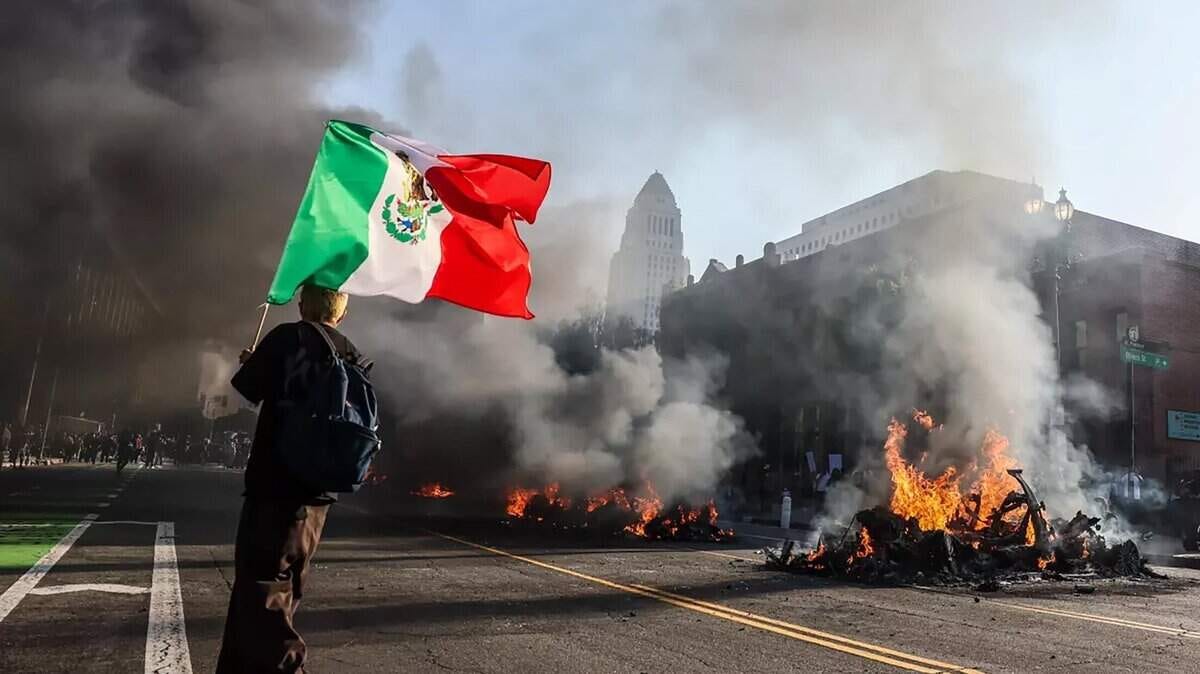
“If you want to regulate federal agents, you have to win a federal election.” Bill Essayli, the First Assistant US Attorney for the Central District of California, said that on September 29, 2026, the day Gavin Newsom signed 21 immigration bills into law. Essayli then advised the Department of Homeland Security to disregard the new state ban on shock gloves. I think his one sentence captures the entire dispute. California Democrats are attempting nullification through operational control. Their most aggressive measures tell federal officers what equipment they may carry, how they must identify themselves, and under what state-created conditions they may conduct federal business. Pair that with pressure on detention capacity and a fresh supply of lawsuits, and the strategy seeks to make immigration enforcement depend on Sacramento’s permission.
Picture a deportation officer in Los Angeles at 5 a.m. Her supervisors in DHS issued her equipment, assigned her a vehicle, and set the agency’s policy on face coverings. Now Sacramento has issued its own orders. AB 2760 bans the shock gloves her agency bought and, by its own terms, applies to federal law-enforcement agencies, directing them to revise their use-of-force policies. SB 937 restricts flash-bangs and explosive breaching by federal officers in immigration operations. SB 1004 regulates masks. AB 1650 requires the agency to create and attach a decal to the doors of her rented vehicle, legible from 50 feet. She now answers to two chains of command. When they conflict, which one does she obey?
Congress settled that long ago. Under 8 USC 1103, the Secretary of Homeland Security administers the immigration laws, controls and supervises the employees who enforce them, and issues the regulations and instructions they follow. Nothing in that statute invites a state legislature to amend the instructions. California keeps a great deal of power, of course. It can govern its own police, refuse to rent out its jail cells, and decline to lend state resources to federal work. I said as much in August, writing about New York, when I accepted that Washington cannot conscript a county sheriff. Refusing to help, however, is one act and issuing orders is another. My neighbor may refuse to lend me his ladder. He does not get to tell me which ladder to buy.
The courts have already noticed the difference. On April 22, 2026, the Ninth Circuit enjoined the identification provision of California’s earlier law, SB 805, pending appeal in United States v. California. The panel concluded that the United States would likely succeed because a state cannot directly regulate federal operations, even when it imposes identical rules on its own personnel, and it held that a modest degree of interference does not rescue a forbidden direct regulation. That ruling came from California’s own federal circuit, the same one conservatives spend most of their careers complaining about. It was interim relief on the earlier statute, not a final judgment on this package. Still, look at what SB 1004 does. It extends the mask rule to state officers, which is Sacramento’s attempt to answer the charge of singling out federal agents. The Ninth Circuit has already explained why equal treatment does not cure the defect.
AB 1650 shows the problem in miniature. The decal requirement covers privately owned vehicles furnished to federal, state, and local agencies for certain custody operations, and it carves out plainclothes, undercover, and tactical work. Those exceptions narrow the law. They do not change who is giving the order. Whether a sticker is burdensome hardly matters. What matters is whether Sacramento has supervisory authority over the federal agency peeling the backing off it. Even sympathetic scholars see the trouble. Kevin Johnson, an emeritus law professor at UC Davis who considers the laws well-intentioned, told the Associated Press that “the state has very limited, if any, powers in dictating to the federal government how its officers are armed.”
Detention is the second front. California tried once before to abolish the private facilities ICE uses, and in 2022 the en banc Ninth Circuit struck that effort down in GEO Group v. Newsom, holding that the state could not override Congress’s decision to let federal officials choose their detention arrangements. SB 1367 now forbids new land-use approvals for privately operated detention facilities, including conversions of existing buildings. The mechanism is zoning, not an outright ban. The effect is the same: Washington may not obtain the facilities it is authorized to contract for. AB 1801 piles on expanded notice and public-meeting requirements, and AB 1633 imposes a 25% tax on covered operators’ California income starting July 1, 2028. Chief Justice John Marshall warned in McCulloch v. Maryland that “the power to tax involves the power to destroy.” I will concede that modern doctrine lets states tax federal contractors under neutral rules, and United States v. Washington (2022) forbids only discrimination against federal operations. The tax needs a careful challenge. The zoning ban does not.
Then comes the money. SB 747 took effect immediately, reaches conduct back to March 1, 2025, and creates a state cause of action for violations of federal constitutional rights, including violations by federal officials. In Egbert v. Boule, the Supreme Court refused to invent new damages remedies against a Border Patrol agent, reasoning that Congress, not judges, should decide when federal officers face personal liability. California apparently decided Congress was taking too long. SB 747 does preserve qualified and sovereign immunity and acknowledges the right to remove cases to federal court, so it may survive. Its function is plain enough. Each lawsuit adds a cost to each arrest, and Sacramento collects that toll without changing a word of federal law.
Put the pieces together, and the design emerges. Restrict the equipment, dictate the markings, raise the personal exposure, and choke off the beds. No single bill repeals the Immigration and Nationality Act. Each one simply converts another stage of an arrest into a checkpoint where the state can intervene. I cannot yet prove the package will make enforcement impossible, and nobody should claim it already has. Pressure is the architecture’s evident purpose. “Civil war without the war” works as a political metaphor for that contest over sovereignty, and I mean it as a metaphor. The legally grounded charge is narrower and more damning: California is claiming powers incompatible with its membership in a constitutional union.
California has fought this fight before. In 1889, Deputy US Marshal David Neagle was guarding Justice Stephen Field when David Terry attacked the justice in a railway dining room. Neagle shot Terry dead, and California arrested the marshal for murder. The Supreme Court ordered him released because he had acted under federal authority and done no more than was necessary and proper to protect Field. Neagle never gave federal officers a license to do whatever they please. It barred a state from punishing the proper execution of a federal duty. Hans von Spakovsky of the Heritage Foundation tied the mask fight to Neagle last October, noting that officers being doxxed and harassed is exactly the sort of operational judgment federal leadership must make. So California may investigate a fatal shooting, as AB 1806 requires. It may not manufacture illegality by declaring federally authorized conduct a state offense.
Sacramento’s defenders say conservatives have defended states’ rights for decades, and that California is simply “opting out” of a policy its voters reject, exactly as Printz v. United States allows. They add that federal supremacy would otherwise let ICE trample constitutional rights. The Hoover Institution’s Seeking Sanctuary defends a state’s right to stay out of federal enforcement, and it says just as plainly that states cannot stop federal operations. The Ninth Circuit drew the same line in 2019, upholding California’s noncooperation while striking provisions that interfered with federal activity. As for rights, supremacy protects lawful federal authority and nothing more. A federal court can still hear a claim of excessive force. California does not need command of ICE to guarantee that, and wanting accountability does not hand a state a power the Constitution withholds.
The deeper wrong is democratic. Californians vote for president and send 52 members to the House. They lost the immigration argument in November 2024, and they are entitled to win it back at the next election. What they cannot do is convert control of their statehouse into a veto over national decisions, because that would give one state’s electorate authority over obligations that belong to all 50. Back in June 2025 I wrote that “states may not create sanctuary zones immune from federal law.” This package is the logical next step: a sanctuary zone with its own rules of engagment for the federal officers inside it.
While all 21 bills are abusive, I am not claiming they are all unconstitutional. Preserving CalWORKs eligibility for a detained parent, telling crime victims about available protections, and punishing employers who threaten workers with ICE are ordinary state business, and Newsom actually vetoed the broader AB 1896. While California has not legally seceded, its actions demonstrate something very similar. The vulnerability is concentrated in AB 2760, SB 937, SB 1004, AB 1650, and SB 1367, and that is where the Justice Department should challenge and seek injunctions against applying each one to federal operations, while Congress should write the federal-officer remedy statute that Egbert invited so Sacramento cannot keep inventing its own, and every Republican in Washington who claims to care about the rule of law should say out loud that a governor does not get to approve the equipment list of a federal agency. Newsom is welcome to run for president and fix immigration from the Oval Office. Until then, he governs California, and Washington governs its own officers.
If you enjoy my work, please subscribe https://x.com/amuse/creator-subscriptions/subscribe
Alexander Muse is a Fellow at the John Milton Freedom Foundation and publishes daily political analysis at amuseonx.com. Primary sources cited in this piece are linked inline; campaign finance figures are drawn from FEC filings, polling data from publicly released crosstabs, and legal claims from filed pleadings. Corrections are posted to the original URL with a dated changelog. Readers who identify errors are invited to contact the author directly. Each op-ed edited for grammar and clarity using Ai in partnership with Grammarly. Data provided in a sponsored partnership with Polymarket.
California considers itself to be a separate country as its leaders do whatever they want and they do not want to be controlled by the U.S. government, especially when the president is Trump and the Republicans are the majority.
Cold Civil War.