


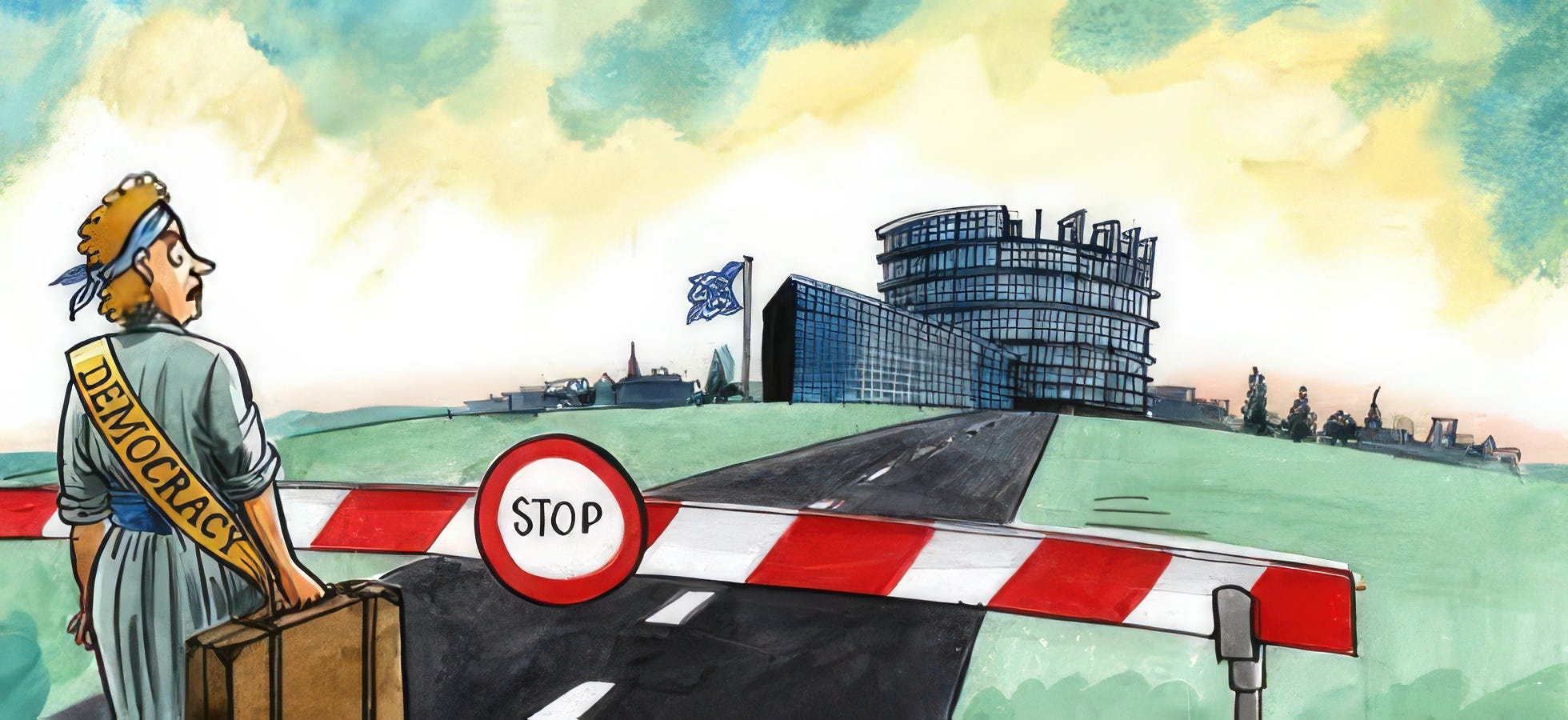
Imagine Congress votes on a bill. The nays win, 314 to 276. Now imagine the Speaker announces that the nays actually lost, because under an obscure rule the nays needed not a majority of votes cast but a majority of every seat in the chamber, including the members who stayed home that day. The bill survives. It becomes law over the objection of the people’s elected representatives. Americans would call that a constitutional crisis. In Brussels, on July 9, they called it a Wednesday.
The measure in question is a surveillance program its critics call Chat Control. It allows technology companies to run automated scanning software across the private messages of ordinary Europeans, hundreds of millions of people suspected of nothing, looking for illegal material. The stated purpose, protecting children, is genuinely important. But the story here is not really about surveillance. It is about how the European Union actually governs, and it should alarm anyone who assumed Europe was still a collection of democracies. What happened this month is the clearest demonstration in years that the EU has built a machine capable of overpowering its own voters, and the machine just proved it works.
To follow the story, an American needs to know only three things about how Brussels operates, and none of them resembles anything in our Constitution. First, the laws of the EU are written and proposed by the European Commission, a body of appointed officials no European citizen has ever voted for. Think of it as if federal legislation could originate only inside the executive agencies, with Congress forbidden from writing its own bills. Second, national governments weigh in through something called the Council, which functions like a permanent negotiating session of ministers and diplomats from the 27 member countries, meeting mostly behind closed doors. Third, there is the European Parliament, the one and only EU institution whose members are directly elected by voters. If democracy lives anywhere in this system, it lives there. Keep your eye on which of these three bodies wins the fight that follows.
The surveillance program began in 2021 as a temporary measure, an emergency bridge while Europe worked out permanent rules. Temporary is doing a lot of work in that sentence. It was extended in 2024. In December 2025 the appointed Commission proposed extending it yet again, through 2028. And here is a detail worth pausing on, because it tells you everything about the mindset of the people who run this system. Before proposing to continue a program that scans the private communications of an entire continent, the Commission’s own paperwork recorded that it consulted no outside stakeholders, gathered no independent expertise, and conducted no impact assessment. Its stated reason was that there were no other options worth comparing. The unelected body that alone decides what Europe’s parliament may vote on looked at mass scanning of private messages, decided the only conceivable choice was more of it, and then used that decision to excuse itself from asking anyone else’s opinion. This is not how a government behaves when it believes it answers to voters. It is how an administration behaves when it knows it does not.
The elected Parliament, to its credit, pushed back. In March 2026 it demanded a narrower program with real limits, by a crushing vote of 458 to 103. Negotiations with the member governments’ Council went nowhere. So on March 26, Parliament did what legislatures are for. It voted the extension down. On April 3, the law expired. Dead. In America, that would be the end of the matter. The people’s representatives said no, and the clock ran out.
Watch what Brussels did next, because this is the part that should keep worried friends of Europe up at night. In late June, a committee of career diplomats, the permanent representatives who staff the Council and whom no voter has ever heard of, quietly agreed to fast-track a revival. On July 2, the Council published its solution to an awkward legal problem. An expired law, it admitted, cannot be extended, because there is nothing left to extend. So the Council simply copied the entire text of the dead law, word for word, into a brand new regulation with fresh dates, and sent it back to Parliament. They did not persuade anyone. They did not negotiate. They ran the corpse through a photocopier and gave it a new name.
And the photocopy came with a trap built in. Because of the stage in the process at which the revived text arrived, the rules of engagement changed. On a first pass, Parliament can kill a measure with an ordinary majority of those voting. But when Parliament confronts a Council position on a second pass, killing it requires an absolute majority of the entire membership, all 719 seats, whether members are present or not. That fixed number was 360. Every absent member, every abstention, every empty chair now counted, in practical effect, for the surveillance program. Then, on July 7, an urgency motion passed by a whisker, 331 to 304, compressing the whole matter into a single week and skipping the normal deliberative process. One member fighting the measure, the Czech legislator Markéta Gregorová, said out loud what everyone could see: “This is unprecedented. This is no longer just about protecting privacy, it is about protecting our democracy. No means no.” She accused the largest political bloc of dragging a rejected proposal back from the grave in violation of Parliament’s own rules.
Two days later came the vote. Members favoring rejection: 314. Members opposing rejection: 276. Among those who cast a yes-or-no vote, 53.2% wanted the program killed. The opponents of Chat Control won by 38 votes, and they lost, because 314 is 46 short of 360. The 112 members who did not vote at all decided the outcome without ever going on record. Patrick Breyer, a former member of the Parliament and Europe’s most persistent privacy advocate, called it exactly right: “The fact that Chat Control is moving forward against the will of the majority of voting MEPs is a farce and damages democracy.”
It happened twice that morning, which is what makes the episode impossible to dismiss as a fluke. A separate amendment would have restricted the scanning to people actually identified as suspects by a judge, the sort of individualized suspicion Americans would recognize as the bare minimum the Fourth Amendment demands. That amendment won 322 to 255. A clear majority of Europe’s elected representatives wanted surveillance tied to actual suspects rather than aimed at everyone. It failed too, for the same reason, 38 votes short of the magic number. Twice in one sitting, the only elected institution in the European Union expressed its will by a clear majority, and twice the machinery recorded the opposite result.
Defenders of Brussels will say every step was legal, and they are right. The high threshold has been in the treaties for decades. Nobody stuffed a ballot box. But legality is not the same thing as democracy, and the distinction matters enormously here, because what the institutions did was maneuver a dead and defeated policy into the one procedural posture where the deck was stacked, after the Commission proposed it without consulting a soul, after the diplomats revived it in private, after the urgency vote cut short debate, and after the counting rule turned absentees into supporters, and at the end of all that perfectly legal manuevering a program rejected by elected majorities marches on toward 2028 anyway. Even the EU’s own internal privacy watchdog concluded this year that the program lacks effective safeguards against what it called general and indiscriminate monitoring. Even the Commission itself, in its own implementation report, admitted the available evidence was insufficient to say whether the intrusion on citizens’ rights is proportionate to the benefit. They could not prove the program was justified. They extended it anyway, over a majority, twice.
The political scientists Andreas Follesdal and Simon Hix diagnosed this disease 20 years ago. Real democracy, they argued, requires that voters be able to identify who governs them and throw those people out, a feature they called essential to even the thinnest theories of democracy, “yet is conspicuously absent in the EU.” Test their claim against this episode. Suppose you are a European who is furious about what just happened. Whom do you vote against? The Commission that proposed the extension is appointed, not elected. The diplomats who fast-tracked the revival are civil servants. The Council is 27 governments pointing fingers at one another. And your Parliament, the one body you actually elect, voted your way and was overruled by arithmetic. There is no one to fire. Responsibility has been engineered out of the system, distributed across so many interlocking bodies that accountability evaporates on contact. That is not an accident of design. It is the design.
Americans should care about this for a simple reason. The European Union presents itself as democracy’s headquarters, the adult in the room, the standard against which unruly American populism is measured and found wanting. Its officials lecture Washington, scold Silicon Valley, and grade elections around the world. Yet when its own elected chamber said no, twice, to scanning the private messages of 450 million people, the system treated those votes as an inconvenience to be routed around. A government that can resurrect rejected laws, rush them past deliberation, and count empty chairs as consent has not defended democracy from authoritarianism. It has quietly built the administrative version of it, one procedure at a time, and dressed it in democracy’s clothes. Europe’s future depends on whether its citizens notice before the costume becomes the constitution.
If you enjoy my work, please subscribe https://x.com/amuse/creator-subscriptions/subscribe
Alexander Muse is a Fellow at the John Milton Freedom Foundation and publishes daily political analysis at amuseonx.com. Primary sources cited in this piece are linked inline; campaign finance figures are drawn from FEC filings, polling data from publicly released crosstabs, and legal claims from filed pleadings. Corrections are posted to the original URL with a dated changelog. Readers who identify errors are invited to contact the author directly. Data in sponsored partnership with Polymarket.
This is exactly the plan of the radical left when they take back control of the US govt
Spare us your anemic EU bashing, and your hypocritical rhetoric about the Constitution, while you simp every day for your wannabe king and his craven enablers.