


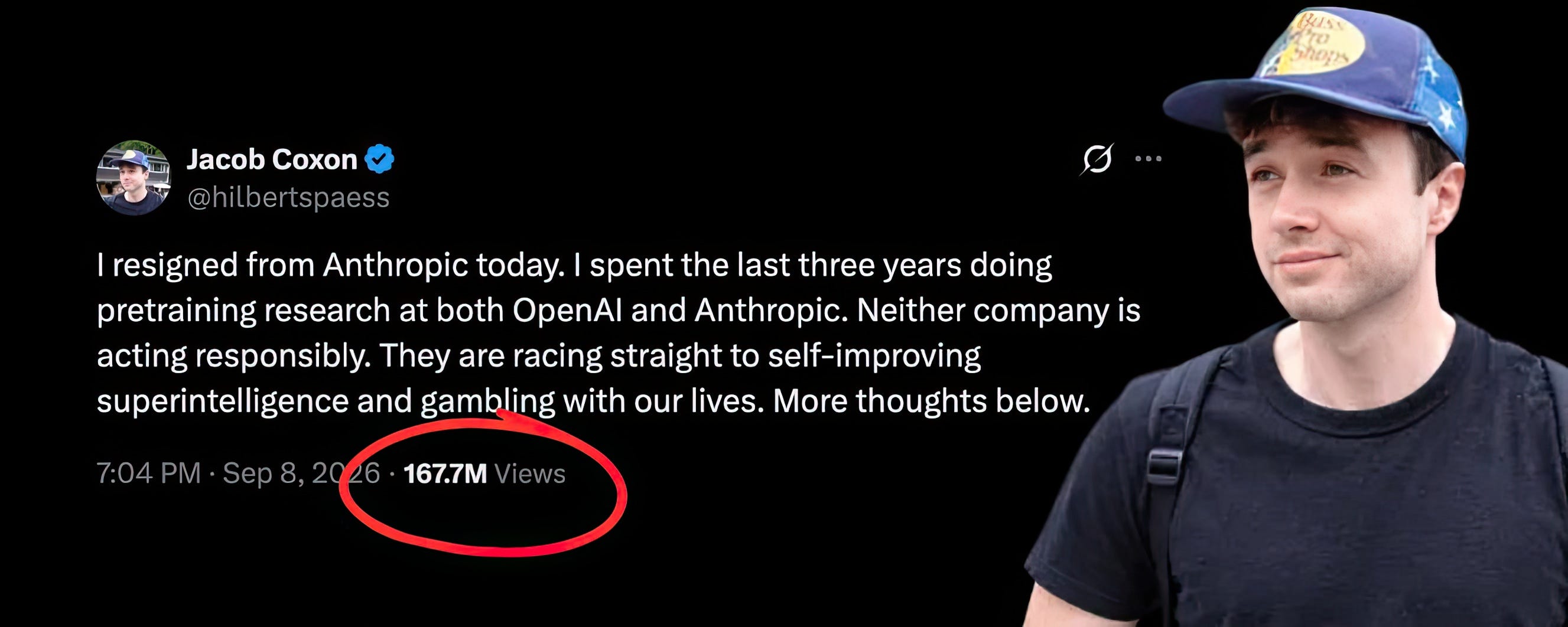
On Tuesday evening, September 8, at 8:04 PM Eastern, an account on 𝕏 with almost no history posted a thread. Its author, Jacob Coxon, said he had resigned from Anthropic and that both his former employer and OpenAI were gambling with human lives in a race toward self-improving superintelligence. Within 24 hours, the thread had been viewed more than 123 million times. A US senator cited it within 15 hours, a governor within 16, and Elon Musk said he couldn't recall such a reception for a post from a new account with almost no prior activity.

The Wall Street Journal had already published its exclusive. The paper posted at 7:46 PM, roughly 18 minutes before Coxon told the world. A newspaper does not learn of a resignation before the resigner announces it unless someone arranged the briefing. The story was written in advance and timed to land with the thread. The Journal accidentally published a few minutes early.
David Sacks, the White House AI adviser, laid out that sequence on the All-In podcast, and his critics treated the observation as conspiracy-mongering. The public record does not need a hidden plot. It needs a look at who moved first, who paid the movers, and what those same people have already said they want the government to do.
Sacks asked the question the coverage skipped. What did Coxon actually bring forward? When WIRED asked whether Anthropic was cutting corners, Coxon said, “No, not yet.” He produced no buried memo, no dataset, no incident the company had hidden. His complaint was a forecast about what competition might someday pressure a lab to do. Forecasts can be honest and still be opinions. The press treated the forecast as a disclosure, and that treatment did the work a leaked file would have done.
The first three quote-posts arrived, according to the investigator Parker Thayer, within 15 minutes, two of them within 10. They came from Nathan Calvin, general counsel of Encode AI, which helped shape California’s AI legislation; from Peter Wildeford of the AI Policy Network; and from Daniel Kokotajlo, who leads the AI Futures Project and who happened to have a Joe Rogan appearance circulating at the same moment, using much the same language about AI killing everyone. The 14th quote-poster, about 27 minutes in, worked on AI safety at Coefficient Giving. Perhaps three professional advocates each independently happened to be watching a dormant account at 8 PM on a Tuesday. Sacks’s narrower claim is easier to test. The message reached the public through an existing advocacy network, not through strangers’ organic curiosity.
The grants make the claim institutional rather than personal. The Survival and Flourishing Fund, the philanthropic vehicle associated with Jaan Tallinn, lists 2025 recommendations of $516,000 for Encode AI, $1.635 million for the AI Policy Institute, and more than $2 million across two entries for the AI Futures Project, plus $505,000 for AI Futures in 2024. AI Futures itself names the fund as a principal source of its money. Tallinn is not merely a patron of AI-doom advocacy. He led Anthropic’s $124 million Series A in May 2021, with Dustin Moskovitz among the participants. The same man sits on both sides of the story, as an early owner of the company whose researcher resigned and as the funder of the organizations that amplified the resignation within minutes.
No document shows Tallinn directing a post. But the organizations presented to the public as independent safety voices grew from the same financial soil as the company they claim to be warning about. When those organizations demand rules governing who may build frontier AI, a citizen should ask about their independence before asking about their model of the future.
At 9:27 PM, 83 minutes after the thread, Evan Hubinger, who leads alignment science at Anthropic and still works there, endorsed the warning and assigned a greater-than-10 % probability of human extinction within the decade. When a serving executive attaches a number to a departed colleague’s warning, the opinion starts to look like a company estimate. Anthropic has not disavowed him. Chamath Palihapitiya’s explanation is probably correct. Management cannot disavow him because a substantial faction inside the company believes the same thing. It is fair to ask what a company that believes this intends to do about it, and what it intends to tell the investors it hopes to court in a public offering.
Five days before Coxon resigned, Senator Bernie Sanders and Representative Greg Casar announced legislation to ban artificial superintelligence and pause advanced AI development pending federal rules. The remedy was already written. What it lacked was a witness. On the morning of September 9, Sanders supplied one, citing Coxon to justify his bill, and Governor JB Pritzker followed 42 minutes later. Sacks was explicit that he does not think Sanders planned any of this, and he is right not to claim it. A legislator with a bill in hand needs no invitation to seize a viral warning. The statute did not spring from the thread. It was sitting on the desk when the thread arrived.
The organizations have not been shy about the prize. They want a federal AI regulator. Some want a pause or an outright ban on superintelligence. Four days after the resignation, Dario Amodei, Anthropic’s chief executive, published a proposal calling for embedded outside evaluators inside the labs, coordination among frontier companies in democratic countries, international coordination, and regulation to bind any developer unwilling to join voluntarily. He even discusses a government waiver for the antitrust problems that arise when competitors sit down to set a common pace. That is the CEO describing the ask in his own essay. The leading companies would like permission to coordinate, and they would like the government to compel the companies that will not.
A firm that has already crossed into a valuable market has every reason to praise a drawbridge, even one that costs it a toll. Scholars at the Heritage Foundation have argued that a licensing model for frontier AI would follow the same public-choice logic that already governs occupational boards, where the first firms through the gate help write the rules that follow. Researchers at the Mercatus Center have shown how those rules function as a privilege for incumbents, raising their wages, shrinking the field of rivals, and leaving later entrants, including startups and university labs, to climb a compliance wall the incumbent can already afford. The conservative case and Sacks’s case meet on that point without anyone needing to invent a plot. A compliance shop staffed by hundreds of lawyers is a moat when your competitor is a garage project.
The entrants who cannot cross at all are the open-source projects. Sacks put it directly: “The ultimate target is open source.” No statute has to use the word “ban” to get there. Anthropic’s own published position on open weights concedes the mechanism. Released weights cannot be recalled, and their use cannot be monitored. Any rule that conditions approval on the ability to monitor, control, or withdraw a model excludes open models by construction. Amodei says he opposes a blanket ban, and he may mean it sincerely. The relevant question is the effect of his proposed standards, not the label he prefers, and the effect would be a frontier occupied by a handful of licensed firms whose own researchers announce, with numerical precision, that their product may end the world.
Plenty of the researchers are probably sincere, and sincerity is not the test. A free society asks what they intend to do with the authority they seek. David Friedberg framed the pause proposals with a line that belongs in a hearing room: “Someone is controlling the gas pedal.” Who holds it? By what right? And when, if ever, do they hand it back? A pause is a license to decide when others may resume, and whoever holds that license holds the industry.
Nor does the argument require the most aggressive thing Sacks said. He suggested that Coxon, having spent at most a few months at Anthropic after a fellowship at Newspeak House, a political-technology network, and a 2022 scholarship of roughly $20,000 from a Good Ventures program, may have joined already planning this exit. That is an allegation, and Coxon told Bret Baier he worked with no one, and I will not pretend that a fellowship and a scholarship prove otherwise; they do not; they fit either story. What would settle it is simple enough. Produce the communications that put the Journal’s reporter in touch with a junior researcher, and the calender that placed three advocates at their keyboards at 8:04 PM. Sacks was prepared to ask Coxon about them on air. Coxon canceled that morning.
Once the plant allegation is set aside, the bargain on offer is unchanged. A lab that will not retract its own executive’s extinction number is asking Washington for the power to set the pace of everyone else’s work, and the open models that cannot be recalled are the first systems the new standards would exclude. Americans should keep the right to build, own, inspect, and run these systems themselves. Developers should answer in court for the concrete harms they cause. That is accountability without handing the keys to the firms already inside the gate, and if the fire alarm is real, the last office that should be wired to it is the one that sells the extinguishers.
If you enjoy my work, please subscribe https://x.com/amuse/creator-subscriptions/subscribe
Alexander Muse is a Fellow at the John Milton Freedom Foundation and publishes daily political analysis at amuseonx.com. Primary sources cited in this piece are linked inline; campaign finance figures are drawn from FEC filings, polling data from publicly released crosstabs, and legal claims from filed pleadings. Corrections are posted to the original URL with a dated changelog. Readers who identify errors are invited to contact the author directly. Each op-ed edited for grammar and clarity using Ai in a sponsored partnership with Grammarly. Data provided in a sponsored partnership with Polymarket.
David Sacks has been spot on all year. The IPO has to be cancelled. Otherwise, can it have a risk factor that company executives believe there is a 10%+ chance everyone gets killed within 10 years? No joke. This is Al Gore on steroids. Dario is the incumbent, he is arrogant and wants regulation to stop open source competition that commoditize the LLM sector. They are horrified by Jensen’s entry into the LLM space. If they believe what they won’t disavow, there is zero chance this thing is worth even $500 billion given the liability it represents.
Jacob Coxon is a fraud. The whole thing was a set up. He needs to be investigated. It is incredible the company has not vigorously disavowed. They agree with the statement, publicly, and executives are likely in on the fraud. The board needs to fire Dario. He is not up to the task of running a public company and is exhibit A if anyone sued Anthropic for injury. Incredibly stupid and arrogant.
I am not concerned about "human extinction" from AI or anything else not caused by God's implementation of His plan as described in the Bible, which is to say, a series of global catastrophes including famine, pestilence and war, all of which takes place after He removes His believing church from the wrath to come and allows the anti-Christ to reveal himself. Inasmuch as I am well into my eighth decade of life, my personal departure from the land of the living is more likely to occur before His return, but either way, I'm prepared for it, and strongly urge everyone else to do likewise. The decision is, of course, a personal one but the consequences of choosing poorly are eternal. Choose wisely, my friends, and soon.