


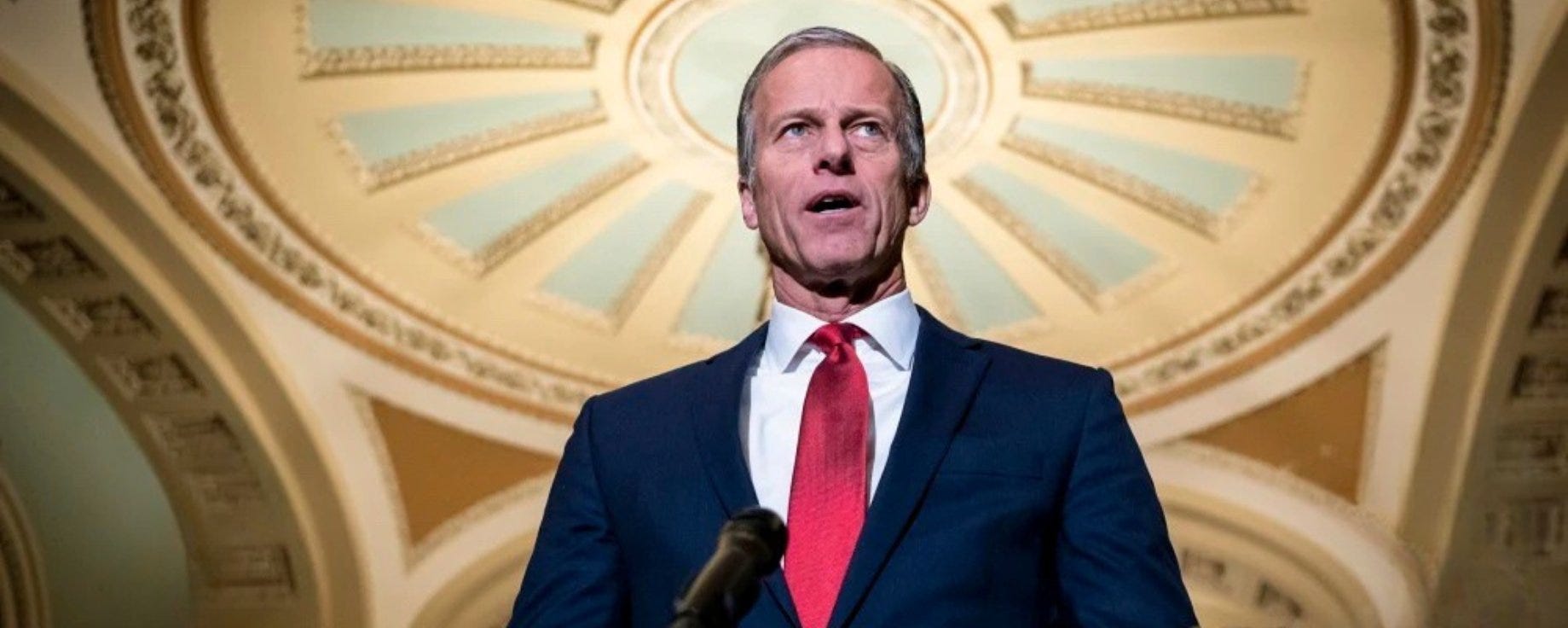
Ask any executive recruiter the first question they pose about a candidate and you will hear some version of this: who does he answer to? Not who does he claim to serve, not whose interests does he invoke in speeches, but who, as a matter of cold institutional mechanics, can take his job away. The question matters because people respond to the incentives that actually bind them, not to the ones printed on the letterhead. Apply that question to John Thune and the mystery of the SAVE Act dissolves.
Begin with the structural fact, because everything else follows from it. The Senate majority leader is not elected by South Dakota. He is not elected by the country. He is elected by the Senate Republican Conference, by secret ballot, by simple majority. With 53 Republican senators, the threshold is 27 votes. Those 27 colleagues hired Thune, and only those colleagues can fire him from the leadership. Every six years the 900,000 residents of South Dakota can return him to the Senate, but they cannot hand him the gavel or take it away. The tens of millions of Americans who want documentary proof of citizenship before a ballot is cast have no vote in that election at all. Call this the leader’s true constituency. It is a constituency of 27, and it explains his behavior better than ideology, better than temperament, and far better than the official story about Senate norms.
Now set that structure against the record, because the record is no longer hypothetical. The House passed the Safeguarding American Voter Eligibility Act in April 2025 by a margin of 220 to 208, with 4 Democrats crossing over, and passed it again in February 2026. In the Senate, on March 26, 2026, a cloture vote on the Husted amendment to the SAVE Act vehicle drew 53 votes. Read that number again. The bill did not fail for want of a majority. It failed because the cloture rule demands 60, and 53 is not 60. Then, during the vote-a-rama, the case became airtight. The SAVE Act in its original form drew exactly 50 Republican votes after Susan Collins flipped to support Mike Lee’s text. With Vice President JD Vance available to break a tie, 50 is a functional majority under any procedure that requires only a simple majority. Supporters argue, correctly, that the bill effectively commands the backing of 51 senators. The majority is not a forecast or a talking point. It is a recorded fact, entered in the Senate’s own journals.
A puzzled reader might object here. If the majority exists but the rules require 60, is the leader not simply bound by the rules? The objection sounds reasonable until you examine what the rules actually are and who controls them. The 60-vote cloture threshold is not in the Constitution. It is a standing rule of the Senate, and the Senate has demonstrated, repeatedly and recently, that a determined majority can route around it. Three established roads to passage stand open, and Thune has personally declined to walk any of them.
The first road is the talking filibuster. The modern filibuster bears no resemblance to the endurance contests of Strom Thurmond’s era. Today a senator need not hold the floor, need not speak, need not even appear. Conservatives have taken to calling it the Zombie Filibuster, a blocking device that operates without effort or exposure. Mike Lee said it plainly on the floor: but for the Zombie Filibuster, the House-passed bill would already be on the President’s desk. Lee and others have pushed Thune to restore the older, harder version, to force 47 Democrats to physically hold the floor and defend their obstruction on camera, after which the Senate could move to a final vote at a simple majority. Thune has resisted, reportedly worried that his own members might not stay unified through a prolonged floor fight. Notice what that worry concedes. The obstacle is not the Democrats. It is the management of his own conference, the 27 votes that keep him in his chair.
The second road runs through the parliamentarian. Elizabeth MacDonough ruled that the SAVE America Act fails the Byrd Rule and therefore cannot ride in the reconciliation package. President Trump responded by demanding her removal, calling her a radical left lunatic. Thune declined, telling reporters that her rulings break both ways, that the conference would lose a few and win a few. Here the reader should pause on a remarkable admission from an unlikely source. The New Republic, writing in opposition to the bill, conceded that the parliamentarian’s guidance is not binding and that the Republican majority could simply overrule it. When the opposition press stipulates that the leader possesses the power and is merely choosing not to use it, the columnist’s work is half done. Thune’s own explanation for his refusal, that overruling her would create even more vote issues, is the second quiet concession of the piece. Vote issues where? Not in South Dakota. Not in the country, where the bill polls at 71%. Inside the conference. Among the 27.
The third road is the bluntest: end the legislative filibuster outright, as Trump has repeatedly urged. Thune ruled it out in his maiden floor speech as leader, defending the 60-vote custom by describing the Senate as a counterbalance to the House, a deliberative body designed to check the majority. Take him at his word. That is the cleanest possible statement, in his own voice, that he ranks the institutional custom above the outcome his majority wants. The custom, recall, is the same one that protects every sitting member of his conference from ever having to cast a hard vote, which is to say, the custom is itself a service rendered to the 27.
Perhaps, the skeptical reader replies, the leader is a sincere institutionalist, and sincerity deserves respect even in error. The reply founders on the freshest evidence in the record. In May 2025, Senate Republicans rolled back a California electric vehicle standard despite the parliamentarian advising that the measure was subject to a 60-vote threshold. In September 2025, the same majority moved to overrule the chair and lower the threshold to a simple majority for the en bloc consideration of 48 nominees. NBC News, no friend of the right, reported that across 2025 the conference knocked down precedents and weakened minority power in 3 separate instances when its own ambitions demanded it. Same leader. Same conference. Same procedural tools. Deployed for an emissions waiver and a slate of nominations. Withheld for proof of citizenship at the ballot box. An institutionalist who suspends his institutionalism whenever the conference’s internal priorities require it is not an institutionalist. He is an agent, faithfully serving his actual principals.
And what of the country he is supposedly protecting from rash legislation? Gallup found in October 2024 that 84% of American adults support requiring photo identification to vote and 83% support requiring proof of citizenship for first-time registrants, with roughly two thirds of Democrats endorsing both. Pew Research put photo ID support at 83%, including 71% of Democrats. A February 2026 Harvard CAPS/Harris survey, an instrument co-directed by a former Democratic pollster, found 71% of registered voters supporting the SAVE America Act by name, with the underlying provisions polling between 75% and 81%. Heritage Action found strong majorities across 5 battleground states. In February 2026, Representative Brandon Gill led 34 members of the Republican Study Committee in a formal letter urging Senate action, putting 35 members of Congress on record that the votes and the public are aligned and only the schedule is missing. There is no constituency in America for burying this bill. There is only a constituency in one caucus room.
Thomas Jefferson, in his first inaugural address, declared the will of the majority to be the vital principle of republics, a will that must prevail to be rightful. The SAVE Act presents that principle in its purest modern form. A majority of the House has passed the bill twice. A functional majority of the Senate has voted for it on the record. A supermajority of the public, crossing party lines, supports its provisions. The President stands ready to sign it. Between all of that and the statute books stands one man’s discretionary choice, and that man’s career depends on keeping 27 people comfortable. This is not a conspiracy theory. It is a principal-agent problem, the most ordinary phenomenon in organizational life, operating exactly as the textbooks predict.
Which brings us to the remedy, because the same structure that created the problem contains its solution. The conference that hired Thune by secret ballot can replace him by secret ballot, and the precedent is recent. In November 2022, Rick Scott forced the first contested Senate Republican leadership vote since 1996. The challenge failed, but its existence proved the mechanism is live. The 27 votes that protect Thune are votes that can be withdrawn, and every senator who casts one now owns the burial of a bill his own voters support at 91%. In every other American institution, a chairman who refuses to call a vote on a majority-supported item is replaced by the board. The Senate Republican Conference is the board. The question is no longer whether Thune will move the SAVE Act. He has answered it 3 times, once for each road he declined. The question is whether 27 senators will keep paying him to say no.
If you enjoy my work, please subscribe https://x.com/amuse/creator-subscriptions/subscribe
Alexander Muse is a Fellow at the John Milton Freedom Foundation and publishes daily political analysis at amuseonx.com. Primary sources cited in this piece are linked inline; campaign finance figures are drawn from FEC filings, polling data from publicly released crosstabs, and legal claims from filed pleadings. Corrections are posted to the original URL with a dated changelog. Readers who identify errors are invited to contact the author directly.
Excellent summary of the three ways Thune has used to not pass the SAVE Act. 27 Senators voted for him on a secret ballot as Majority Leader. We can easily guess who many of those 27 are. We need GOP Senators to grow a spine and elect a new leader. Call out those 27.
As the successor to the Murder Turtle, John Thune is perfect. A younger, less intelligent version of the Turtle, but from the same cloth. His leadership is directed at support of the status quo, not the people. It's time he was voted out of leadership, then out of the Senate.