


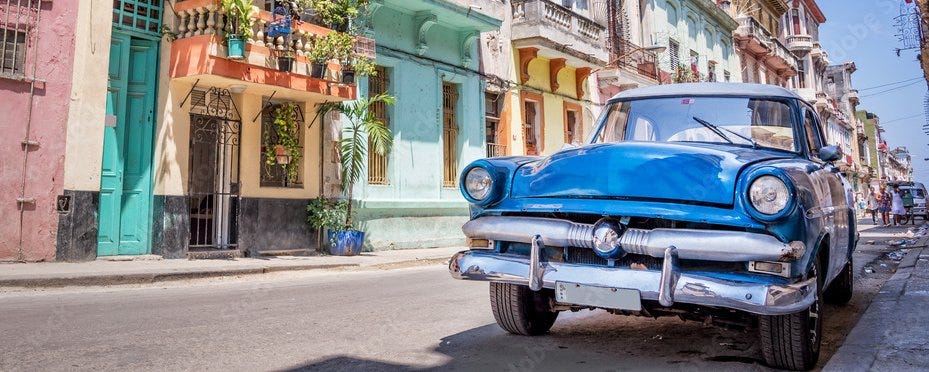
For 60 years, Americans told jokes about Cuba. The island of 1957 Chevrolets held together with wire and paint. The ration books. The crumbling facades of Havana, photographed lovingly by tourists who mistook decay for charm. The sugar harvests that missed their quotas year after year. We measured Cuba the way we measure most countries, by GDP, by military hardware, by the living standards of its people, and by that measure Cuba was a punchline. A failed state 90 miles from Florida, propped up first by Soviet subsidies and later by Venezuelan oil, exporting little besides cigars and refugees.
The joke, it turns out, was on us. While we were counting Cuba’s broken tractors, Havana was counting something else entirely: its converts. Secretary of State Marco Rubio’s new State Department report, Cuba: The Capital of 21st Century Communism, makes the case that the Castro regime’s true export industry was never agricultural. It was revolutionary ideology, intelligence tradecraft, activist networks, and the methods of state subversion. And by that measure, the measure Havana itself used, Cuba was one of the most successful small powers of the modern era.
Consider first what Fidel Castro said he wanted. In 1958, before he had even taken Havana, Castro wrote that when the Cuban conflict ended, a much wider and bigger war would begin for him, the war he intended to launch against the Americans. This sentence deserves more attention than it has received. It was written before the embargo, before the nationalizations, before the Bay of Pigs, before any of the grievances that generations of apologists have offered as explanations for Cuban hostility. The war against the United States was not a reaction to American policy. It was the point.
Castro converted that ambition into doctrine with remarkable speed. His Second Declaration of Havana proclaimed that the duty of every revolutionary was to make the revolution. The 1967 Organization of Latin American Solidarity conference, hosted in Havana, declared armed revolutionary struggle the path for the entire continent and called for the destruction of existing political and military institutions. A joint US intelligence assessment in 1971 concluded that as soon as Castro assumed power in January 1959, Havana became the center for subversive operations against other Latin American countries, and it documented the money, weapons, training, propaganda, and personnel flowing outward from the island. Nearly every republic in the hemisphere felt the interference. During the regime’s first three decades, at least 20,000 guerrillas passed through Cuban training. By 1982, the CIA counted more than 40,000 Cuban personnel operating in Africa alone.
Exporting guerrilla war to Bolivia or Angola is one thing. What does any of this have to do with the United States, a country that faced no serious insurgency? The answer lies in Cuba’s genuine innovation, which was not military but conceptual. Orthodox Marxism organized history around economic class. It appealed to industrial workers on the basis of material interest, and in prosperous postwar America that appeal fell flat. Cuban Third Worldism solved the problem by changing the revolutionary subject. The protagonist of history was no longer the factory worker. It was the colonized nation, the racial minority, the student, the guerrilla, the oppressed of the earth. Under this framework, a black resident of Detroit, a Vietnamese peasant, a Puerto Rican separatist, and an Algerian revolutionary could all be cast as soldiers in a single transnational war against the same imperial center. The enemy was no longer the capitalist class. It was the West itself.
This was a weapon designed for a free and diverse society. It did not require poverty to work. It required only grievance, and it offered young Americans something economic Marxism never could: a heroic identity. A student at Columbia or Berkeley could spiritually defect from his own civilization and enlist in the imagined ranks of the world’s oppressed without leaving campus.
The evidence that this transmission actually occurred does not come primarily from conservative sources. The historian Teishan Latner, writing an academic study with no conservative agenda whatsoever, concluded that Cuba became the primary Third World influence on the US Left for more than three decades. Cynthia Young’s Soul Power, published by Duke University Press, documents in detail how American activists appropriated theories, strategies, films, literature, and political vocabularies from Third World anticolonial struggles. These scholars were not writing indictments. Some wrote with evident sympathy. That is precisely what makes their findings so valuable. When your opponents’ own historians confirm the scale and durability of the influence, the debate over whether it happened is finished. The only remaining question is what it meant.
Havana did not leave transmission to chance. The 1966 Tricontinental Conference brought more than 500 delegates from 82 countries to Havana and created a permanent organization, headquartered on the island, to coordinate anti-imperialist activity worldwide. The Venceremos Brigade, founded in 1969, transported roughly 10,000 Americans to Cuba over the following decades for what was billed as agricultural solidarity work but functioned as political education inside an environment controlled by the Cuban state and penetrated by Cuban intelligence. The Fair Play for Cuba Committee bought newspaper advertisements and built local chapters. Cuba’s official friendship agency, ICAP, eventually claimed more than 2,000 solidarity organizations in over 150 countries.
Did any of this matter operationally? The record says yes, and the sequence is unusually clear. Several early Venceremos figures were simultaneously founding the Weather Underground. In Havana, Weather leaders met Cuban and North Vietnamese representatives, and a top-secret FBI assessment later concluded that those meetings intensified the group’s commitment to bringing armed struggle home. The group declared war on the US government, went underground, and by 1975 had claimed 25 bombings, including attacks on the Capitol, the Pentagon, and the State Department. The FBI counted roughly 2,500 bombings in the United States during one 18-month stretch in 1971 and 1972, the high-water mark of the revolutionary wave. In Puerto Rico, the connection was even more direct. Filiberto Ojeda Ríos spent years in Cuba, received training as a Cuban intelligence officer, and helped found the FALN, whose bombing campaign killed 6 people. He later led the Macheteros, who murdered US sailors, staged eight coordinated bomb attacks on federal facilities in a single day, and destroyed 9 American fighter aircraft in a 1981 raid on a Puerto Rico air base. And when American revolutionaries needed refuge, Havana provided it. Joanne Chesimard, convicted of murdering New Jersey State Trooper Werner Foerster, escaped prison and surfaced in Cuba, where the regime converted a cop killer into a revolutionary icon whose writings still circulate in American activist movements today.
The deepest penetration, however, came through the true believers. Cuban intelligence perfected a recruitment model that most spy services could only envy: find a politically alienated young American, convert grievance into loyalty, and then patiently encourage the recruit into positions of access. Ana Montes was noticed for her hostility toward US policy in Central America, recruited, and steered into an intelligence career. She rose to become the Defense Intelligence Agency’s senior Cuba analyst, distorted American assessments from the inside, and exposed 4 undercover US officers. The FBI’s conclusion about her motive was stark: pure ideology. She took no meaningful payment. Victor Manuel Rocha was recruited in 1973 and served Havana for half a century while climbing through the Foreign Service, the National Security Council, and an ambassadorship, boasting near the end that his contribution was more than a grand slam. James Olson, the former chief of CIA counterintelligence, rendered the professional verdict: the Cubans were much better than the KGB ever was. Ideological agents cost little, leave no financial trail, and believe their betrayal is virtue, which is why they last for decades, and which is why the Wasp Network could sit inside a Florida humanitarian aviation group feeding flight schedules to Havana until Cuban fighters shot down two unarmed civilian planes over international waters in 1996, killing 4 Americans, an operation for which the Justice Department finally indicted Raúl Castro himself this past May.
Some will object that all of this is Cold War history, that the Soviet collapse ended whatever threat the island posed. The record suggests otherwise. Cuba’s model did not die in 1991, it adapted, narrowed, found new patrons, embedded itself in Venezuela’s security services where Cuban advisers rebuilt military intelligence into an inward-facing instrument of regime survival with at least 1,500 personnel, and offered its geography to Beijing. CSIS satellite analysis has identified 4 active Cuban sites capable of electronic surveilance against the United States, and a 2026 update found that a new 32-antenna array at Bejucal appears complete and likely operational, positioned to monitor sensitive American military activity across the southeastern seaboard, the Caribbean, and the Gulf.
The Heritage Foundation has been documenting this architecture since the 1970s, often to an indifferent audience. Mike Gonzalez’s recent Heritage study reaches the same conclusion Rubio’s report does: six decades of terrorism, subversion, and the deliberate corrosion of American cohesion. The strongest moral charge in the indictment is also the simplest. A totalitarian state that imprisoned its own dissidents and denied its own people the right to speak, organize, or travel exploited American academic freedom, free speech, free association, and due process to organize against the society that guaranteed them.
We spent 60 years measuring the wrong things. Cuba never needed a functioning economy to wage its war, because the war was never economic. It was a war for the loyalties of the West’s own children, fought in universities, solidarity brigades, and government agencies, and it compounded across generations long after the original handlers were gone. Rubio’s report is not nostalgia. It is an audit, and the audit shows that the poorest country in the hemisphere ran the most patient and most successful influence operation ever mounted against the United States. The ruins of Havana were never the scoreboard. The converts were.
If you enjoy my work, please subscribe https://x.com/amuse/creator-subscriptions/subscribe
Alexander Muse is a Fellow at the John Milton Freedom Foundation and publishes daily political analysis at amuseonx.com. Primary sources cited in this piece are linked inline; campaign finance figures are drawn from FEC filings, polling data from publicly released crosstabs, and legal claims from filed pleadings. Corrections are posted to the original URL with a dated changelog. Readers who identify errors are invited to contact the author directly. Data in sponsored partnership with Polymarket.
“A totalitarian state that imprisoned its own dissidents and denied its own people the right to speak, organize, or travel exploited American academic freedom, free speech, free association, and due process to organize against the society that guaranteed them.”
Let this sink in.
Proof that true ideological belief will outweigh money every time in the long run. Wow, the proof here is overwhelming and disconcerting. Thank you, Secretary Rubio and the Trump administration in general for continuing to expose all these deeply held dark secrets.