


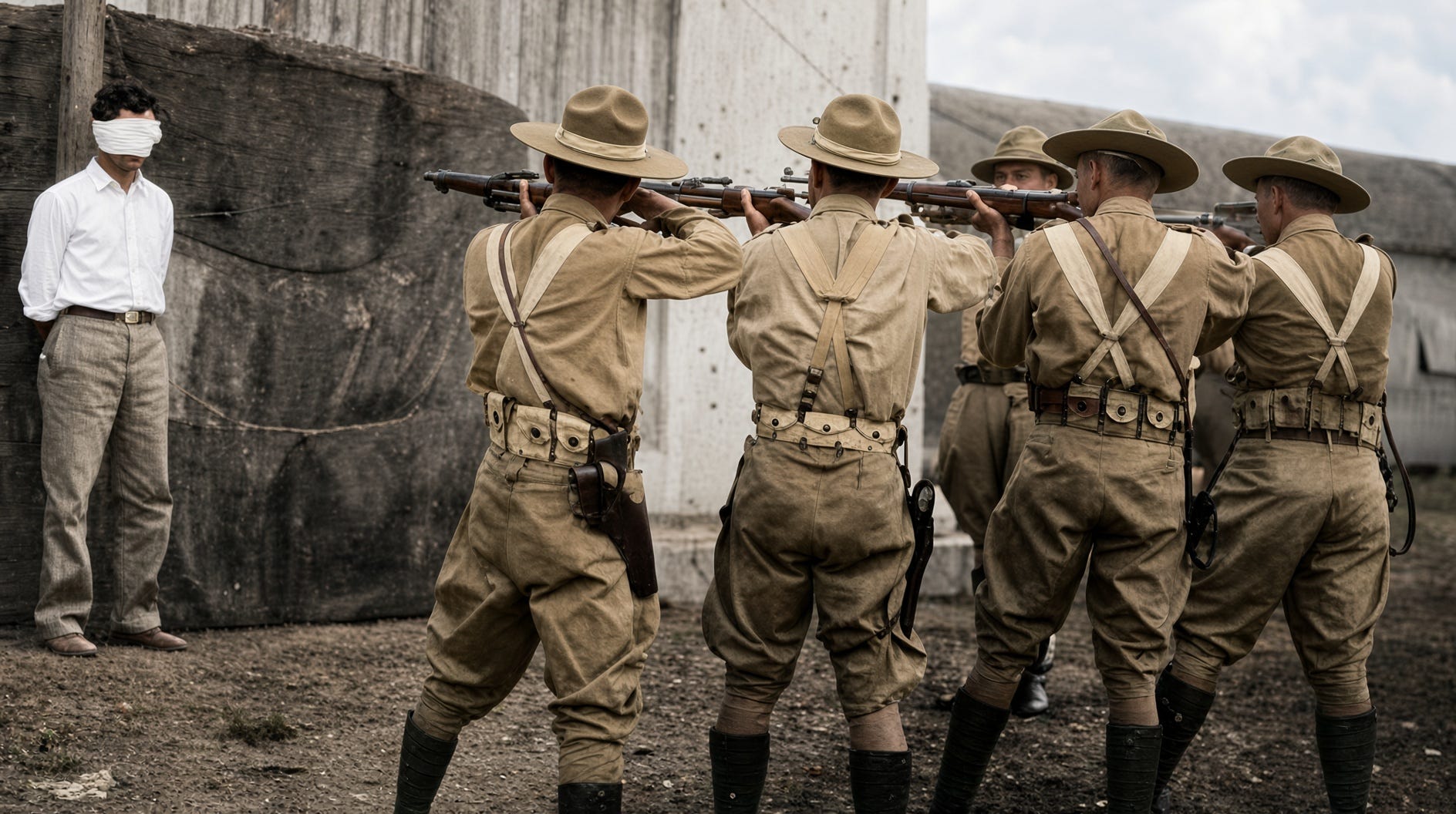
On December 3 at 1 PM Central, if the courts allow it, an Army firing squad at Fort Hood will execute Nidal Hasan, and anyone with an internet connection will be able to watch. The Pentagon confirmed the livestream on October 8, six days after President Trump approved the death sentence and two days after Acting Army Secretary Adam Telle signed the execution order. Hasan murdered 13 people and wounded 32 on that same post on November 5, 2009. A military jury convicted him in August 2013. The Supreme Court declined to hear his case in March 2025. Seventeen years will have passed between the crime and the punishment, and for all but the last few minutes of those 17 years the public has been permitted to watch. It watched the trial. It read the verdict. It followed the appeals. The objection now is that the defendant should be sent out of the room for the ending.
Think about what we already accept. The Sixth Amendment guarantees the accused a public trial. In Richmond Newspapers v. Virginia (1980), Chief Justice Warren Burger traced the open courtroom from the English assizes through the colonial courthouse and concluded that “a presumption of openness inheres in the very nature of a criminal trial.” Burger’s reason had nothing to do with whether spectators enjoy trials. A judge who knows he is being watched is less likely to cut corners, a prosecutor under observation is more careful with the truth, and a public that can see justice done is more likely to believe it was done. Every one of those reasons applies with greater force to the moment when the state actually kills a man. The trial decides whether the government may take a life. The execution is the taking. We have arranged things so that the deliberation is open and the act is hidden, which is exactly backward.
For most of American history nobody would have found that arrangement natural. Colonial hangings took place in town squares and courthouse yards, usually with a sermon. Pennsylvania and New York began moving executions inside prison walls in the 1830s, and the other states followed over the next 70 years, with Virginia still hanging men publicly in Richmond until 1907. Britain made the same move in 1868 with the Capital Punishment Amendment Act. What strikes you about the 1866 parliamentary debate that preceded it is that almost nobody in the chamber wanted to abolish hanging. The question was whether the public should see it. Defenders of the old practice argued that publicity was the only guarantee the sentence was carried out, and that it was carried out the same way against a lord as against a laborer. Opponents answered that the crowds at Newgate treated the morning as a holiday. Both sides were right; the opponents won, and the rule they left behind, that the state should inform the public of executions without letting it watch, has governed Anglo-American practice ever since.
The American endpoint came on August 14, 1936, in Owensboro, Kentucky, when something like 20,000 people turned out to see Rainey Bethea hanged. Kentucky permitted public hanging for rape but required murderers to die inside the penitentiary, so prosecutors charged Bethea with rape alone even though he had confessed to killing his victim. The crowd behaved like the Newgate crowd, with vendors and picnics, and the national press was appalled. Kentucky abolished public hanging in 1938. Since then an American execution has been witnessed by a few dozen designated people, officials, a handful of reporters, relatives of the victim, a representative of the condemned, while the rest of the country reads a wire story the next morning.
Owensboro is the strongest card the critics hold, and it deserves a straight answer. What went wrong in 1936 was not that the public could see the hanging. The state surrendered control of the event to a crowd that came for a show. The distinction matters because the Pentagon is not proposing to sell tickets on a parade ground. A livestream from Fort Hood, run by the Army, with a fixed camera, no commentary, and no crowd, is closer to the C-SPAN feed from a Senate hearing than to a county fair. Nobody argues that televising Congress turned legislation into entertainment, or that opening the courtroom turned the murder trial into theater, though in each case some people watch for the wrong reasons. The remedy for a bad audience is rules of decorum, enforced, and nobody has ever thought the better remedy was to turn off the lights.
The argument that should move even opponents of capital punishment concerns what happens when the lights are off. A government that executes in private controls the account of what it did. The witnesses are chosen by the warden, the curtain is drawn when the officials want it drawn, and the public learns of a botched lethal injection, if it learns at all, from the condemned man’s lawyer weeks later. This past June, Judge Candace Jackson-Akiwumi of the Seventh Circuit wrote in dissent that independent observation of executions promotes accountability, encourages compliance with lawful standards, and can expose procedural failures. It was a dissent and creates no right to a camera, but the reasoning is hard to answer. Deborah Denno of Fordham Law, who has spent a career documenting what goes wrong in American death chambers, told the Associated Press that a broadcast could improve transparency and public understanding, and she is no friend of the death penalty. The people most worried about state misconduct should be the first to want the state watched. I have previously written that while I don’t oppose the death penalty in principle, I oppose it in practice because I don’t trust the government to get it right 100% of the time.

A second argument, older and less comfortable, is that Pete Hegseth stated plainly on October 8. “People need to understand that there are serious consequences for these types of things,” he said. Nobody thinks a future jihadist will run the odds before he fires, and Hegseth did not say so. He claims punishment speaks, and that punishment nobody can see says very little. Hasan put on his uniform, walked into a processing center where soldiers were preparing to deploy, shouted “Allahu Akbar,” and shot unarmed men and women until civilian police brought him down. The Army tried him on the post where he did it, and it will execute him there. A death sentence announced in a press release is an abstraction. A firing squad on the ground at Fort Hood, before the country, is the law finishing the sentence it began in 2009. The retributive theory of punishment holds that a sentence is society’s formal verdict on an act, and a verdict delivered in secret is barely a verdict at all.
Objections remain. Some relatives of the Fort Hood dead will not want to watch, and some will not want anyone else to watch either. A decent policy consults them, warns them, and never cuts them off, and nothing about a livestream requires a single family member to turn it on. Others point out that Iran and the Taliban hold public executions and ask whether America wants that company. The comparison fails at the first step. What makes an Iranian hanging monstrous is the trial that preceded it, the offense that was charged, and the dissent that was being punished, and none of that changes if the hanging moves indoors. Hasan received 13 years of review by military courts, the Court of Appeals for the Armed Forces, and the Supreme Court. Visibility does not launder an unjust sentence, and secrecy does not stain a just one. The remaining worry, that jihadists will circulate the footage as propaganda, assumes they lack material already. The men who admire Hasan have his own words and his own deed, and a clip of the state answering him is hardly the recruiting poster they would choose.
What is genuinely new is scale. Owensboro required a train ticket; December 3 will require a phone. People the Army cannot control can clip, loop, and set a broadcast to music, and an honest defender of the policy has to concede that the Pentagon is taking on a problem the sheriff of Daviess County never faced. That argues for care in the production, for a single fixed shot, for no replay from official channels, for the solemnity of a military ceremony rather than the pacing of cable news; it does not argue for the curtain. The curtain was always a concession to our squeamishness rather than a safegaurd for anyone’s rights, and squeamishness is a poor basis for a rule about how the most powerful government on earth exercises its most irreversible power.
A citizen who opposes capital punishment should want the country to see what it authorizes, on the theory that the sight will change minds. A citizen who supports it should be willing to look at what he supports. Either way, the republic is better served by people who know what is being done in their name than by people who have arranged not to know. On December 3, the Army will fire, the country will watch, and for the first time in 90 years the last act of an American criminal judgment will be as public as the first. That is not a return to the county fair. It is a return to the courthouse.
If you enjoy my work, please subscribe https://x.com/amuse/creator-subscriptions/subscribe
Alexander Muse is a Fellow at the John Milton Freedom Foundation and publishes daily political analysis at amuseonx.com. Primary sources cited in this piece are linked inline; campaign finance figures are drawn from FEC filings, polling data from publicly released crosstabs, and legal claims from filed pleadings. Corrections are posted to the original URL with a dated changelog. Readers who identify errors are invited to contact the author directly. Each op-ed edited for grammar and clarity using Ai in partnership with Grammarly. Data provided in a sponsored partnership with Polymarket.
A military firing squad for a crime on a military base is appropriate.
Many years ago 46 to be exact I had an interesting lecture of sorts in New Mexico at an old museum with the curator . He grew up in the area and as a boy saw the execution ( botched ) of “ Black Jack “ Ketchum a local bandit + bank + train robber . He was 9 years old and with his dad went to the public hanging event in 1909 . He said that day he knew he would grow up to be a good person because he saw what happens when you’re not ! Public executions are not an entertainment event they should serve as a lesson to those who commit the most heinous acts against society like , murder , Treason , rape of children + women , torture or trafficking of humans . Those are crimes against humanity and deserve justice, not a circus !