


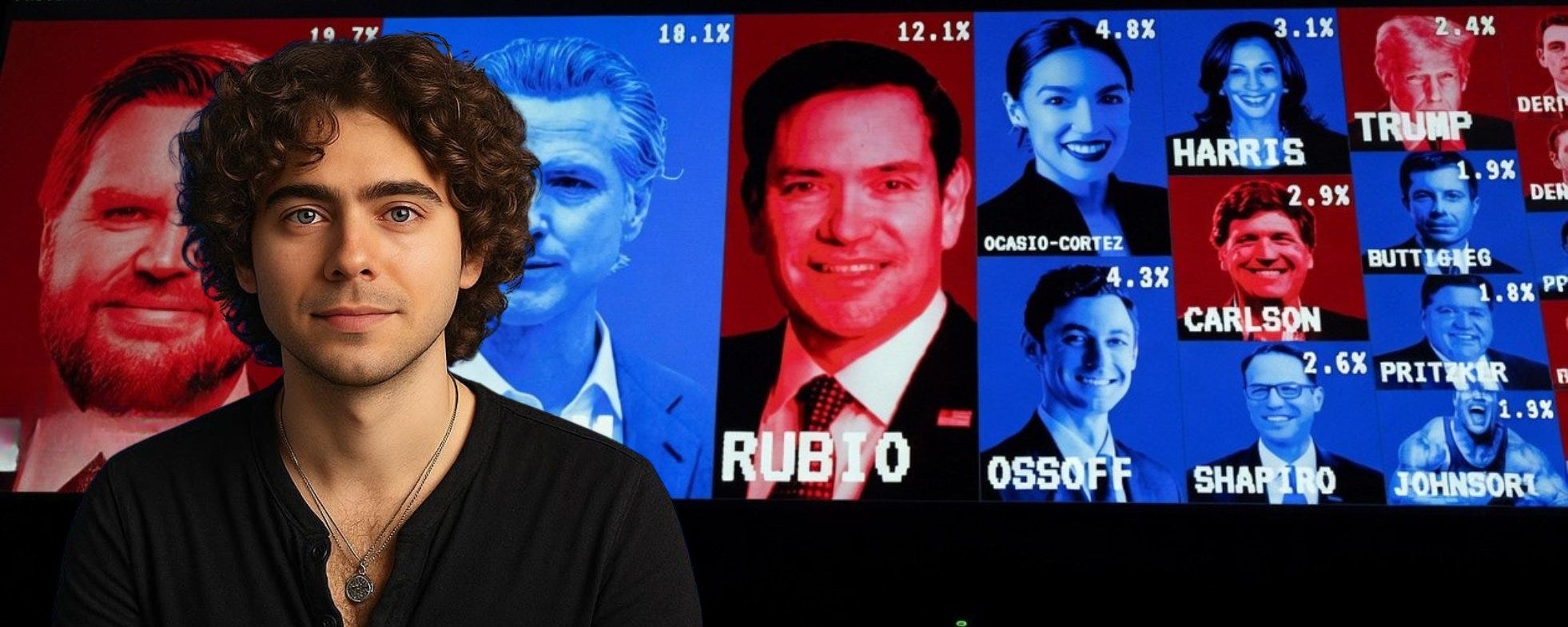
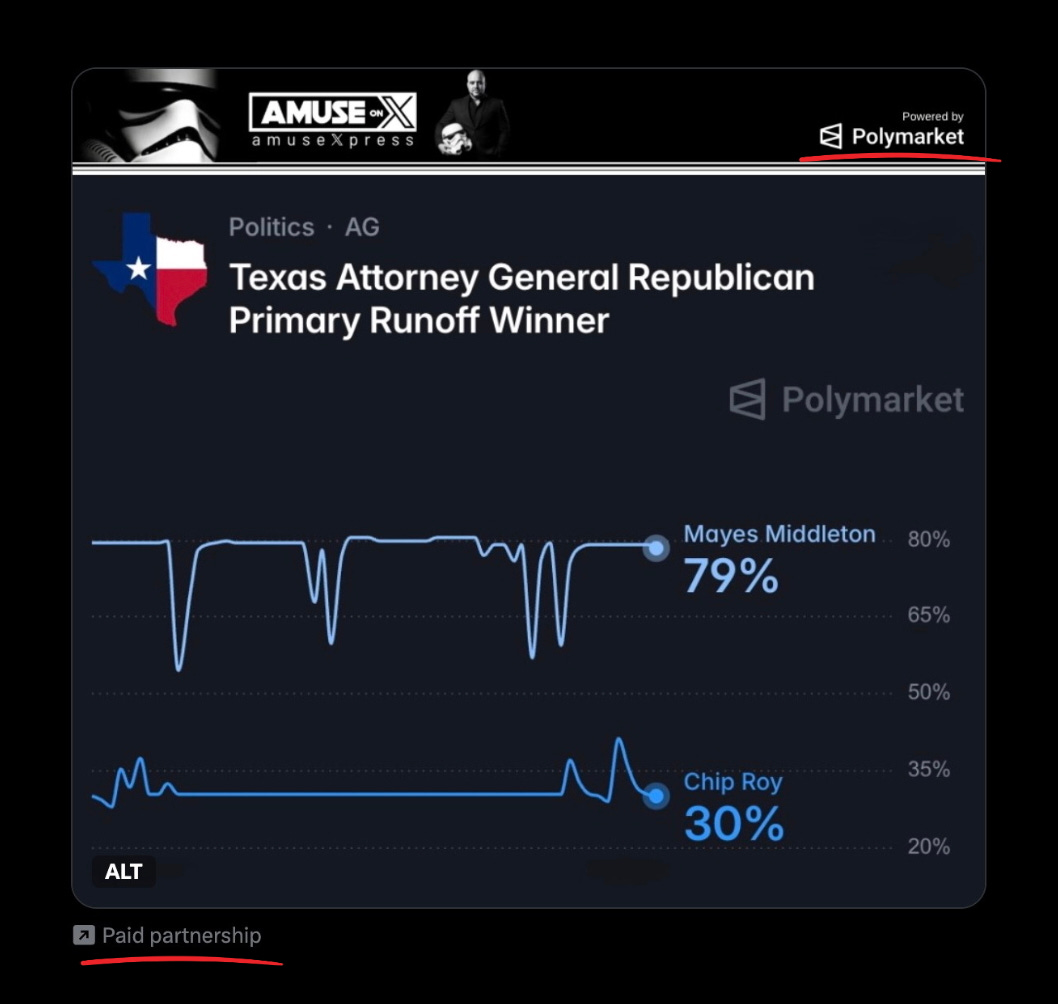
Let me begin with a small confession that ought to matter to any reader weighing what follows. I have never placed a bet on a prediction market. As an American citizen, I am not legally permitted to wager on Polymarket, and I have not done so. What I have done, every day for years now, is cite prediction markets in my writing because they are the single best real-time indicator I have found of where political reality actually stands. When Kalshi and then Polymarket approached me about sponsoring my work, I accepted without hesitation. They do not care which side I take on any issue. They like that I share their markets with my readers. Polymarket today pays me a flat monthly fee in exchange for being my exclusive prediction market partner, and I disclose that here at the top so the reader can weigh everything that follows with full knowledge of the arrangement.
The reason I cite these markets so often is simple. They work. They worked in 2024 when almost nothing else in the American political-information industry did. They worked in 2022 in the aggregate when polling-based aggregators got embarrassed. They worked, in a more primitive form, from 1868 through 1940, when Americans openly wagered on presidential elections on the New York Curb Exchange and correctly identified the winner in 11 of 15 contests from 1884 to 1940. They have worked, in academic study after academic study, for the better part of forty years. The Iowa Electronic Markets, comparing 964 election polls against five U.S. presidential elections from 1988 through 2004, beat the polls 74% of the time, with the market advantage growing the further out from election day the comparison was drawn.
The 2024 presidential election is the cleanest test case any reader could ask for, because it happened in front of all of us. Polymarket’s presidential winner market processed more than $3.6 billion in trading volume. On Election Day morning, the RealClearPolling betting average had Trump at 60.0% and Harris at 38.6%, and Polymarket itself sat at roughly 59% Trump to 38% Harris. Nate Silver, the most prominent name in polling-based forecasting, was at the same moment calling the race “a pure toss-up.” The Reuters/Ipsos final national survey had Harris at 44% to Trump’s 43%. The RealClearPolitics polling average had the race within the margin of error in all seven swing states. Trump then won 312 electoral votes to Harris’s 226 and carried the popular vote 49.81% to 48.34%. He won every Blue Wall state. The market was right; the polling industry was, once again, wrong.
This was not an isolated event. The American Association for Public Opinion Research, the polling industry’s own professional body, concluded in its post-2020 task force review that the 2020 cycle produced the highest error margins in 40 years. Its own report acknowledged that polling understated Trump’s actual vote share by an average of 3.3 percentage points and that polling in 2020 Senate and gubernatorial races was, on average, 6.0 percentage points too favorable for Democratic candidates relative to the certified vote margin. The AAPOR’s review of 2024 acknowledged that public polling, even after two cycles of admitted error, still underestimated Republican votes relative to Democrats. Three consecutive presidential cycles, three errors, all pointing in the same direction. At some point, a pattern that consistent is no longer error. It is method.
The standard objection to prediction markets is that they can be manipulated. The objection is true, in the narrow sense that anyone with enough money can push a price in the short term. The objection collapses, however, the moment one understands how liquidity functions. When a candidate or his supporters attempt to manipulate a market by buying up one side, they leave a visible trail of capital and price movement, and they inject fresh liquidity that other traders can immediately bet against. Manipulation in a deep, transparent market is not a bug. It is an invitation. It is the most efficient way to lose money to better-informed counterparties, and counterparties show up quickly because they can see exactly what is happening. The 2025 academic anatomy of Polymarket’s 2024 presidential market documented this directly. Arbitrage-deviation half-lives fell from hours to under a minute over the course of the cycle, and Kyle’s lambda, a standard microstructure measure of how susceptible prices are to manipulation, dropped from 0.53 to 0.01. When a single large account moved aggressively in October, capital flowed into both sides of the trade, consistent with heterogeneous beliefs rather than one-sided manipulation. The Polymarket of November 2024 was substantially more liquid and substantially harder to manipulate than the Polymarket of January 2024.
Polling has no such corrective mechanism. The truth about polling, which the industry would prefer the public not dwell on, is that it can be manipulated long before any numbers reach print, and most of the manipulation is methodologically defensible enough to pass professional review. The biggest lever is sample construction. A pollster can overweight or underweight groups by age, race, education, party identification, geography, or likelihood of voting and produce dramatically different outcomes from precisely the same raw responses. Turnout assumptions are especially powerful, because likely-voter models are inherently subjective and can quietly exclude irregular voters who happen to favor one candidate. Question wording and order matter, too. A question about crime, inflation, immigration, or a scandal placed immediately before the ballot question can prime respondents emotionally and shift the headline number by several points. A pollster can choose when to field a survey, such as immediately after negative news for one side, and can selectively release favorable internal polls while burying unfavorable ones. Small samples, aggressive weighting, and oversampling of friendly demographics can manufacture the illusion of momentum, which then influences donors, media coverage, and even voter psychology through the bandwagon effect. Even without outright fabrication, the volume of methodological discretion available to a determined polling firm is enormous, and most of it remains invisible to the reader of the resulting article.
A prediction market, by contrast, hides nothing. The price is the price. The volume is the volume. The trades are recorded, and in Polymarket’s case, recorded on a public blockchain that any researcher can audit. A pollster can publish a survey with a sample of 800 likely voters weighted in a way no outside party can fully reconstruct, and the average reader will treat the result as scientific. A prediction market price reflects what millions of dollars, sometimes billions, are actually willing to stake on a defined outcome. One of these instruments rewards being right. The other rewards being plausible. The difference matters more than the polling industry would like to admit.
The clearest single illustration of this is the story of the French trader who has come to be known publicly as Théo. In October 2024, while the entire American polling establishment was insisting the race was a coin flip, Théo did something no major American pollster appears to have been willing to do. He hired YouGov, the legitimate global polling firm that polls for CBS News, to conduct a specialized study in Pennsylvania, Michigan, and Wisconsin using what is known as neighbor polling. Rather than asking respondents how they intended to vote, Théo’s poll asked respondents how they believed their neighbors would vote. The neighbor question is designed to surface shy voters, the phenomenon AAPOR has formally acknowledged in its post-2016 and post-2020 reviews. The results, in Théo’s own words, aligned almost exactly with the prices on Polymarket at the time. Trump was leading in Michigan, Pennsylvania, and Wisconsin with implied probabilities between 55% and 60%. The standard polls of the same states showed dead heats. Théo liquidated almost everything else he owned, accumulated roughly $80 million in Trump positions on Polymarket, and on November 6 collected approximately $85 million. A single trader in Paris, using a single polling methodology American firms refused to deploy, beat the entire American polling industry. He did so because the market rewarded him for being right, and the polling industry rewarded itself for being safe.
There is one more dimension to this case that conservatives in particular should understand. Friedrich Hayek, in his 1945 essay “The Use of Knowledge in Society,” argued that the knowledge required to coordinate a complex society never exists in concentrated or integrated form. It exists only as the dispersed, incomplete, and often contradictory knowledge held by individuals scattered across the system. A central planner cannot collect that knowledge fast enough or completely enough to act on it well. A price system can, because prices coordinate dispersed information automatically through voluntary exchange. Polls attempt to do what Hayek warned could not be done. They try to concentrate political knowledge through a sample of strangers answering a phone. Prediction markets, by contrast, do what Hayek said price systems do. They aggregate the dispersed, incomplete, contradictory knowledge of thousands of participants into a single live number. That is not gambling. It is Hayek applied to elections.
I cite prediction markets often because they are good indicators of where things stand. They require interpretation, like any signal, and a sophisticated reader should always understand what a market is actually pricing and over what horizon. But the case that polls are systematically more reliable than markets is no longer defensible. The 2024 election made that obvious. The academic literature has known it for a generation. The Intercontinental Exchange, parent of the New York Stock Exchange, has now committed roughly $2.6 billion to Polymarket, including a $600 million direct investment completed in March 2026, which is not the sort of capital allocation made on the assumption that the information being generated is worthless. The institutions that bet wrong for a living do not stay in business. The polling industry has bet wrong three cycles in a row in the same direction and remains in business only because it has captured the cultural authority that ought to belong to whichever method actually works.
Ignore the prediction markets at your peril. They are not infallible, and no one who reads them carefully claims they are. But on any given day, the live price on Polymarket reflects the considered judgment of capital that has something to lose. A poll reflects the considered judgment of a pollster who does not.
If you enjoy my work, please subscribe https://x.com/amuse/creator-subscriptions/subscribe
Alexander Muse is a Fellow at the John Milton Freedom Foundation and publishes daily political analysis at amuseonx.com. Primary sources cited in this piece are linked inline; campaign finance figures are drawn from FEC filings, polling data from publicly released crosstabs, and legal claims from filed pleadings. Corrections are posted to the original URL with a dated changelog. Readers who identify errors are invited to contact the author directly.
The lesson is Hayek with a betting slip: dispersed knowledge beats centralized arrogance. Pollsters pretend that 800 weighted respondents and a mystical likely-voter model can capture reality. Markets aggregate thousands of judgments from people willing to risk capital. That does not make prediction markets perfect. It makes them accountable. The polling cartel keeps missing in the same direction, then blames “shy voters,” “turnout surprises,” or “methodological challenges” while cashing the next check. A trader who is wrong gets punished immediately. A pollster who is wrong gets invited on television. You are a fool not to let the free market inform decisions over the credentialed fog machine.
Well we all know why 2020 election had the most errors—because 2020 was the most corrupt election ever with fake mail-in ballots and voting machines manipulation. Biden getting 81 million was laughable. The Dems cheated to the point of being so obviously manipulated. Maybe sometime soon many more of those involved will be indicted. We all knew Biden did not win.