


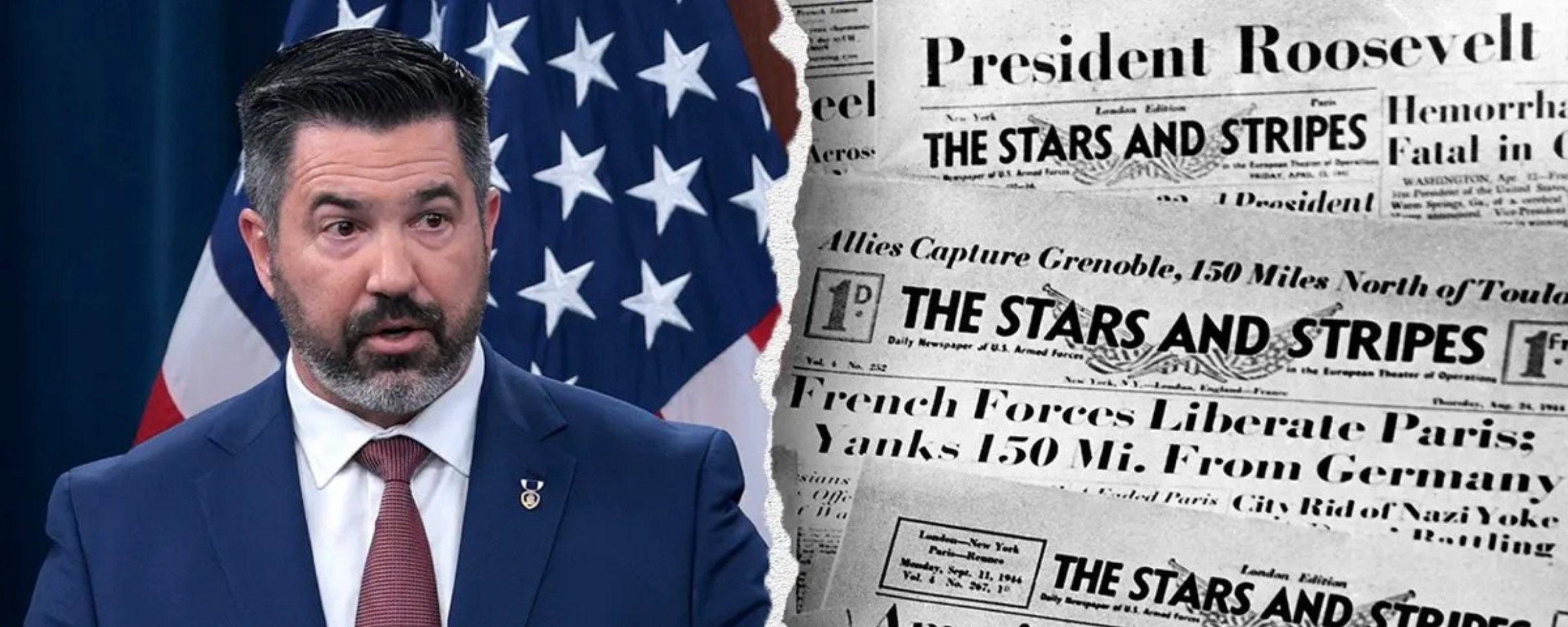
Last Friday, the Pentagon sent separation notices to Stars and Stripes publisher Max Lederer, editor-in-chief Erik Slavin, and reporter Lara Korte. The charge was insubordination. By nightfall, the firings were being billed as a raid on a free press. That billing only works if you forget who signs the paychecks. If the editor of a company magazine went on television and announced that she did not work for the company, no one would treat her dismissal as a constitutional event. Stars and Stripes is that magazine. The company is the Department of Defense.
The paper sits inside the Defense Media Activity, a field activity of the Office of the Secretary of Defense. Its publisher is a civilian federal employee. Its reporters are federal employees. The annual budget runs about $29 million. Roughly $14.5 million comes directly from taxpayers and is used to print the paper and ship it to bases. The other half comes from sales and advertising within military communities that exist because taxpayers built them. About 1.4 million people see the paper on a given day, nearly all of them online.
When the Department published a proposed rule in April 2024, it described Stars and Stripes as “the only DoD-authorized organization to provide First Amendment-type reporting.” The authorization belongs to the Department. “First Amendment-type” is a management phrase. It is not a holding that the reporters enjoy the same constitutional shield as the staff of a private newspaper.
Ten senators told Secretary Hegseth in January that Congress had mandated the paper’s independence for decades. The record is thinner than the letter. In 1988 Congress asked the Government Accountability Office to examine censorship at the Pacific edition. GAO found that the Pacific paper had dropped 86 wire stories, 32 of which cast the military in a bad light, and concluded that a command newspaper and a free-press newspaper, “when commingled, create an inherent conflict.” Congress then told the Department to write better rules and added an ombudsman. The Department wrote them: a directive in October 1993 and a public regulation in April 1994. Every sentence of independence the newsroom now quotes comes from those Pentagon documents. None of the senators pointed to a section of the U.S. Code that locks the policy in place, because there is none. That is why the lawsuit filed last Thursday pleads the First Amendment and the Administrative Procedure Act rather than a statute.
The Department has since rewritten what it wrote. On January 15, it removed the 1994 regulation from the Code of Federal Regulations, explaining that the rule “does not have an impact or burden on the public” and belonged in internal guidance. On March 9, an eight-page memo moved the public affairs office from administrative to active oversight, barred wire-service reprints and comics, and required content consistent with “good order and discipline.” On August 21, a new instruction took effect. It still promises operations “free from censorship or propaganda.” It also gives the public affairs chief approval over the hiring of the publisher and the ombudsman and directs periodic audits “to validate mission relevance.” Cindy Elmore, a scholar sympathetic to the newsroom, documented in 2011 that the Department has revised these instructions for years, sometimes expanding its own oversight. Newsweek conceded last week that the paper’s institutional independence is “largely illusory,” because the institution being covered controls the employment machinery around the newsroom. That machinery is what last month’s firings used.
On July 5, CBS Sunday Morning aired a segment in which Slavin said that being told to spike an accurate story and run a Pentagon-written one instead “would be a red line,” and in which Korte said, “I’m working for Stars and Stripes, not for the Pentagon, not for any administration.” Both later confirmed that their supervisors approved the interview in advance. On August 11, the paper published a story about morale aboard the USS Abraham Lincoln, which had spent more than 250 consecutive days at sea supporting combat operations against Iran. Within four days, the acting Secretary of the Navy called the coverage “dishonest” and said it “harmed service members.” Secretary Hegseth called it “completely misrepresented.” The President rejected it outright. On August 21, all three received separation notices. Lederer’s notice cited his refusal to deliver the other two.
The journalists say the CBS interview was pretext and the Lincoln story was the real cause. Grant them the chronology. It still runs into Garcetti v. Ceballos. In 2006, the Court held that “when public employees make statements pursuant to their official duties, the employees are not speaking as citizens for First Amendment purposes, and the Constitution does not insulate their communications from employer discipline.” An editor and a reporter who obtained supervisory sign-off to appear on national television as Stars and Stripes staff were speaking as Stars and Stripes staff. Judge Trevor McFadden put his finger on it at Friday’s hearing: “They did get sign-off.” Counsel replied that this merely showed they had followed Pentagon media procedures. Followed procedures in official capacity. No restraining order issued. The Pentagon volunteered a one-week pause, and accounts of the room have the judge more skeptical of the journalists than of the government.
The Free Speech Clause restrains the government from regulating private speech. It does not require the government to keep paying for speech it rejects, nor does it bind the government’s own voice. “When government speaks,” the Court said in 2015, “it is not barred by the Free Speech Clause from determining the content of what it says.” A publication produced by federal employees on a federal payroll under a federal instruction is government speech. The military setting tightens the rule further. The armed forces are “a specialized society separate from civilian society,” Justice Rehnquist wrote in 1974, and they “need not encourage debate or tolerate protest to the extent that such tolerance is required of the civilian state.” The government’s lawyer invoked “troop loyalty, discipline, and morale.” He was standing on doctrine the Court has repeated for fifty years.
David Boaz of the Cato Institute made the funding point about NPR two decades ago: “political interference is entirely a consequence of political funding.” The logic travels. If Stars and Stripes wants the independence of a private newspaper, it can adopt a private newspaper's funding model. Until then, its funders set the mission. Project 2025 said the same of the Voice of America, warning that the editorial “firewall” there had been used to block the CEO from exercising oversight. The administration acted on that warning in 2025. Stars and Stripes never had a firewall. It had a directive, and the same legal coalition that fought for VOA is now running a version of the same brief in a new courtroom.
The President likes this paper. In September 2020, when his own Pentagon proposed zeroing out $15.5 million and shutting it down, he overruled them in a single post and promised that funding would not be cut “under my watch.” People cite that episode as proof of independence. An institution that can be closed by a budget line, and saved by a President, is not independent of the people who write the budget line. The same President who kept it open is entitled to insist that it serve the warfighter rather than lecture him.
Stars and Stripes has a real culture of independent-minded reporting, and readers in uniform value it. That culture grew within an Army institution that General Pershing founded in 1918 as the official organ of the American Expeditionary Forces, and it endured because successive Secretaries chose to tolerate it. When a newsroom on the Department’s payroll tells the country it answers to no one in the chain of command, and then publishes, during a shooting war, a story the Navy’s civilian leadership believes demoralized sailors at sea, the Department has to choose. It chose civilian control of the military, as the Constitution puts it: with elected officials accountable for the outcome, not with employees who are not. The taxpayer is not writing a check to a newspaper that denies he is the publisher.
If you enjoy my work, please subscribe https://x.com/amuse/creator-subscriptions/subscribe
Alexander Muse is a Fellow at the John Milton Freedom Foundation and publishes daily political analysis at amuseonx.com. Primary sources cited in this piece are linked inline; campaign finance figures are drawn from FEC filings, polling data from publicly released crosstabs, and legal claims from filed pleadings. Corrections are posted to the original URL with a dated changelog. Readers who identify errors are invited to contact the author directly. Each op-ed edited for grammar and clarity using Ai in partnership with Grammarly. Data provided in a sponsored partnership with Polymarket.
DOW doesn’t need its own half-assed PBS…
They’ve been “woke” for a long time now and I’m happy to see the Tokyo Roses sent on their merry way. They wrote like China or the EU was paying their salaries.