



In 1889, the mayor of New York City ordered the electric current shut off. Arc lights that had begun to illuminate Manhattan's streets went dark, and the city, in the language of the day, fell into endless tunnels of gloom. Mayor Hugh J. Grant had said he would rather stop all electric lights than see another death from the wires. Newspapers carried sensational accounts of electrocutions, editorial writers demanded that the wires be buried, and the Board of Electrical Control wrestled with the problem of poorly insulated copper running above the heads of pedestrians. A boy named Moses Streiffer had been killed grabbing a dangling wire on East Broadway the year before, and by the close of 1889, at least five New Yorkers had died from high-voltage lines. The public, understandably, was afraid.
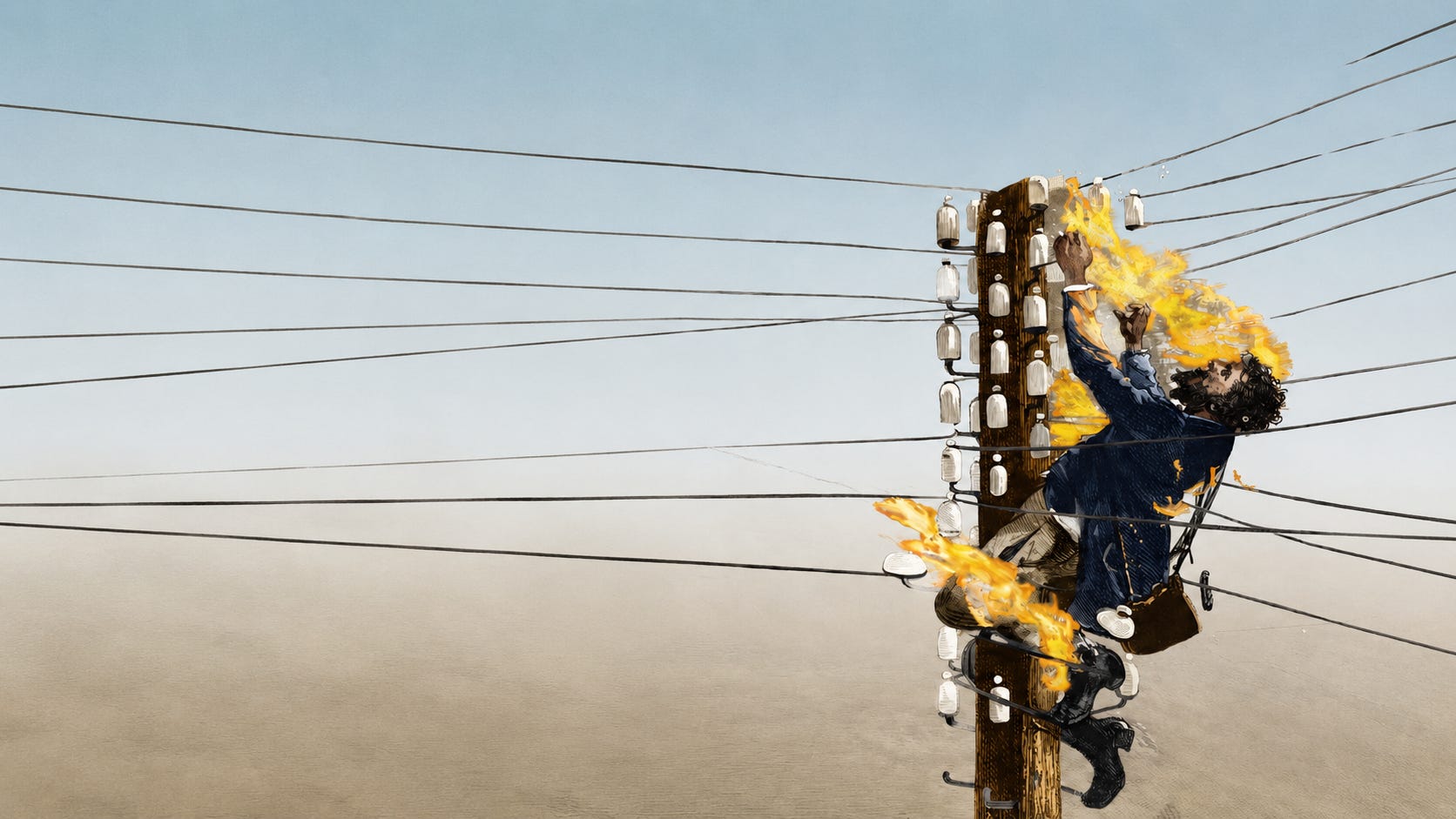
Within four decades, electricity would power nearly every urban household in the United States.
I open with this episode because the argument I wish to make depends on a pattern, and the pattern is best seen by example. The pattern is this. Every transformative infrastructure in American history has been preceded by a season of public panic, the panic has typically been amplified by interested parties masquerading as concerned citizens, and the panic has typically given way, after a decade or two, to widespread normalization and gratitude. We feared electricity. We feared the railroads. We feared the airports, the cellular towers, the nuclear plants, and the highways. In each case the fear was real, in each case it was politically powerful, and in each case it was eventually overcome by the simple fact that the infrastructure worked and the country needed it. Today we fear data centers. The fear is being manufactured by familiar hands, and unless it is overcome, the country will lose something more consequential than a few new buildings on the outskirts of a Texas county. It will lose the race for artificial intelligence to the Chinese Communist Party.
Consider the polling, because the polling is the engine that drives the policy. In May 2026, Gallup reported that 71% of Americans oppose constructing AI data centers in their local area, with only a little over one-quarter in favor. A March 2026 Quinnipiac University poll found 48% opposed and 35% in support of new data centers in their own communities. A February 2026 Marquette Law School poll of Wisconsin registered voters found 70% saying that the costs of data centers outweigh the benefits, with only 29% saying the reverse. The Washington Post and George Mason University Schar School polling in Virginia, the state that hosts the world’s densest concentration of data center infrastructure, found that 59% of voters would be uncomfortable with a new data center in their community and 56% oppose tax incentives that bring such projects to the state. These are not marginal results. They are the numbers of a country talking itself into a strategic retreat.
What is striking is that the substance of the objections does not survive scrutiny. The dominant complaints, repeated in poll after poll, are that data centers raise electricity prices, consume unconscionable amounts of water, and degrade local quality of life. Each claim, examined carefully, collapses. Take water. The World Resources Institute estimates that a large data center can use up to 5 million gallons per day under conventional evaporative cooling, a figure that has been repeated endlessly by activists, and yet that figure dramatically overstates what modern facilities actually require. Air-cooled and closed-loop liquid-cooled designs can bring water consumption down to roughly what an ordinary office building uses for its restrooms and kitchen sinks. Meanwhile the average 18-hole golf course in the American South consumes around 500,000 gallons of water per day during the growing season, and no county commissioner has yet proposed a moratorium on golf. The water objection is therefore not an objection to water use per se. It is an objection to a specific kind of land use that activists have decided to oppose, dressed in the language of conservation.
Take electricity prices. The polling shows that voters believe data centers raise the cost of power for ordinary households. The truth runs almost precisely in the opposite direction. Power is a commodity with significant fixed costs and a regulated rate of return. When demand rises and the utility’s fixed infrastructure is more fully utilized, the per-unit cost of generation falls. Large industrial customers, including data centers, are price-makers in the downward direction over the long term, not the upward direction. The objection one hears, that residential ratepayers are subsidizing transmission upgrades for data center clusters, is a real complaint about a specific tariff design, but it is a complaint about utility regulation, not about data centers. And here the deepest irony emerges. The largest data center operators have repeatedly proposed building their own power generation behind the meter, that is, on their own property, paid for with their own capital, drawing nothing from the grid. The entities most strenuously opposed to this arrangement are the regulated utilities themselves, because their profits, set by regulators as a fixed return on capital, can only grow by expanding their rate base and their customer count. A data center generating its own power is a data center the utility cannot bill.
In Texas, this dynamic is unfolding before our eyes. The Permian Basin is now home to a rapidly expanding constellation of data center projects, and the utilities are racing to build transmission lines out to West Texas to serve them. The capital cost of those transmission lines is being recovered, in the conventional way, through rate cases that fall on residential consumers across the state. The consumers, understandably, are angry. But their anger has been carefully aimed at the data centers rather than at the regulated monopolies that insisted on building the lines in the first place. The data centers did not ask for the transmission. They asked, in many cases, for permission to build their own gas-fired or nuclear generation onsite, and they are being refused or delayed by regulators acting on the advice of utilities whose business model depends on remaining the middleman. A consumer movement that wished to lower electricity bills would direct its fury at the utilities. A consumer movement that has been captured by NGO messaging directs its fury at the customers.
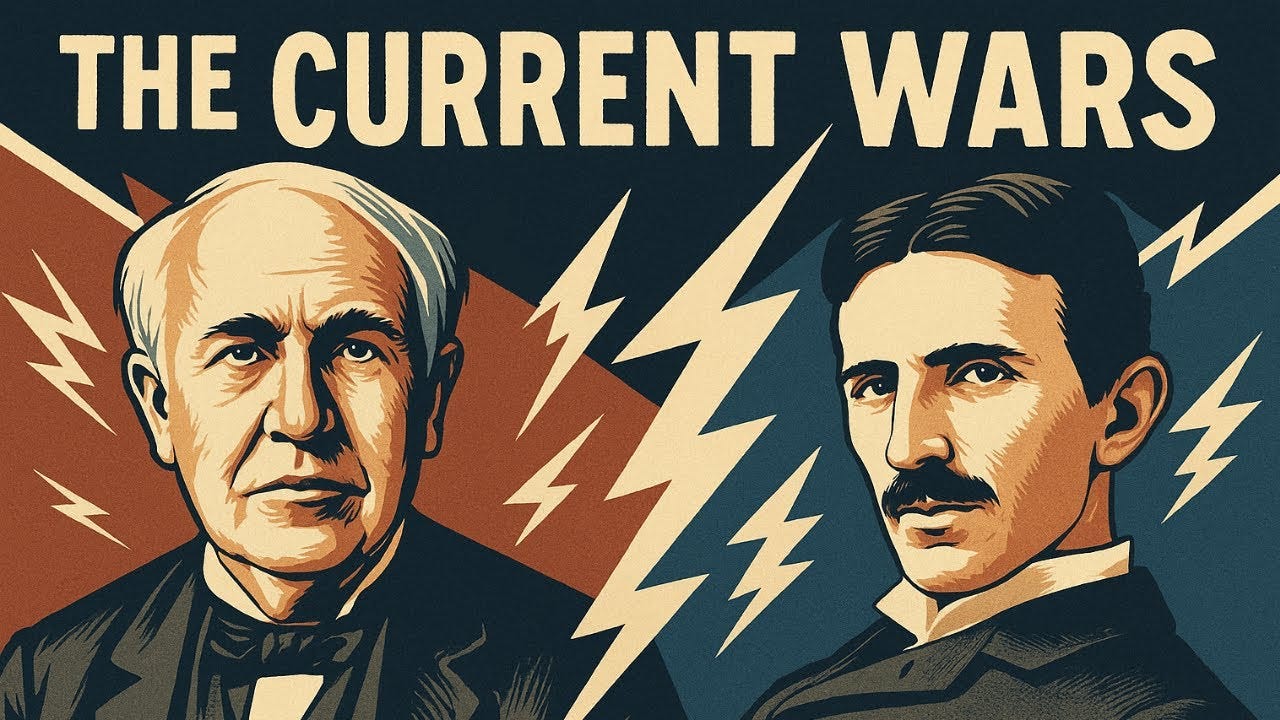
How did this misdirection happen? Here the historical analogy sharpens. In the late 1880s, the campaign against alternating current was not a spontaneous folk uprising. It was substantially funded and amplified by Thomas Edison's commercial interests, which had bet on direct current and stood to lose enormously if alternating current prevailed. Edison's allies coined the phrase the executioner's current, lobbied for the use of AC in the electric chair, and fed lurid stories to newspapers eager for circulation. The panic was real, and the deaths were real, but the volume and direction of the panic was shaped by interested actors with money to spend. The modern data center panic follows the same pattern with different actors. A cluster of Democrat-aligned environmental and consumer NGOs, many of them documented recipients of several billion dollars in funding from foreign billionaires and entities tied to the Chinese Communist Party, have systematically organized opposition campaigns in localities from Prince William County to Monterey Park to Tucson. Climate Power and Blue Rose Research, to take one example, fielded a national survey in early 2026 with messaging optimized to produce the opposition numbers they then publicized. The messaging tested most effective was utility costs and power outages, the very narrative the polling now reflects. This is not organic public sentiment discovering itself. This is engineered sentiment being measured.

The Chinese strategic interest is the part that conservatives must say aloud, because no one else will. Beijing is building data center capacity at a pace that exceeds American buildout. Beijing is not consulting local homeowners associations. Beijing understands, as the Heritage Foundation and the Hudson Institute have repeatedly emphasized in their work on technology competition, that artificial intelligence will determine the next century of military, economic, and surveillance power. A nation that cannot build the physical substrate of AI cannot lead in AI. The Chinese Communist Party therefore has every incentive to fund, directly and through intermediaries, any organization in the United States that can slow American construction. That such funding exists is no longer a matter of speculation. It is a matter of disclosure filings, congressional testimony, and the increasingly transparent grant trails of climate and consumer NGOs whose donor bases include individuals and foundations with deep commercial ties to the People’s Republic.
Imagine, then, the following counterfactual. It is 1942. The federal government has begun the Manhattan Project. The first reactors are being designed at the University of Chicago, the first enrichment facilities are being sited in Tennessee, and the first weapons laboratory is being established in New Mexico. A coalition of civic organizations funded by the A emerge to demand that the project pause for additional environmental review. Local homeowners object to the noise and the lights. A poll is commissioned showing that 71% of Americans would not want a uranium facility in their community. The newspapers run sensational stories about radioactive water. The country, persuaded, slows down. The war ends differently.
That counterfactual is the situation in which the United States now finds itself with respect to AI infrastructure. The Manhattan Project of our era is the buildout of compute, power, and cooling at the scale required to train and run the systems that will define the rest of the century. The objections being raised against that buildout are, on the merits, a mixture of misinformation about water, misdirection about electricity, and aesthetic preference dressed as policy. The funding behind the objections is, in significant part, foreign and adversarial. The historical pattern, from electrification onward, tells us how this ends if we let it. The country eventually builds the infrastructure, the panic eventually subsides, and the citizens who shouted loudest eventually live comfortably on the benefits. The only question is whether the United States builds quickly enough to win, or whether it builds slowly enough to lose.
Reagan once observed that there are no great limits to growth because there are no limits of human intelligence, imagination, and wonder. The data centers rising across Texas and Virginia and Arizona are not a threat to the country. They are the country, in its next form. The men and women funding the campaigns against them are not its conscience. They are its competitors, and in some cases, its enemies.
If you enjoy my work, please subscribe https://x.com/amuse/creator-subscriptions/subscribe
Alexander Muse is a Fellow at the John Milton Freedom Foundation and publishes daily political analysis at amuseonx.com. Primary sources cited in this piece are linked inline; campaign finance figures are drawn from FEC filings, polling data from publicly released crosstabs, and legal claims from filed pleadings. Corrections are posted to the original URL with a dated changelog. Readers who identify errors are invited to contact the author directly.
I *broadly* agree with you, with two moderate caveats
1. The power grid needs, in many cases, to be upgraded and stabilized to support the needs of both the data centers and their surrounding communities, which is not trivial
2. Water supplies likewise need substantial work in many locations
The data center owners have, thus far, not been “wildly successful” in either case, and are proving to be less-than-ideal neighbors
That’s the physical infrastructure side of the coin
On the point of “existential angst”, for those whose livelihoods are or will be affected by AI, we need to pay close attention to the lessons learned from previous technology revolutions
Clear, timely, useful, accurate information has to be made available, and there needs to be some kind of plan to help people shift and adapt
The last revolution - PCs and the internet - took about 15 years to have its full impact felt across the board. This one will be much faster
“Everything will be just fine, trust me bro” isn’t the most trustworthy or reassuring message, even if it’s true
You make an excellent case for AI datacenters. I'm of the opinion that they are the future and we need to embrace them now.