


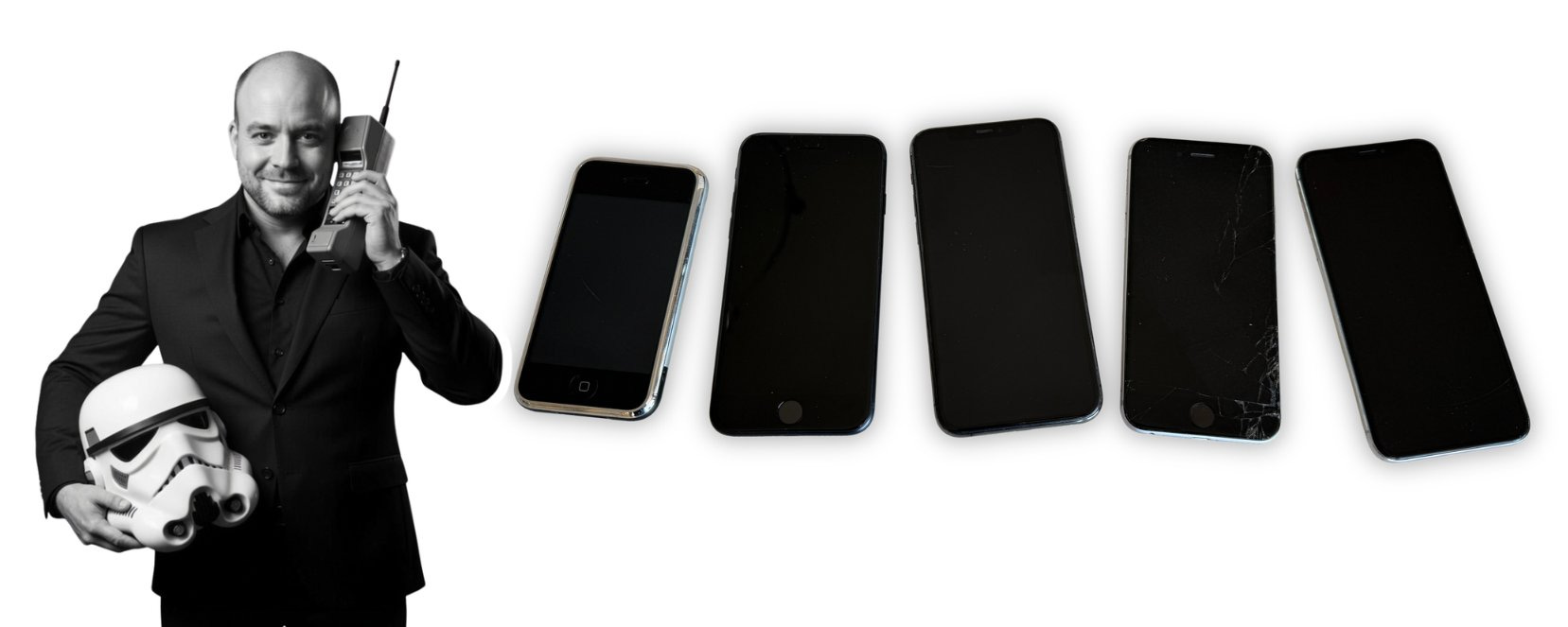
The employee at the Apple Store recognized my problem before I finished describing it. This week, my iMessage stopped working with no warning, no email, no on-screen notice, and no mention of any rule I had broken. I walked in expecting a rare technical glitch. He told me several people bring that complaint to the store every day, then apologized, handed me a phone number, and sent me on my way. I have carried an iPhone since the first one shipped in 2007 and used iMessage since Apple introduced it in 2011. Laptops, desktops, Mac minis, Apple TV, HomePods, AirPods: all of it runs on Apple’s platform, because Apple spent 15 years persuading me that everything would work together, and it did, right up until the morning the company decided I was no longer welcome in its messaging system and declined to tell me why.
Texas should make Apple explain itself. Attorney General Ken Paxton should open a consumer protection investigation into how Apple handles suspended messaging accounts, and the Legislature should follow with a narrow statute requiring large messaging providers to give notice, state the rule, offer a real review, and guarantee a reliable way to pull a phone number out of a proprietary system the customer can no longer use. I still do not know whether I violated some provision of Apple’s terms, whether an automated filter misfired, or whether someone compromised my account and used it to send garbage. Apple will not say. Its position, as best I can reconstruct it, is that I may have done something wrong, and that this is all I am entitled to know.
Apple operates 17 retail stores in Texas and roughly 269 across the United States. If one Dallas-area store sees a handful of silenced customers every day, the company is restricting a substantial number of accounts, perhaps 200,000 a year, but only Apple knows exactly how many.
The store employee gave me the number for a representative who had no information about why Apple had restricted my account. For my privacy and protection, he explained, he wasn’t permitted to have it. I told him I waived the privacy; I wanted someone at Apple to tell me whether I had been hacked, whether I had tripped a rule, or whether a machine had made a mistake. He suggested I read the terms of service, all 10,000 words, without indicating which clause I supposedly violated. That is a bureaucratic dead end dressed up as customer care.
The blue bubbles are the least of it. A text from one iPhone to another travels through Apple’s servers rather than the carrier’s, and Apple keeps a directory of registered phone numbers. If the company suspends an account but leaves the number registered, every iPhone owner who has ever texted me goes on sending messages into a mailbox I cannot open. They see the familiar bubble, so they have no reason to call, email, or try again. Apple publishes a deregistration tool for people who switch to Android. I have not switched, and I still own the phone. Apple has locked me out of one room in the house while it keeps telling the neighbors I am home.
Nowhere in its United States iCloud terms, revised on September 14, 2026, barely a month before my suspension, does Apple claim an unlimited right to terminate for any reason. The terms list specific grounds, including contractual violations, legal requests, security problems, fraud, and nonpayment, and promise 30 days’ notice and a chance to cure nonmaterial breaches. Either Apple thinks my breach was nonmaterial and its contract owed me a chance to fix it, or it thinks the breach was material or my account compromised and can say so. Silence is the one option the agreement Apple drafted does not leave it.
The Deceptive Trade Practices Act, codified at Chapter 17 of the Business and Commerce Code, prohibits false, misleading, or deceptive commercial practices under §17.46 and hands the Attorney General enforcement authority under §17.47. Sections 17.60 and 17.61 allow the Consumer Protection Division to issue civil investigative demands for documents and sworn testimony, a power the Texas Supreme Court reaffirmed in March 2026 after a company tried to resist. I know Paxton is a little busy right now, but I would appreciate it if he’d have his office put six questions to Apple. How many Texas accounts has it restricted? Did people make those decisions, or did software? Do suspended numbers remain registered as iMessage destinations, and do senders see delivery confirmations for messages the recipient cannot read? How many suspensions have been reversed on review? And what, precisely, is a locked-out iPhone owner supposed to do?
Section 5 of the Federal Trade Commission Act reaches unfair practices, and the test at 15 U.S.C. §45(n) asks whether a practice causes substantial injury that consumers cannot reasonably avoid and that no countervailing benefit outweighs. A customer cannot avoid a routing failure he cannot see. The Department of Justice sued Apple on March 21, 2024, alleging the company maintains monopoly power in smartphone markets, and its complaint singled out messaging restrictions as a tool for discouraging customers from leaving. Apple disputes the claim. I make a clean exhibit for the government anyway, because I can neither leave Apple’s messaging system cleanly nor stay in it, and that is what a switching cost looks like from the inside.
Apple’s best argument is security. Spammers, fraudsters and account hijackers are real, and a company that explains exactly why it flagged an account hands the next bad actor a map. The answer is already in operation on the other side of the Atlantic. Article 17 of the European Union’s Digital Services Act requires covered platforms to give a statement of reasons when they suspend an account, and Article 20 requires an internal complaint system. Both carve out security and law enforcement. The United Kingdom’s Online Safety Act imposes similar duties. Europe is no one’s idea of a free-market paradise, yet Apple complies there without surrendering its servers to scammers. If Cupertino can explain itself to a Belgian, it can explain itself to a Texan.
Justice Clarence Thomas, concurring in Biden v. Knight First Amendment Institute in 2021, observed that today’s digital platforms resemble the old common carriers and public accommodations and that the doctrines built for them may apply again. Those doctrines bound innkeepers, ferrymen and carriers who held themselves out to the public; each owed reasonable service, and none could shut the door on a traveler at whim. Conservatives honor contracts and private property, and a business may ordinarily refuse service to whom it likes, but the common law has never treated every business alike. iMessage is not a telephone company and should not be regulated like one. A service bolted into the only messaging app on the phone in your pocket, however, sits closer to the ferry than to the restaurant.
In Manhattan Community Access Corp. v. Halleck, the Supreme Court held in 2019 that a private forum operator is not the government, so Apple owes me no due process under the Fifth or Fourteenth Amendments. Halleck is correct as far as it goes, which is why this belongs with the Legislature, the body that can write into statute the kind of duty the common law once laid on the innkeeper and the ferryman. NetChoice v. Paxton, decided in 2024, cautions that a Texas law compelling a platform to carry speech will face serious First Amendment scrutiny. A law requiring a truthful delivery indicator and a working off-switch for your own phone number regulates a product, the way a lemon law regulates a car, and courts have never treated an honest odometer as compelled speech.
The Legislature should require large providers of messaging services tied to consumer devices or phone numbers to promptly notify customers when they restrict access and to state whether the restriction is temporary or permanent, as part of a Digital Communications Consumer Protection Act. The notice must identify the contractual provision at issue and describe the alleged violation in enough detail that the customer can respond, with narrow exceptions for active security investigations, and any permanent restriction must go to a human reviewer. The provider must not knowingly maintain a routing state that silently swallows messages when a safer alternative is technically feasible. It must let a suspended customer deregister the phone number without first regaining access to the service that suspended the account, and it must open its enforcement records, in confidence, to the Attorney General. None of that forces Apple to carry a single message it does not want to carry; it forces Apple to tell the truth about where the messages go.
Texas has done this before with telemarketers, data brokers, and age verification for app stores, and messaging is a smaller lift than any of them. The conservative instinct is to let a state of 30 million people with a functioning attorney general’s office do the work, under a rule narrow enough that a company can obey it on a Tuesday.
Apple became the most valuable company on earth, a $3 trillion corporation, by making its products indispensable and asking customers to pour their families, their businesses, and their memories into a single ecosystem. That kind of dependence creates responsibility, and conservatives who spent a century warning against arbitrary power in government hands have no reason to excuse it when a corporation holds the switch. At the end of the day, I am asking for three things any innkeeper owed a traveler in 1850: tell me why you are putting me out, let me answer, and do not keep telling my friends I am still in the room. Meanwhile, if you need to reach me, you can on Signal: amuseox.01
If you enjoy my work, subscribe https://x.com/amuse/creator-subscriptions/subscribe
Alexander Muse is a Fellow at the John Milton Freedom Foundation and publishes political analysis at amuseonx.com. Readers who identify errors are invited to contact me directly. Each op-ed is edited for grammar and clarity using AI in partnership with Grammarly. Data provided in a sponsored partnership with Polymarket.
Please keep speaking out, Alexander. You have a lot of people standing behind you!
I've never owned an Apple device due to their "benovelent" policies that limit my control of my data. Google is hardly better but I'm a Pixel for now. You may want to go to an Android device until Elon releases a phone.