


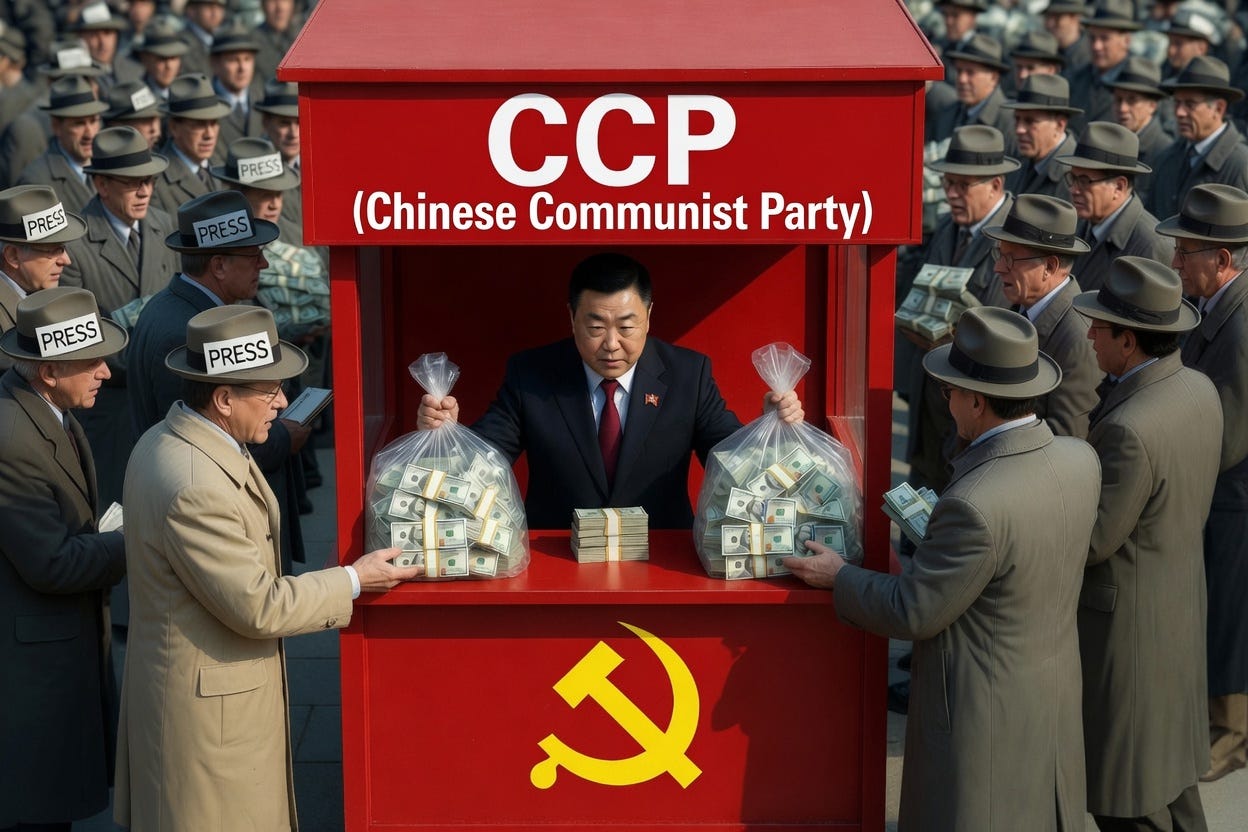
A friend forwarded me an article last week that I have not been able to shake. It ran in the Dossier under the byline of Jordan Schachtel, and it carried a title that reads like a receipt: $7,600 Per Doomer Dispatch. The claim is not a metaphor. By the Tarbell Center’s own public accounting of its grants, Schachtel reports, working journalists are paid an average of better than $7,600 for every article the center bankrolls, with individual grants running as high as $20,000 for a single story. Sit with that figure for a moment. It is more than most reporters earn in a month, paid out for one piece of coverage on a single subject, and the subject is almost always the same: that the most promising technology of our lifetimes is in fact a slow-motion catastrophe.
Schachtel asks the question that follows naturally, and it is the right one. If you have ever wondered why so much of the corporate press treats artificial intelligence like a horror film rather than an industrial revolution, the answer may be that someone is paying for the horror. I want to take that suggestion seriously, because it points at something larger than one center and one grant page. It points at a method.
Here is the method, stated plainly. You do not need to tell a writer what to write if you control who gets paid to write. Think of a wealthy patron who never once instructs a painter what to paint, yet commissions only those painters who already paint what the patron loves. Over time the galleries fill with a single sensibility, and no one can point to an order that produced it, because no order was ever given. I will call this selection power, to distinguish it from editorial control. Editorial control leaves fingerprints. Selection power leaves none. The finished product, a byline, a policy memo, a local moratorium, carries no visible mark of its origin, and that invisibility is precisely the point.
I can offer a small experiment of my own to illustrate the mechanism, because I have just made myself part of it. I have applied for a Tarbell grant. The application is revealing in a way its authors may not intend, since it asks the writer to set out exactly what he has published on the subject in the past and exactly what he proposes to write on artificial intelligence and data-center policy in the future. That is selection power reduced to a form. The funder never has to edit a sentence, because it learns your disposition before a single dollar changes hands and then chooses accordingly. I expect to know within a week or two whether the center will underwrite a writer who regards these technologies as an industrial revolution rather than an apocalypse. If the answer is no, and I suspect that it will be, then the grant page is not a record of journalism funded but of a viewpoint purchased.
Once you see selection power, you begin to notice that the AI-fear apparatus is built on it at every level. Start with the cleanest evidence, the material that even a hostile fact-checker cannot wave away, because it comes from the organizations’ own websites and from filings with the Internal Revenue Service rather than from inference. The Tarbell Center does not deny its funding. Its journalism fellowships are underwritten by Coefficient Giving, which is the rebranded Open Philanthropy, along with the Effective Altruism Infrastructure Fund, the Future of Life Institute, and the Survival and Flourishing Fund. As of 2025 the majority of Tarbell’s money originates with a single source, Coefficient Giving. So at the layer where the public first encounters AI as a topic, the layer of the journalist, a small donor network sits astride the spigot.
Now follow the same network up one level, to the people who staff the offices that write the rules. The Horizon Institute is the structural twin of Tarbell, except that it embeds its fellows in government rather than in newsrooms. Horizon received $2.9 million in seed funding from Open Philanthropy, the vehicle of Meta co-founder Dustin Moskovitz and his wife, and a related Moskovitz entity, Good Ventures, gave $11.8 million in 2023. Horizon fellows, on salaries funded by that network, have gone on to work at the Department of Defense, the Department of Homeland Security, the State Department, the House Science Committee and the Senate Commerce Committee, and at think tanks such as RAND and Georgetown’s Center for Security and Emerging Technology. A former Office of Congressional Ethics figure put it bluntly, suggesting that this use of fellowships looks like an effort to mask the program’s ties to its funder and to the wider movement behind it.
The third level is the supply of expert consensus, and it follows the same pattern. Open Philanthropy gave Georgetown’s Center for Security and Emerging Technology $55 million, and that center pays the salaries of fellows who hold government posts with high security clearances. In 2023, reporting in Fortune found Open Philanthropy funding the salaries of more than a dozen AI fellows scattered across congressional offices, federal agencies, and think tanks, with the Senate’s lead legislators on the issue each working alongside a fellow paid by that same network. The throughline is hard to miss. Fund the journalists who frame the problem, fund the fellows who staff the offices writing the rules, and fund the think tanks that manufacture the consensus both will cite. One donor network, three layers of the policy stack, and not a single direct order required.
A careful reader will object here, and the objection deserves a real answer. Philanthropies fund journalism and policy work all the time, the reader will say, and there is nothing sinister in a foundation supporting reporters or fellows. That is true as far as it goes. The trouble is not that money flows; it is the concentration and the coincidence of the flow. When the same handful of funders appears at the newsroom, in the congressional office, and inside the think tank that both of them quote, you no longer have three independent voices arriving at the same conclusion. You have one voice speaking through three microphones, and the appearance of independent agreement is itself the product being purchased.
So far I have stayed on the firmest ground, the effective-altruism funding network whose flows are admitted and documented. I want to be candid as I move onto softer terrain, because candor is what separates a serious argument from a smear. The second stream of opposition to American AI infrastructure, the campaign against data centers themselves, rests more on motive plus mechanism than on signed confessions, and a responsible writer should say so out loud rather than let an opponent say it first. With that caveat stated plainly, the pattern is striking enough to demand explanation.
A New York Times investigation in 2023 traced a financial web built by Neville Roy Singham, who sold his consulting firm for roughly $785 million and relocated to Shanghai, and which the paper described as a lavishly funded campaign promoting pro-China talking points. Reporting since has put roughly $285 million flowing into six US nonprofits, with more than $1.4 million reaching Code Pink, over a quarter of its budget. That network is now the subject of multiple congressional probes. Onto this foundation the Bitcoin Policy Institute, in a May 2026 report by Sam Lyman, lays the data-center connection, and it offers what it calls the cleanest chain. The Wyss Foundation gave $1,255,000 to the Americans for Financial Reform Education Fund, which then signed the December 8, 2025 coalition letter demanding a national pause on data centers, and the Sanders and Ocasio-Cortez moratorium bill was introduced 107 days later. The report adds a detail almost too neat to invent: while Chinese state outlets such as CGTN, China Daily, and Global Times warn American audiences that data centers will ruin their power grids, the Chinese state subsidizes up to half the energy costs of its own AI data centers. The warning is for export only.
The coordination evidence is where this stops feeling like coincidence. Power the Future’s April 2026 report, Manufactured Outrage, documents a tight December 2025 sequence in which Food and Water Watch adopted a moratorium position, organized the 230-group letter, told NPR it was talking with members of Congress, and then watched Sanders endorse the very position weeks later. Organizers said the quiet part on the record. A Food and Water Watch staffer told Wired that the New York moratorium bill was, in his words, our idea, and an allied figure confirmed a multi-state working group coordinating the effort. Most important for those of us on the right, Data Center Watch found that 55% of the officials publicly opposing these projects were Republicans, and organizers in red counties admitted stripping the climate language out of their pitch to avoid alarming conservatives. The campaign is not merely targeting the left’s enemies. It is recruiting our own people by hiding its colors.
Put the picture together and the stakes resolve into focus. America is in a race to build the computing infrastructure on which the next century of economic and military power will rest, and a well-financed apparatus has discovered that it can slow that buildout without ever making an honest public case. It can pay journalists to frame AI as an apocalypse, pay fellows to staff the offices drafting the constraints, and seed local outrage that stalls projects one county at a time. DataCenterWatch counts at least 142 activist groups across 24 states that have already blocked roughly $18 billion in projects and delayed another $46 billion. Whether every actor in this chain intends to serve Beijing is beside the point, and I do not claim to read their hearts. The effect is a strategic gift to a rival that subsidizes at home the very technology its propaganda discourages here.
The doomer beat, then, is not simply mistaken. By its own published price list it is paid, and the money traces upward through admitted effective-altruism channels and, by strong inference, through foreign-linked ones as well. I will report back when Tarbell answers my application, because the answer will be its own small piece of evidence. The burden, in the meantime, belongs to those who would call all of this mere coincidence. They are welcome to try, but they should know the receipts are public, and the rest of us have learned to read them.
If you enjoy my work, please subscribe https://x.com/amuse/creator-subscriptions/subscribe
Alexander Muse is a Fellow at the John Milton Freedom Foundation and publishes daily political analysis at amuseonx.com. Primary sources cited in this piece are linked inline; campaign finance figures are drawn from FEC filings, polling data from publicly released crosstabs, and legal claims from filed pleadings. Corrections are posted to the original URL with a dated changelog. Readers who identify errors are invited to contact the author directly.
Good detective work in tracing the funding of much of data center opposition to China. However, you do not address the substantive critiques of data centers: high electricity and water rates for consumers. Unless data centers bring their own supply, they must pay taxes sufficient to offset their demand driven cost increases.
The problem with data centers is that technology is going to move past them. They won’t be needed and will become massive eyesores in communities, a new rust belt if you will. Here is an idea: if data centers are vital to national security, place them on military bases throughout the country. Put the military in charge of maintaining them and dismantling them when they are no longer needed.