


Consider a man who begins behind the wheel of a delivery van. He learns the routes, then the dispatch board, then maintenance schedules and payroll. After a few years, he rises to operations manager at one of the more than 40 independent delivery firms that contract with Amazon in New York City. His employer nominates him for a 16-week training program. Selected from nearly 900 candidates, he receives classroom instruction, mentorship from owners who have already built what he aims to build, help drafting a business plan, and a $30,000 grant to cover startup costs and living expenses while the new company finds its feet. He does not walk away with a raise. He walks away with a company.
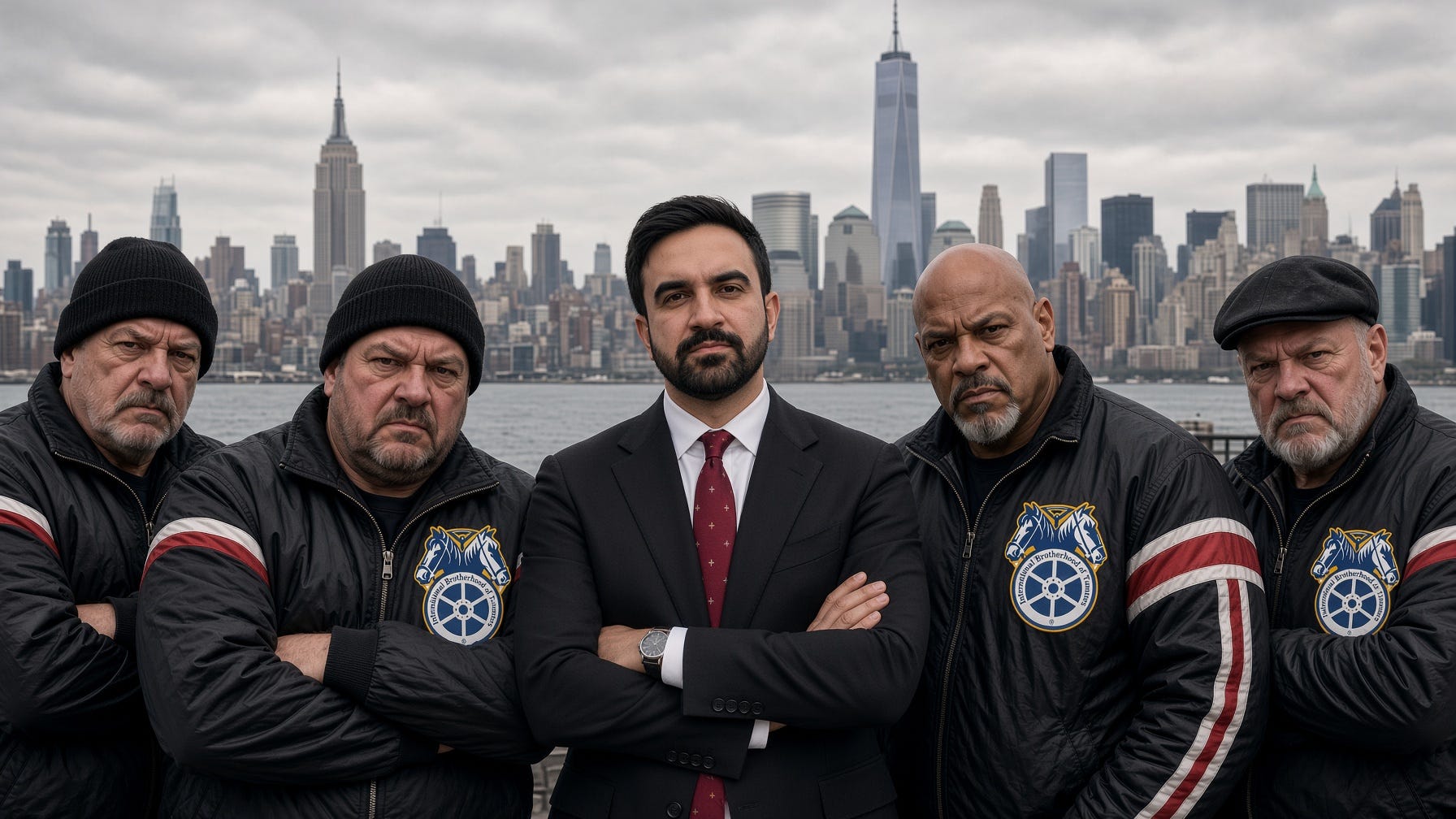
That distinction between a raise and a company now sits at the heart of the argument before the New York City Council. The Delivery Protection Act, introduced by Council Member Tiffany Cabán, endorsed by Mayor Zohran Mamdani, and pressed hard by the Teamsters, would require that anyone performing core warehouse or delivery work inside the five boroughs be employed directly by the facility’s operator. Contracting the work to a third party would be prohibited. The independent delivery companies would cease to exist as employers, and their workers would be transferred onto Amazon’s payroll without compensation. The Teamsters want to turn business owners into wage slaves they control. They state openly that the bill would make Amazon’s DSP model illegal within the five boroughs. This is not an unfortunate side effect opponents have inferred. It is the advertised purpose.
A bill sold as a check on corporate power would abolish more than 40 locally owned companies and hand their roughly 5,000 workers to the largest corporation in the industry. Roughly 25% of those companies are owned by black or Hispanic entrepreneurs. About 10% are veteran-owned. Another 10% are owned by people who came up through the driver ranks and graduated from the ownership program. Every one of those owners would be converted, at a stroke of the pen, from a proprietor into either an Amazon employee or nothing at all. If the goal were maximum corporate consolidation dressed in anti-corporate language, this design would be hard to improve upon.
You might be wondering why any of this matters. Delivery is delivery. Someone drives the van either way, and if the drivers end up better paid under a single large employer, why mourn the intermediaries? The answer is that small businesses are not intermediaries. They are the operating system of the American economy. The Small Business Administration counts 36.2 million small businesses employing 62.3 million Americans, which is 45.9% of the private-sector workforce. Those firms generate 43.5% of US gross domestic product. In the SBA’s most recent measurement period, they accounted for 88.9% of the nation’s net job growth. Bureau of Labor Statistics data tell the same story from another angle: firms with fewer than 250 employees produced 51% of net job creation from the third quarter of 2020 through the third quarter of 2025. Large corporations employ enormous numbers of people. Small firms are the ones creating the next job.
The delivery partner model is simply that American pattern applied to logistics at scale. Rather than placing every driver in the country on one payroll administered from one headquarters, Amazon supplies the package volume, the routing technology, the training, and access to vehicles and services at negotiated rates, while independent local owners do the hiring, dispatching, supervising, and building of teams. Amazon has put more than $12.3 billion into the program since 2018. Over a recent five-year stretch, 4,400 entrepreneurs across 19 countries created 390,000 driving jobs and generated $58 billion in revenue for their own businesses. Divide those figures, and the average participating entrepreneur is running an operation with something like 89 drivers. These are not people who downloaded an application and started making deliveries in a personal sedan. They are employers, with insurance, dispatch offices, payroll, and management teams.
The part of the arrangement that most deserves attention is the training pipeline, because it solves a problem that has defeated a great many well-funded government programs. Most entrepreneurship initiatives begin with an applicant who has an idea and no operating experience, and who must persuade an investor that his plan will survive contact with reality. This program begins with people already inside the business. Applicants must have worked at their company for at least a year, which means they have already dealt with route construction, package flow, driver retention, vehicle breakdowns, peak season volume, safety requirements, and angry customers. Their own bosses nominate them, so the screen is demonstrated performance rather than a resume. And the $30,000 graduation grant addresses the barrier that stops most working-class founders before they begin. Kauffman Foundation research finds that 83% of entrepreneurs get neither a bank loan nor venture capital at the start, nearly 65% rely on personal or family savings, and close to 10% carry startup costs on personal credit cards. Training plus capital plus a guaranteed first customer is a rare combination, and it is precisely the combination a driver with $4,000 in savings needs.
Why does ownership matter more than wages? Because the two things are not on the same scale. Federal Reserve data from the Survey of Consumer Finances are blunt about this. Families with no privately held business had a median net worth of $155,700 excluding business value, and a median income of $67,000. Families owning a business with two to five employees had a median net worth of $575,900 and a median income of $135,200. Families owning a business with more than five employees had a median net worth of about $1.25 million and a median income of $237,200. That is roughly eight times the wealth and three and a half times the income of the family without a business. The Urban Institute, hardly a redoubt of movement conservatism, found the corresponding fact about mobility: workers who stay in wage and salary jobs are the most likely to stay in the same income class, while workers who move from wage employment into entrepreneurship are the most upwardly mobile and the least likely to remain at the bottom.
Unions do raise wages, and the 2023 Teamsters contract at UPS is a real accomplishment by its own lights, delivering an immediate $2.75 hourly increase, $7.50 in raises over five years, and an average top rate of $49 for full-time drivers. Nobody should pretend that is nothing. But notice the architecture of what a union produces. It is a classification, a seniority ladder, a schedule of negotiated steps, and a top rate. Once a worker reaches the top of his classification, his upside depends on the next round of bargaining, on overtime, or on promotion into a different recognized category. He does not acquire equity because he trained better drivers or ran a more profitable route. Labor economists have a name for this feature: wage compression. Collective bargaining narrows the differences within a covered group, which helps workers at the bottom and flattens the return to exceptional performance at the top. Compression is not a scandal. It is simply what a bargaining unit is for.
Yet that same structure helps explain the hostility to the ownership model. A workforce split among 40 independently owned companies is a nightmare to organize while a single workforce on one corporate payroll is a single campaign, one election, one contract, one revenue stream, and a driver who becomes an owner is not merely harder to organize, he is permanently gone from the bargaining unit, no longer a dues payer, no longer a standardized labor input, but a small employer on the other side of the table. The union hierarchy has every institutional reason to prefer consolidation. Teamsters president Sean O’Brien’s $471,455 salary is drawn from a membership of about 1.3 million workers who occupy, and are expected to keep occupying, the category of employee. I do not say that to suggest he is unentitled to a salary. I say it to point out that the institution’s interests and the ambitious driver’s interests are not the same interests, and when they conflict, this bill picks the institution.
Notice also what the legislation does not contain. It does not create grants to help drivers buy out their employers. It does not transfer the assets of those companies to the workers. It does not establish driver-owned cooperatives, which a serious socialist might at least have attempted. It does not preserve the independent firms while imposing tougher safety or wage standards on them, which a serious regulator would have drafted in an afternoon. It simply requires direct employment by the biggest entity in the room. Cabán and Mamdani could have written a bill that multiplied owners. They wrote one that subtracts them, and the fact that this is a core plank of the DSA program rather than an oversight is the thing New Yorkers should sit with.
The contracting model, by the way, is not some Amazon innovation invented to dodge labor law. FedEx reported roughly 5,700 independent small businesses supplying its linehaul and pickup-and-delivery operations. The United States Postal Service, an agency of the federal goverment, ran more than 7,900 active Contract Delivery Service agreements in fiscal 2020, at a cost of about $447 million, because independent route contractors turned out to be a sensible way to reach addresses that salaried carriers could not economically serve. If the principle behind the Delivery Protection Act is sound, it condemns all of them.
The Heritage Foundation’s James Sherk warned years ago, during the joint employer fights, that making lead companies liable for the workforces of their contractors would not produce a worker’s paradise. It would replace independent owners with corporate middle managers. That prediction is now a legislative proposal. The trade on offer in New York is not exploitation versus protection. It is independent owner versus salaried supervisor, equity versus a title, a business you can sell or leave to your children versus a slot on an organizational chart.
Which brings us back to the operations manager with the business plan. Under this bill, he can still be promoted. He can still earn a good wage, and if the Teamsters organize the consolidated workforce, he may earn a better one. What he cannot do is own the company. The destination has been made illegal; no amount of hourly improvement within the classification is a substitute for what he was actually working toward. A free economy is one in which the ambitious worker is permitted to become the boss. New York is about to decide, on behalf of 5,000 people who did not ask for the favor, that he may not.
If you enjoy my work, please subscribe https://x.com/amuse/creator-subscriptions/subscribe
Alexander Muse is a Fellow at the John Milton Freedom Foundation and publishes daily political analysis at amuseonx.com. Primary sources cited in this piece are linked inline; campaign finance figures are drawn from FEC filings, polling data from publicly released crosstabs, and legal claims from filed pleadings. Corrections are posted to the original URL with a dated changelog. Readers who identify errors are invited to contact the author directly. Each op-ed edited for grammar and clarity using Ai in a sponsored partnership with Grammarly. Data provided in a sponsored partnership with Polymarket.
Unions outlived their usefulness years ago. They now exist only to continue to pay large paychecks to the officers.
Will NYC have to learn the lesson that you can't vote your way back out of communism?