


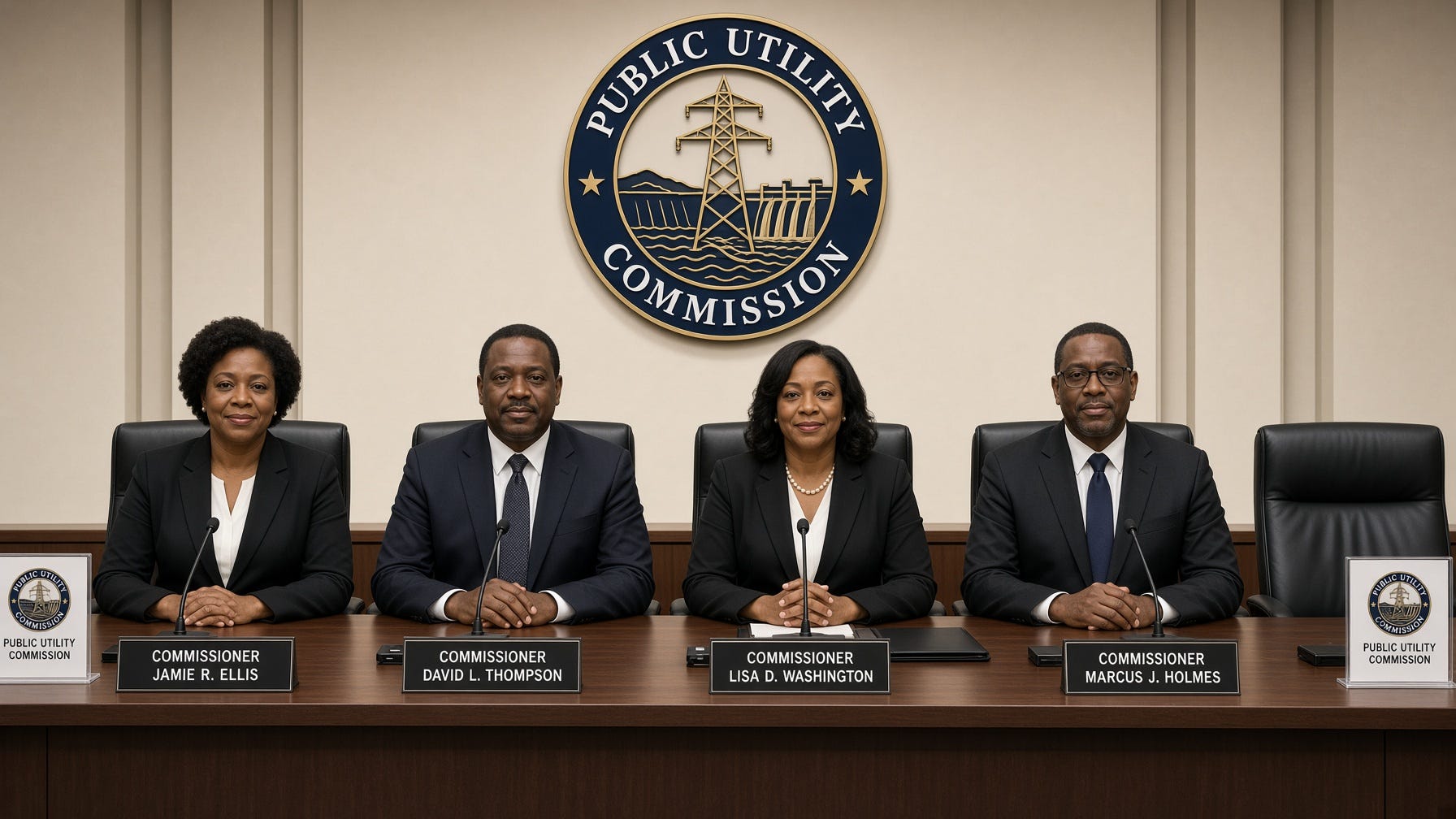
On October 27th, Democrat donors were invited to log on to a virtual fundraiser to elect “climate utility leaders,” with Kamala Harris billed as the special guest. The beneficiaries were not Senate candidates or governors. They were four people running for the Georgia Public Service Commission and the Arizona Corporation Commission, offices most voters couldn’t find on their own ballot with a flashlight. The cohosts included a DNC council on climate, the Georgia Democrat Party, and a PAC called Lead Locally, whose website explains that by winning races like these, “we can block permitting for new pipelines, ban fracking across states.” The pitch tied cheaper electricity to data center bans and a march toward 100% clean energy.
The Democrat Party has taken the playbook it used to elect so-called Soros prosecutors and pointed it at the obscure commissions that decide whether data centers get electricity. Ten states still elect the commissioners who regulate their utilities. Those races are cheap and ignored, settled by voters who tend to stop reading somewhere around the county coroner. A few million dollars, spent patiently, can seat regulators across those ten states who never cast a vote to ban a data center and still make sure almost none get built. Republicans who want America to win the superintelligence race should treat these contests as the main event, and legislators should write rules that keep a power hookup from becoming a political veto.
The prosecutor model worked beautifully, which is why it’s back. In April 2017, George Soros gave $1.45 million to Philadelphia Justice & Public Safety, an independent PAC backing a defense lawyer named Larry Krasner for district attorney. None of it went into Krasner’s campaign account; it paid for television, mail, digital ads, and canvassers. Krasner won. By February 2018, his office had announced that prosecutors would generally stop asking for cash bail for lower-level offenses. Judges still set bail, of course. Yet the office that brings the criminal cases in the country’s sixth-largest city had changed its posture toward thousands of defendants, and no legislature ever voted on it.
Chicago got the sequel. In February 2020, according to the Washington Free Beacon, the Soros-founded Democracy PAC sent $2 million to Illinois Justice & Public Safety PAC to protect Kim Foxx, the Cook County prosecutor whose office had dropped the charges against Jussie Smollett. Foxx won reelection. The method in both cities was the same: find an office with vast discretion and little public attention, flood it with dark money, and let the winner remake policy through administrative choices rather than statutes. Conservatives then spent years cleaning up, recalling Chesa Boudin in San Francisco, impeaching Krasner in the Pennsylvania House, and finally retiring George Gascón in Los Angeles. Undoing an election, it turns out, is a lot harder than winning one.
Democracy PAC’s April 2026 report to the Federal Election Commission shows a $2 million contribution to Working Families Party PAC on January 16, plus $423,000 a week earlier to Justice & Public Safety, the same NGOs that installed Krasner and Foxx. Working Families endorses Clara Pratte and Jonathon Hill, the Democrats running for the Arizona Corporation Commission, and its federal and Arizona committees share a name, an address, and a treasurer. Along with Chispa AZ and EDF Action Votes, Working Families helps fund Arizonans for Affordable Energy, which reported $85,000 in radio streaming on October 28 to promote Pratte and Hill and attack Republicans Kevin Thompson and Ralph Heap. All told, outside groups have spent nearly $2 million on the Arizona race.
The Democrats and their willing accomplices in the drive-by media will call this guilt by association. I’m not claiming George or Alex Soros hand-picked four commission candidates, and honestly the argument doesn’t need it. A network like this exists so that nobody has to. The founder capitalizes Democracy PAC, Democracy PAC capitalizes Working Families, and Working Families chooses the races and buys the ads. The prosecutor campaigns ran the same way, which is why every denial sounded so sincere.
Utility commissions offer even better arithmetic than district attorneys. Project Blue, a data center planned outside Tucson, came with a developer forecast of $3.6 billion in initial investment, 3,000 construction jobs, and 180 permanent ones. Tucson rejected the annexation in August 2025, and the Corporation Commission later approved the project’s power agreement anyway. Pratte has said she and Hill would have opposed that agreement. Put the roughly $2 million spent on Arizona’s race next to the $3.6 billion riding on a single project, and you have found the cheapest veto in American politics. In Georgia, the maximum check to a commission candidate is $8,400, about the price of a decent used Corolla, and it buys a stake in a body that recently approved nearly 10 gigawatts of new generation.
Nor is the goal much of a secret. On October 20, Lead Locally published an endorsement slate of local candidates running to stop data centers, people it describes as wanting to regulate, restrict, and stop them. Peter Hubbard, the Democrat commissioner defending Georgia’s District 3 seat, was blunter in a September statement with former Atlanta mayor Keisha Lance Bottoms: “Data Centers should not be allowed here in Georgia, unless they agree to the following conditions.” The list that followed included renewable energy, union labor, disclosure rules, community protections, and operating flexibility. Georgia’s commission is 3-2 Republican today. If Hubbard holds his seat and Shelia Edwards wins District 5 on Tuesday, Democrats run it. Arizona’s commission is 5-0 Republican and can’t flip this year, but two seats buy a beachhead and a running start on 2028.
Georgia and Arizona are canaries in the coal mine. The ten states that elect utility regulators are Alabama, Arizona, Georgia, Louisiana, Mississippi, Montana, Nebraska, North Dakota, Oklahoma, and South Dakota. Commission seats were on the ballot in nine of them this year, and in Georgia, Louisiana, North Dakota, and Alabama, control of the commission was mathematically in play. These bodies mostly have three or five members, so a determined network needs to win two or three races to own a state’s electricity policy. A statewide down-ballot race in North Dakota or a commission district in Louisiana costs a fraction of one competitive House seat. For less than the price of a single Senate race, you could assemble working majorities across most of these commissions, and no legislature would ever take a vote.
Democrats will answer that this is all about affordability. A retiree in Macon shouldn’t subsidize a tech giant’s server farm, they say, and commissioners only want developers to pay for the power plants and transmission lines they require. That is roughly Edwards’s platform, and on that narrow point she is right. So is President Trump, whose March Ratepayer Protection Pledge calls on developers to cover their own energy and infrastructure costs. Georgia has already done it. In August, Georgia Power and commission staff filed a joint statement committing that, under the reviewed large-load contract, ordinary customers would not be stuck with specified costs if the data center walked away early. That’s ratepayer protection, and it came out of a Republican-majority commission without a single mandate about where the electrons come from.
Which tells you what the rest of Hubbard’s list is for. A union-labor requirement doesn’t lower anyone’s power bill. Forcing a data center onto renewables doesn’t shield a family in Valdosta from stranded costs; it shrinks the pool of power the project may buy and raises the price of what’s left. Those conditions are tolls, and if you put enough tolls on a road, sooner or later nobody drives on it. Lead Locally has said much the same in writing. Affordability is the banner, while the money, the cohosts, and the organizers’ own words reveal the goal of outright bans on data centers.
Legislatures in the elected-commission states should settle the affordability fight by statute. Require large-load tariffs with minimum bills, exit fees, and collateral, so household protection doesn’t hinge on who wins a November race. In the same bill, bar commissions from conditioning service on labor agreements or on fuel choices beyond what reliability and cost actually demand. Commissions, meanwhile, should approve flexible-load tariffs. Researchers at Duke estimated in 2025 that the grid could accomodate about 98 gigawatts of new large load if those customers agreed to curtail just 0.5% of their annual energy use, which is how you connect quickly without building plants for customers who never show up.
Then there’s the money. Republican donors will spend tens of millions on a Senate race without blinking; they will not spend $500,000 on a commission seat that decides whether a $3.6 billion project gets power, and that is a mistake the left stopped making years ago. Party leaders in Georgia, Louisiana, and North Dakota should recruit commission candidates with the seriousness they bring to governor’s races. And voters, for their part, might try reading to the bottom of the ballot.
Berkeley Lab projects that data centers will use about 11.8% of American electricity by 2030. The White House pledge says the country’s technological leadership depends on that infrastructure being “built here at home.” Which part of home, and whether it ends up being home at all, will be decided less in Congress than in hearing rooms in Atlanta, Phoenix, Baton Rouge, and Bismarck. Capital goes where the power is, whether that means Texas, where the governor appoints the regulators, or countries happy to host what we decline to build. The left learned in the prosecutor wars that discretion is power and that the cheapest office to win is the one your opponent ignores. At the end of the day, conservatives learned the same lesson the expensive way, one recall at a time, and I would rather not pay that tuition a second time with the AI economy.
If you enjoy my work, subscribe https://x.com/amuse/creator-subscriptions/subscribe
Alexander Muse is a Fellow at the John Milton Freedom Foundation and publishes political analysis at amuseonx.com. Readers who identify errors are invited to contact me directly. Each op-ed is edited for grammar AI with Grammarly.
Destined for failure. How much will they steal from it? Not one white person on the board, that says a lot.
Democrats want the US to the be the EU. No energy, no AI, no manufacturing. Open borders and unlimited welfare. Total destruction.