


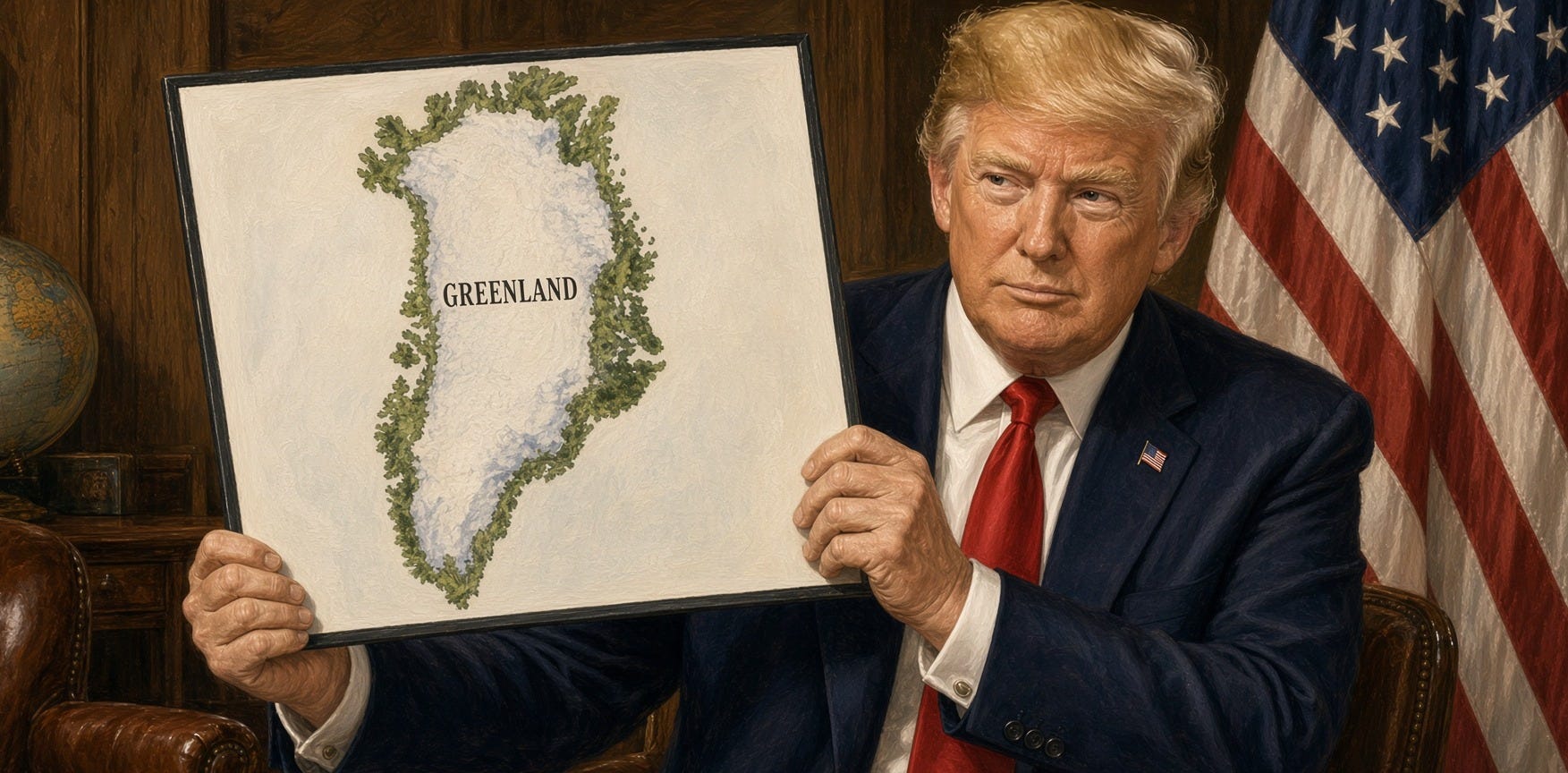
In August 2019, Mette Frederiksen called talk of selling Greenland absurd, and Donald Trump canceled his state visit to Copenhagen. On September 22, Frederiksen, Trump and Greenland’s prime minister, Jens-Frederik Nielsen, signed an Arctic security agreement. The island stays in the Danish realm as long as the people of Greenland want to stay. America gets permission to modernize and expand Pituffik Space Base, two named locations for an additional defense area, a ban on military installations by states outside NATO, and new screening of sensitive foreign investment. The distance between those two scenes is the art of the deal performed in public over seven years, and it follows the playbook Trump published in 1987 almost to the letter.
A Boy Scout once stopped the psychologist Robert Cialdini on the street and asked him to buy $5 tickets to a Scout circus. Cialdini said no. The boy then asked whether he would at least buy some chocolate bars at $1 apiece, and Cialdini bought a couple, although he does not like chocolate bars. In a study his team published in 1975, college students were asked to counsel juvenile delinquents two hours a week for two years, and every one of them refused. When the researchers retreated to a smaller favor, chaperoning some of those juveniles on a trip to the zoo, 50% agreed. When students were asked only about the zoo, 17% agreed. Psychologists call this the door-in-the-face technique. Cialdini traced its power to reciprocity: the retreat feels like a concession, and people feel obliged to respond in kind. Trump put the same idea into dealmaker terms in The Art of the Deal. He aims very high and keeps pushing, and he usually gets what he wants even when he settles for less than his opening demand.
An anchor only works when the complaint beneath it is real, and this one was. For years Copenhagen treated the Arctic as a quiet backwater, while Greenland, more than three times the size of Texas, sat beneath the shortest air routes between Russia and North America and beside the sea lanes into the North Atlantic. After a 2004 supplement to the 1951 defense agreement, the island’s only designated American defense area was a single base in the far northwest, then called Thule. In February, the Hudson Institute’s Liselotte Odgaard documented gaps in surveillance, response, and information sharing around Greenland and the North Atlantic. A month earlier, Paul McCarthy of the Heritage Foundation argued that Denmark lacked the scale to secure the island alone and that America had to lead while respecting Danes and Greenlanders. “This is not an indictment of an ally,” he wrote. “It is an argument for American leadership.”
We have watched this method work before. In his first term, Trump told NATO allies, in public and without diplomatic anesthesia, that they were shirking their spending obligations, and he let them wonder whether America would show up for members who refused to pay their share. The foreign policy establishment was scandalized. Since he first pressed the point, NATO spending has risen 74.6%, and at The Hague in June 2025 the allies pledged to devote 5% of GDP to defense and security by 2035, a target nobody would have taken seriously in 2016. Critics hand the credit to Vladimir Putin, and his invasion of Ukraine certainly concentrated European minds. Yet Russia had been menacing its neighbors since at least 2014 while European capitals kept promising to spend more next year. Putin supplied the threat; Trump supplied the deadline.
In his second term, Trump turned the same method on the Arctic, opening with a demand he never wanted granted. He floated Greenland as the 51st state. Greenland has fewer than 60,000 people, few of whom look like reliable Republican voters, and the Constitution leaves the admission of new states to Congress. No Republican House and no Republican Senate were ever going to create two Senate seats for the opposition in exchange for an ice sheet, and the president knew it as well as anyone. The talk then turned to buying the island, which Copenhagen also refused, although a purchase is at least a transaction, and a transaction implies a price.
I took the opening bid more literally than its author did. In a December 2024 column titled “Trump’s Greenland Gambit,” I argued that Greenland could become America’s newest territory through Greenlandic choice, negotiation, and our own constitutional process. I would still welcome that outcome if Greenlanders ever wanted it, but the September agreement does not deliver it, and its preamble affirms both Danish sovereignty and Greenlandic self-determination. In hindsight, my headline understood the president better than my column did. A gambit, in chess, is a pawn offered in the opening to win position. Copenhagen declined it, and the position moved anyway.
My later work followed the gambit as it unfolded. In March, in a column titled “Operation Greenland,” I argued that the pressure was forcing Europe to take Arctic defense and allied responsibility seriously, and the signed text points in the same direction. In May, I wrote on 𝕏 about three new bases in southern Greenland and an expanded Pituffik. Pituffik held up. A signature pours no concrete, however, and my count ran ahead of the paperwork: the agreement names two locations for the additional defense area, Narsarsuaq in the south and Mestersvig on the east coast.
Meanwhile, Democrats and their willing accomplices in the drive-by media spent months warning that Trump was becoming a dictator with designs on a NATO ally. Their story has a shaky ending. Dictators do not conclude their campaigns with a signed text that reaffirms the other side’s sovereignty, promises Greenlandic suppliers a contracting preference, and waits on a foreign parliament for approval. Naaja Nathanielsen, a Greenlandic lawmaker, told the Associated Press that her trust had been shaken and that she feared for Greenlanders’ country and livelihoods. She still called the agreement “a huge step in the right direction.”
Then Europe started paying. Since Trump began floating statehood and purchase, Denmark has committed $6.3 billion in new, dedicated Arctic and North Atlantic spending, which works out to more than $1,000 for every Dane. The European Union announced another $232 million in investment in Greenland. Brussels has also proposed raising its seven-year Greenland funding from €225 million to €530 million for 2028 to 2034, more than doubling it. I do not recall any of that money appearing when Washington asked nicely.
The access provisions are specific. Article IV permits the modernization and expansion of Pituffik and designates Narsarsuaq, where the US Army built the Bluie West One airfield in 1941, and Mestersvig for the additional defense area. Any further site requires a proposal specifying location, scope, activities, and mitigating measures; if the Permanent Committee cannot agree within 90 days, the dispute escalates to deputy ministers and then to ministers. Article V adds accelerated approval procedures for unmanned installations outside the defense areas. Skeptics reply that the 1951 agreement already let America operate in mutually agreed defense areas, so the new text merely repackages old rights. The old package held exactly one designated area after 2004, and it had no clock. The new 90-day clock grants no automatic permission, yet it pushes a stalled request up the chain to someone with a title who has to answer for it.
The denial provisions may matter more. A bank that guards its vault while strangers lease the office next door and wire its alarms has not secured much. Article IX bars states outside NATO from establishing their own military installations or persistent forces in Greenland unless the parties agree otherwise. Articles III and X restrict control of, and sensitive access to, critical infrastructure and resource extraction by states and investors from outside NATO, its partners, and the EU, unless the parties agree no threat exists, and Greenland will screen such investment with Denmark in consultation with American authorities. Article VII adds cooperation against espionage and against threatening development near the defense areas. In 2018, a Chinese state-owned construction giant made the shortlist to build Greenland’s new airports, and Copenhagen stepped in with financing after Washington raised concerns. Article XI, which has no end date and even plans for independence, requires Denmark and Greenland to ensure that an independent Greenland would assume the defense obligations and remain in NATO, applying for membership if necessary.
Paper, of course, defends nothing by itself, and conservatives should say so before Democrats do. Administration officials have called the deal zero cost, but Fox News reported that the claim covers obtaining the rights and excludes future construction and deployments. The preamble ties the arrangement to Golden Dome, the missile shield the president wants to build, and I have yet to see a preamble stop a missile. Denmark’s parliament has to finish its procedures, Congress has to appropriate real money for Pituffik and the two named sites, the investment screen has to bite the first time a Chinese-backed buyer comes calling for a rare earth deposit, and none of that happens on its own.
Trump learned to negotiate in New York real estate, where a signed contract is only the midpoint and the deal is done at the closing, when money moves, and keys change hands. Greenland is under contract. The same book that says think big also says deliver the goods, and delivery here has a concrete meaning: better surveillance, faster response, and shared information across the gaps Odgaard mapped, funded by Congress and visible from orbit before this term ends. The Democrats who called this a dictator’s fantasy will be watching for any stumble. Give them nothing. Washington has won the argument, and if the goverment finishes the job, the Greenland agreement will be remembered as the moment Europe began paying for the alliance’s northern flank because an American president made it more expensive not to.

If you enjoy my work, please subscribe https://x.com/amuse/creator-subscriptions/subscribe
Alexander Muse is a Fellow at the John Milton Freedom Foundation and publishes daily political analysis at amuseonx.com. Primary sources cited in this piece are linked inline; campaign finance figures are drawn from FEC filings, polling data from publicly released crosstabs, and legal claims from filed pleadings. Corrections are posted to the original URL with a dated changelog. Readers who identify errors are invited to contact the author directly. Each op-ed edited for grammar and clarity using Ai in partnership with Grammarly. Data provided in a sponsored partnership with Polymarket.
'Operation Penguin'? There are no penguins in Greenland.