


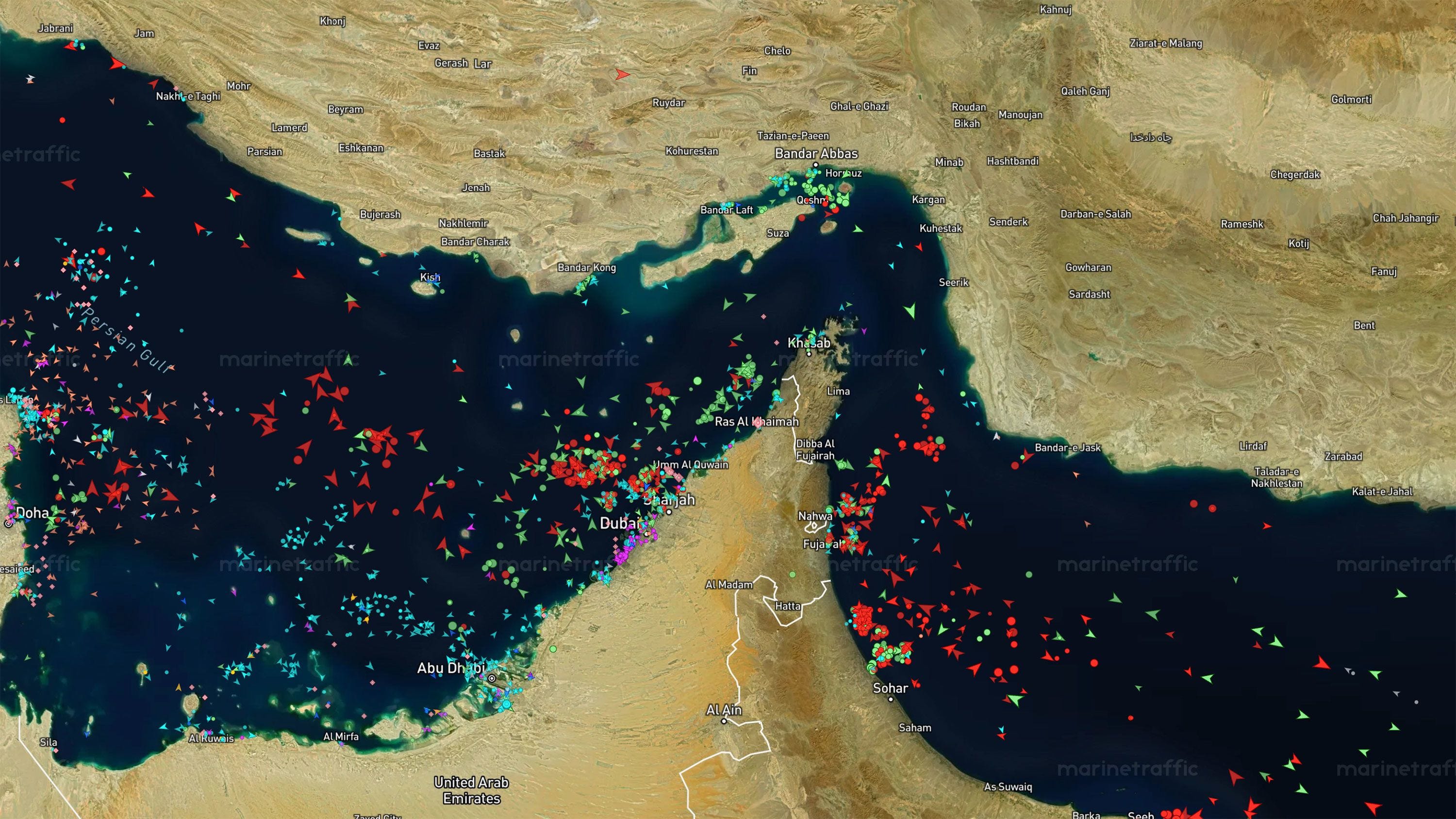
Picture a Saudi tanker running empty, riding high in the water, as it turns out of the Gulf of Oman and back through the Strait of Hormuz, toward the stretch of water Iran has spent this year calling closed. Nothing about the scene looks like a victory. Yet that empty ship tells you more about who controls the strait than any loaded tanker racing out. A loaded tanker leaving might be a one-time escape, oil that was trapped and finally got away. An empty one going back in is a business, and its owner is betting real money that Tehran cannot stop him from filling it and coming out again.
In September, according to a shipping analysis from Burggraben, 22 tankers belonging to Bahri, the Saudi national carrier, made that inbound trip. Burggraben counts roughly 116 vessels now working the shuttle trade, and it estimates that Middle Eastern oil exports have climbed back to about 94%. Iran’s strategy rested on a single threat: nobody’s oil moves unless Tehran allows it. That threat has failed hundreds of times now, one round trip at a time, and Trump deserves the credit, because his strategy has secured the strait in the one sense that matters.
The system works like a harbor with a dangerous mouth. Imagine a port where every ocean liner that runs the entrance risks an expensive hull and a crew that never signed up for combat. So the port hires a fleet of sturdy ferries. The ferries carry cargo across the hazardous stretch and hand it to the big ships waiting in safe water outside, and the liners never come in at all. Capacity then depends on how fast the ferries can unload and turn around.
That is what the Gulf has built. On September 16th, the Chinese state-owned tanker Cospearl Lake was nearing Dalian with 2 million barrels aboard, and it had never loaded a drop inside the Persian Gulf. It collected the cargo the previous month from another tanker, in a ship-to-ship transfer off Fujairah on the Gulf of Oman side of the strait. Noam Raydan of the Washington Institute traced the voyage through shipping data. The Chinese ship did the long haul to Asia while someone else handled the short, contested leg. Iran set out to frighten an entire global fleet and ran into a network that needs only a small slice of that fleet to accept the risk.
This is no boutique operation. Jacob Meldgaard, chief executive of the Danish tanker company Torm, told S&P Global in early September that the shuttle trade was moving about 6 million barrels of crude a day, plus roughly 1 million barrels of clean products, up from about 1 million combined before. That is a shipping executive talking about his own market, not a press secretary.
Washington’s numbers point the same way. On August 28th, the White House said nearly 1,500 commercial vessels had moved under American protection, carrying 750 million barrels of crude, and that 75 ships trying to slip the renewed blockade of Iran had been turned back, a count the military has since raised to 122. On September 19, Adm. Brad Cooper of Central Command reported that US forces had supported more than 1 billion barrels of crude leaving the Gulf and assisted over 2,000 commercial transits in the preceding couple of months. Energy Secretary Chris Wright put August 31 alone at roughly 17 million barrels of oil and gas products crossing by ship, a wartime high, and noted that commercial trackers miss ships running dark. Trump said it in fewer words on August 26: “The Strait is open. We take a lot of ships through the Strait now.”
Iran’s tankers tell the opposite story. Since the blockade resumed on July 14, the tracking firms Kpler, Vortexa, and TankerTrackers.com have recorded no Iranian crude cargo getting through Hormuz to China, according to Reuters, and Iran’s empty tankers have been unable to return for fresh loads. Reuters is not usually a cheerleader for this White House, yet it concluded that the blockade had succeeded where years of sanctions failed. Tehran can still sell oil it moved out before July and parked elsewhere. It cannot refill the pipeline.
So the two fleets are moving in opposite directions. Saudi tankers head into the Gulf empty because they expect to come out full, while Iran’s commercial cycle is broken at both ends. Control of a waterway is easy to confuse with the power to make it dangerous, and a protection racket shows the difference. A racketeer who torches one shop has done real damage, but his power rests on convincing every merchant on the street that nothing moves without his say-so. Once the merchants hire their own guards and keep their shelves stocked, he is still dangerous and still a criminal, and he no longer runs the street.
Tehran has taken up the racketeer’s habits anyway. It has told shipping companies to use a route its own authorities approve and to pay fees for the privilege, and on Saturday its so-called Persian Gulf Strait Authority threatened to blacklist any charterer that sends crews along unapproved lanes. It even published what it described as an apology from a shipowner. A government that actually held the strait would not need to post toll schedules and publish confessions. In June I argued that closing a strait and holding lasting leverage over it are different achievements, and the summer has supplied the proof in cargo.
The arrangement works because two policies pull in the same direction. Richard Goldberg and Mark Dubowitz of the Foundation for Defense of Democracies laid out the formula in June: keep the blockade on Iran and concentrate American naval and air power on getting everyone else’s commerce through. Trump did both. American warships and aircraft provide the protection, and the Gulf producers provide the ships, the oil, and the motive to keep sailing. The Energy Information Administration estimated that Hormuz carried about 20% of global petroleum liquids consumption in 2024, yet American imports through the strait came to only about 2% of US consumption. We care about the world price of oil. Our Gulf partners care about every barrel, so it is right that they carry much of the load.
Michael Bell and Robert Greenway of the Heritage Foundation wrote in January that “wars are not won solely on battlefields,” and that military strength rests on transportation and steady access to resources. By that standard, the Gulf is hosting a race between two logistics systems. One gets better at its job every week. The other lost three tankers on September 5, when Central Command answered Iranian missile fire at two American warships by permanently disabling the Downy near Kharg Island and the Stark 1 near Jask, then destroying the empty Kylo in the Gulf of Oman after ordering its crew off. A regime needs ships to turn crude in the ground into cash in hand. Tehran fired missiles to prove it still ruled the strait and came away with fewer.
The water is still dangerous. Ships keep getting hit, and last week a sailor died when an Indian cargo ship was attacked off Oman. The Financial Times has reported that American air cover is squeezed into two daily transit windows. Burggraben’s own numbers put shuttle freight at $28 to $30 a barrel, so moving a single 2 million barrel cargo costs somewhere between $56 million and $60 million. Those figures are brutal, and exporters keep paying them anyway.
They pay because the alternatives are worse. Torm had arranged for its tanker Innovation to load at the Saudi Red Sea port of Yanbu and sail to Asia through Bab el-Mandeb, but security threats forced a detour through Suez and around the Cape of Good Hope, adding more than 30 days to the trip. A ship tied up on one delivery for an extra month cannot carry a second cargo during that month. Then the Iran-backed Houthis struck pumping stations on Saudi Arabia’s East-West pipeline, the line built to carry crude around Hormuz in the first place, according to Kpler. Against those options, $58 million for a shuttle run is a rational price.
The trade limit has moved accordingly. Kpler reported on September 17 that ship-to-ship transfer capacity is now the main constraint, with Fujairah and Sohar believed to be running near their ceilings. Iranian missiles once set the volume of oil leaving the Gulf; today the answer depends on how many tankers can tie up alongside one another in safe water, and how quickly. A shortage of fenders and anchorage space is an engineering problem. Engineering problems yield to money, and the Gulf states are not short of money.
Iran is not finished. It can still fire on warships and tankers; it can still lean on the Houthis to hit Saudi pipelines, and it will probably do both again before the year is out, but none of that gives back the veto it thought it held over every barrel leaving the Gulf. What it has lost is the ability to make its neighbors choose between their exports and its permission.
Tehran has now put a price on the strait itself. At the United Nations this month, Iran offered to reopen Hormuz within a week if Washington met seven conditions, among them allowing the Islamic Republic to enrich uranium to 60%, lifting the blockade on Iranian ports, and releasing billions in frozen Iranian funds, and Trump turned it down. A regime that held the strait would be dictating terms, whereas this one is bargaining to get its own tankers moving. For decades Hormuz was the knife Iran kept at the world’s throat. This autumn it is the one stretch of water Iran’s own oil trade cannot get through.
Losing leverage over a strait and losing power at home are seperate events, and Washington should not confuse them. Janatan Sayeh made that point in the Daily Wire in August: economic pressure can drain the money and loyalty that hold the regime together, but somebody has to be ready to convert that pressure into results. In practice, that means keeping the blockade and the escorts in place, helping Gulf partners add transfer capacity at Fujairah and Sohar, and holding out for concessions Washington can verify instead of a reopening Tehran can revoke the next time it feels cornered. Trump was right to say no over the weekend. He should keep saying it until the price includes something Iran cannot take back.
If you enjoy my work, please subscribe https://x.com/amuse/creator-subscriptions/subscribe
Alexander Muse is a Fellow at the John Milton Freedom Foundation and publishes daily political analysis at amuseonx.com. Primary sources cited in this piece are linked inline; campaign finance figures are drawn from FEC filings, polling data from publicly released crosstabs, and legal claims from filed pleadings. Corrections are posted to the original URL with a dated changelog. Readers who identify errors are invited to contact the author directly. Each op-ed edited for grammar and clarity using Ai in partnership with Grammarly. Data provided in a sponsored partnership with Polymarket.
"Gulf Oil Is Back to 94%" So, Iran believes they still control that 'Strait of America?' They must be listening to America's "legacy Media." Additionally, somebody needs to engage a 'Cattle Prod' on those "Price Gouging" Oil companies, and get those egregious prices at the pump LOWERED! As John Stossel would say, "GIVE ME A BREAK."
This could have been a confusing article because there are literally so many moving parts, but it is easy to read and understand because it is so well done.