


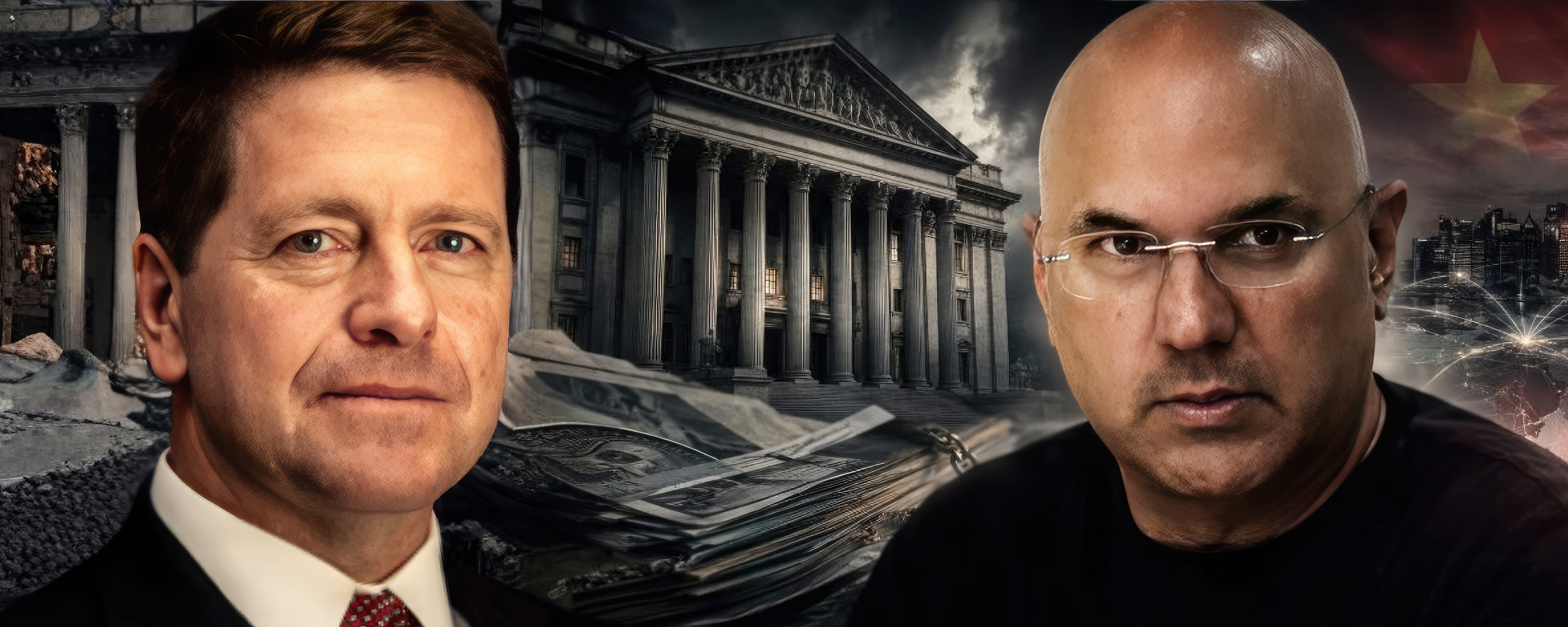
Imagine you are standing beside a wide, fast river, watching debris rush past. Branches, leaves, a child’s lost ball. You could spend a lifetime cataloguing the objects on the surface and never understand the river, because the river is not explained by what floats on it. It is explained by its source, the high ground where the water first gathers and begins to move. Most of our political commentary is the cataloguing of debris. We argue about a particular protest, a particular slogan, a particular encampment outside a particular data center, and we never walk upstream. This week, a federal grand jury in Manhattan started walking upstream.
The news, first reported by Fox News and since confirmed through multiple sources inside the Justice Department, is this. Jay Clayton, the United States Attorney for the Southern District of New York, has convened a grand jury to investigate Neville Roy Singham, the American-born tech tycoon who sold ThoughtWorks in 2017 and decamped to Shanghai. Prosecutors have issued subpoenas for bank records and financial documents. The theories under examination are money laundering, bank fraud, and wire fraud, the ordinary statutory tools the government reaches for when very large sums move through very opaque channels. I want to be precise here, because precision is the whole point. A grand jury investigation is an investigative step. It is not a charge, not a conviction, and not a finding of guilt. It is the moment the river-watcher decides to climb toward the source.
What sits at that source is not in dispute, and this is what too many commentators miss. You do not need the grand jury to tell you where hundreds of millions of dollars went, because the money left a paper trail in the most boring place imaginable, on Internal Revenue Service filings. Consider the 2017 Form 990-PF of an entity called the People’s Support Foundation. Its own Schedule B reports a contribution of $160,200,000 from a limited liability company named Mutod, registered to a suite on East Monroe Street in Chicago, and a further $3,500,000 from Likewise Conceptions, registered to a suite on a road in Crystal Lake, Illinois. These are not the allegations of an anonymous source. They are the foundation’s sworn disclosures to the federal government. Layer in the donor-advised fund channel at Goldman Sachs, through which tens of millions more flowed into a sister entity called the Justice and Education Fund, and the reporting that roughly $278 million entered the American nonprofit system through three channels stops looking like a conspiracy theory and starts looking like an accounting summary.
Here a careful reader will raise the obvious objection. Money is not meaning. So what if a wealthy man funded nonprofits? The political left funds nonprofits, the political right funds nonprofits, this is what civil society looks like. The objection is fair, and it deserves a real answer rather than a sneer. The answer has three parts.
The first part is the architecture itself. Honest philanthropy does not generally require a $160,200,000 transfer from a limited liability company with a mailbox address, routed into a private foundation, and then distributed onward to 501(c)(4) affiliates that are not required to disclose their donors. The New York Times, hardly a Republican publication, spent a year tracing this network and reported in 2023 that American nonprofits linked to Singham had received at least $275 million, frequently through entities that used UPS-store style mailing addresses in Illinois, Wisconsin, and New York. Over the past three years hundreds of millions more have been funneled through these entities. When a structure is built to make tracing difficult, the difficulty is not an accident. It is a design specification.
The second part is the overlap of the people. This is not a diffuse cloud of unrelated charities. The same handful of names recur as officers and directors across the network. Jodie Evans, the co-founder of CodePink, appears as president of the People’s Support Foundation and just happens to be married to Singham. Manolo De Los Santos directs the Justice and Education Fund and runs The People’s Forum in Manhattan. Vijay Prashad sits atop Tricontinental. When the same small circle controls the foundation that receives the money, the funds that move the money, and the media projects that spend the money, we are no longer looking at a coincidence of philanthropy. We are looking at an organization.
The third part, and the decisive one, is what the principals say in their own voices. We are not required to guess at intent when the men in question announce it. Singham has publicly endorsed the new world order advanced by Xi Jinping and the Chinese Communist Party, and has characterized the United States in the harshest possible terms. The Times reported that his organizations shared office space in Shanghai with a firm that worked to promote China’s image abroad, and that Chinese state media amplified accounts in his network hundreds of times in a span of months. You do not need a wiretap to establish alignment when alignment is published. This is the part of the thesis that is strongest, because it rests on the network’s own words and the public record, not on inference.
Now we can return to the river. The harder claim, the one that makes people uncomfortable, is that the visible debris of American protest, the anti-capitalist marches, the ANTIFA street actions, the campaigns against nuclear power, against data centers, against artificial intelligence, against the basic project of American energy abundance, traces upstream to this source. Let me be honest about the logic, because honesty is more persuasive than overreach. No one has produced a memo in which Beijing orders a specific protest. What the public record does establish is something subtler and, frankly, more durable. Seed money is catalytic. A foundation capitalized at $160 million does not need to direct every downstream action. It funds the infrastructure, the staff, the venues, the media shops, the training, and that infrastructure then raises further money from foreign actors and from sincere, unwitting progressives who have no idea whose river they are swimming in. The Chinese Communist Party does not need a remote control. It needs a watershed, and it appears to have built one.
Consider the strategic logic from Beijing’s point of view, because it is not subtle. What would a rival superpower most want to slow? It would want to slow the things that compound American advantage. Cheap and reliable energy. The data centers that house the computation underlying the economy. The artificial intelligence systems that will define the next several decades of military and economic power. It is a remarkable fact, worth sitting with, that a network funded from Shanghai should be so reliably present at the precise pressure points where American development can be delayed by manufactured outrage. Correlation is not proof. But when the correlation lines up this perfectly with an adversary’s declared interests, the burden shifts to those who insist it is all a coincidence.
This is the context in which President Trump’s recent remarks should be read, because the commentariat dismissed them as hyperbole when they were actually a matter of definition. Asked about the rising tide of democratic socialism, the President said, “I think it’s a big threat to our nation actually.” He went on, “They use the word social democrat because it sounds so nice, but it’s really communism you’re talking about.” Then came the line that drew gasps. “I think it’s the biggest threat to our nation there is, maybe since our founding. That includes World War I, World War II, September 11th. It includes the Pearl Harbor attack.” He added, “People will smile when I say that, but the smart people are going to say, you know, he’s probably right. There’s never been anything so dangerous.”
The reflexive reaction was to call this unhinged. The careful reaction is to ask whether the President was making a category error or correcting one. A metaphysician spends his life on a single unglamorous discipline, calling things by their right names, because confusion about what a thing is produces confusion about everything that follows. The genius of the softer label is precisely that it sounds so nice. Social democracy evokes Scandinavian bicycles and tidy welfare states. It is a fine anesthetic. And under the anesthetic, a funding network aligned with an openly authoritarian Communist party pours money into American civil society and calls the result activism. Trump’s claim is not that your neighbor who likes public transit is a Leninist. His claim is that the organized, foreign-financed vanguard at the top of this movement espouses something it is careful never to name. On the evidence of the network’s own writings and its own funders’ own words, that claim is not paranoid. It is a description.
So what should a citizen do with all this? Not panic, and not pretend. The grand jury will do its work, and the presumption of innocence is not a courtesy we extend only to people we like. Singham may be charged, or he may not. But the investigation is not the story. The story is the watershed that the investigation has finally forced into daylight, the architecture of money, the recurrence of the same names, and the published allegiance to a rival power. We spent a decade arguing about the debris. The water was always coming from somewhere. It is long past time we walked upstream.
If you enjoy my work, please subscribe https://x.com/amuse/creator-subscriptions/subscribe
Alexander Muse is a Fellow at the John Milton Freedom Foundation and publishes daily political analysis at amuseonx.com. Primary sources cited in this piece are linked inline; campaign finance figures are drawn from FEC filings, polling data from publicly released crosstabs, and legal claims from filed pleadings. Corrections are posted to the original URL with a dated changelog. Readers who identify errors are invited to contact the author directly. Data in sponsored partnership with Polymarket.
Trump was right to call communism a serious national threat. The modern version does not always arrive with a red flag and a manifesto. It arrives through nonprofits, donor-advised funds, protest training, media projects, campus networks, lawfare, and slogans engineered to sound humane while weakening American power. Beijing does not need to order every march if a funded ecosystem already attacks the pressure points China wants weakened: energy, data centers, AI, police, borders, industry, and national confidence. Follow the money. Name the networks. Protect civil liberties. But stop pretending foreign-aligned activism is just neighborhood idealism with better graphics.
As usual, Alexander is doing the hard work journalists have neither the time nor the inclination to do.