


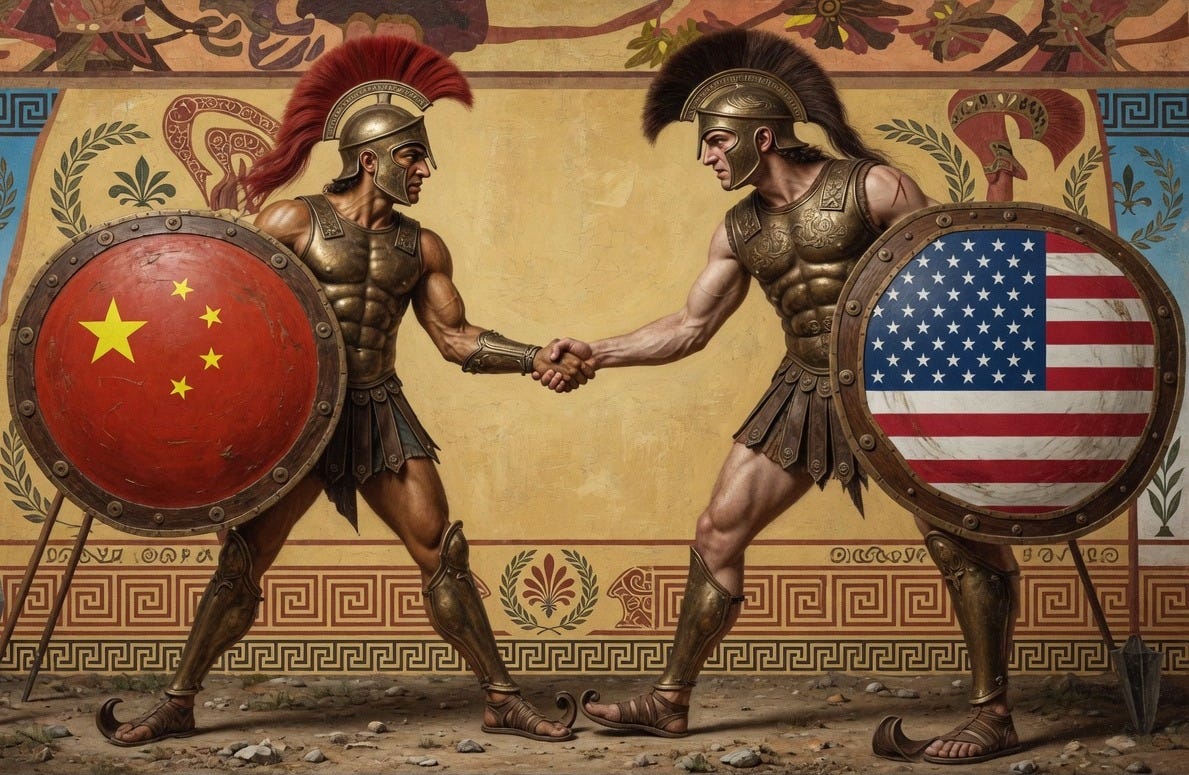
There is a particular kind of intellectual fraud that flourishes only when no one with the relevant expertise is paying attention. The “Thucydides Trap,” a phrase invented by Harvard political scientist Graham Allison and elevated since 2015 to the status of a scientific law of international relations, is exactly that sort of fraud. Earlier this week, Victor Davis Hanson, the classicist who edited the standard scholarly English edition of Thucydides used in American universities, The Landmark Thucydides, finally said the quiet thing loudly. “There is no Thucydides Trap. If there were, it would not apply to us. If it did apply to us, we would not start a war. The entire notion that Premier Xi suggested is bankrupt.”
Three sentences. The mainstream international relations field will not recover from them, and it should not.
To understand why Hanson’s intervention matters, consider the scene that prompted it. On May 14, 2026, Xi Jinping sat across from President Donald Trump in Beijing and invoked the Thucydides Trap. A Communist autocrat, sitting atop a one-party police state, cited a Harvard political scientist to lecture an American president on a Greek text written by a man Xi has almost certainly never read in the original. The premier of a regime that censors its own historians reached for the authority of the Greeks to instruct the leader of the free world about the dangers of confronting authoritarian power. The inversion is so total that it borders on satire, and yet the press dutifully reported it as wisdom.
The reader will reasonably ask: why would Xi do this? Why would the head of state of a rising, or formerly rising, China reach for an obscure academic framework to explain his position to an American president? The answer is the entire argument of this essay. Xi reached for Allison because Allison’s thesis serves Beijing’s purposes. It is, and has always been, propaganda disguised as scholarship, and its function is to teach Americans to accept their own decline as a structural inevitability rather than a policy choice.
Allison’s argument, simplified, is this. In 12 of 16 historical cases over the past 500 years in which a rising power threatened to displace an established power, war resulted. The pattern, he says, traces back to Thucydides, who wrote that “it was the rise of Athens and the fear that this instilled in Sparta that made war inevitable.” Therefore, the United States and China are now caught in the same trap, and the policy implication, conveyed with maximum solemnity, is that Washington must learn to “manage” Beijing’s rise rather than resist it.
Hanson, who knows the actual Thucydides rather than the bumper-sticker version, dismantled the framework on the Daily Signal and again on Fox News. The trouble begins at the source. Athens did not become ascendant in 431 B.C. Athens had been ascendant for half a century, having led the Greek defense against Persia at Marathon in 490 B.C., Salamis in 480 B.C., and Plataea in 479 B.C. The Peloponnesian War was not the product of a sudden Athenian rise. It was the product of decades of bad Athenian decisions, the rejection of the Thirty Years’ Peace, the Megarian Decree, and finally the catastrophic Sicilian Expedition. Athens lost not because she was rising, but because she overreached. The actual lesson of Thucydides is the precise opposite of Allison’s lesson. Catastrophe does not come from structural inevitability. It comes from human folly.
The reader may pause here and ask, fairly, whether this is a quibble about ancient history with no bearing on contemporary policy. It is not. The deeper problem is that Allison’s 16-case dataset is methodologically threadbare, mixing wildly heterogeneous conflicts across five centuries and selecting cases to fit a predetermined pattern. As Richard Hanania documented in Strategic Studies Quarterly, the dataset collapses on inspection. The historical analogy is bad, the historical data is worse, and the political conclusion was the point from the beginning.
Consider what the framework asks Americans to believe in May 2026, and then consider the facts on the ground. Trump arrived in Beijing accompanied by Elon Musk, Tim Cook, Larry Fink, and Boeing’s Kelly Ortberg, the visible cohort of American technological and industrial dominance. The economic mass he brought into the room is staggering. The International Monetary Fund’s April 2026 projections place US nominal GDP at $32.4 trillion against China’s $20.65 trillion, a US lead of roughly $11.2 trillion. As recently as 2021, Chinese GDP had reached approximately 75% of US output. That ratio has now fallen back to roughly 65% and is widening in America’s favor. The Wall Street Journal reported in December 2025 that China’s share of global GDP peaked in 2021 and has been shrinking since.
The energy picture is more decisive still. The US Energy Information Administration reported in May 2026 that total US energy production reached a record 107 quadrillion BTU in 2025, the fourth consecutive annual record. American crude oil production hit 13.6 million barrels per day, marketed natural gas reached 118.5 billion cubic feet per day, and total oil and liquid fuels production stands at roughly 24 million barrels per day, more than Russia and Saudi Arabia combined. China, meanwhile, imports more than 70% of its crude oil, with roughly 38% of all Chinese oil imports transiting the Strait of Hormuz, a vulnerability the Heritage Foundation has correctly identified as catastrophic in any Pacific contingency. China imports 84% of its soybeans and roughly 31% of its edible oils, and its overall food self-sufficiency has fallen below the 80% threshold that international researchers use to classify a nation as food-deficit.
The demographic picture, more than any other variable, ends the China century narrative. China’s National Bureau of Statistics confirmed in January 2026 that the Chinese population fell for the fourth consecutive year, declining by 3.39 million to 1.4049 billion. Births dropped to 7.92 million, the lowest figure since 1949 and roughly comparable to the year 1738, when China’s total population stood at 150 million. Nicholas Eberstadt of the American Enterprise Institute, the closest thing the demographic profession has to a magisterial authority on China, called the 2025 birth crash “a demographic shock of the sort typically associated with dire calamities like famine or plague.” RAND Corporation projects that China will lose 250 million people by 2050, roughly three-quarters of the entire current US population. Eberstadt’s conclusion is worth quoting in full because of how reluctant a concession it represents. “Tomorrow’s impending demographic realities, already visible today, will require us to revisit the now-familiar ‘China’s rise’ narrative. Given the rapid aging and shrinking of the country’s population, by now inevitable, in the decades immediately ahead, this may not turn out to be the ‘Chinese century’, after all.”
Add to this the technology layer. NVIDIA, headquartered in Santa Clara, holds approximately 85% of the global AI chip market and roughly 92% of the discrete GPU market. Its data center revenue reached $193.7 billion in fiscal 2025, up 68% year over year, and $215.9 billion in fiscal 2026. The most advanced AI chips on earth are now being manufactured in Arizona, a fact CEO Jensen Huang has publicly attributed to the Trump administration’s manufacturing push. Apple alone has committed $600 billion to US manufacturing over four years, its largest such commitment in company history. The ISM Manufacturing PMI hit a multi-year high of 52.7 in March 2026, while Chinese investment plunged by roughly 8% in April 2026, year over year, per Goldman Sachs and Capital Economics estimates. Lingling Wei, the Wall Street Journal’s chief China correspondent and no friend of the conservative project, stated flatly in January 2026 that China’s investment-led growth model “is broken.”
Look at this constellation of facts and then ask yourself the question Allison’s framework asks. Which of these two men in Beijing on May 14, 2026, was the rising power, and which was the peaking power? The answer is so obvious that one wonders how the inversion was ever sustained. Hanson supplied the answer on Laura Ingraham’s program two days after the summit. “All the data show that the cards are in Donald Trump’s hands. He can be magnanimous as he wants, but he has all the cards in his hand, and they don’t have any.”
This is the moment the Allison framework dies, and it deserves to die. The serious academic literature has already migrated. Hal Brands and Michael Beckley’s Danger Zone, published by Norton in 2022, articulates what is now the converging view among the most rigorous students of Chinese power. The danger is not American strength. The danger is Chinese fear that the American window of relative decline has slammed shut. Peaking powers, demographically collapsing and economically stagnating, are historically the dangerous ones. The Stimson Center, hardly a redoubt of conservative hawkishness, concluded in November 2025 that “the greatest sources of deterrence against a Taiwan contingency may not come from Washington, but from within China itself.”
The right historical analogy is not Athens and Sparta. It is Reagan and the Soviet Union. In January 1977, Ronald Reagan told his future National Security Adviser Richard V. Allen the entire Cold War strategy in a single sentence. “Dick, my idea of American policy toward the Soviet Union is simple, and some would say simplistic. It is this: we win and they lose. What do you think of that?” The foreign policy establishment, including Henry Kissinger himself, regarded this as recklessness. Eleven years later, the Berlin Wall fell. Within a few years after that, the Soviet Union no longer existed. The established power won decisively without firing a shot, and the rising-power-versus-established-power framework failed completely to predict the outcome. Robert Lighthizer made the same point in his 60 Minutes interview last year. “China to me is an existential threat to the United States. Around $1 trillion a year of wealth from the United States is being transferred to a geopolitical adversary. It’s insane. And it’s working.”
Why, then, did Xi quote Allison? Because the Allison framework is the single most useful piece of intellectual property the Chinese Communist Party has acquired from the American academy in the past quarter century. It tells Americans that confrontation is reckless, that managed decline is wisdom, and that the only mature response to Chinese ambition is accommodation. A fading boxer wants the referee to call the fight on a technical decision. Xi cited Allison because Beijing needs Americans to believe in the trap. The moment we stop believing, the leverage shifts permanently, and Xi’s confession at the summit, dressed in the language of warning, was the tell.
The American intellectual class has spent a decade teaching Americans to accept a future that the data never supported. Hanson, in three sentences, ended the spell. The Thucydides Trap was never history. It was a political narrative, and its purpose was American retirement. The retirement has been canceled.
If you enjoy my work, please subscribe https://x.com/amuse/creator-subscriptions/subscribe
Alexander Muse is a Fellow at the John Milton Freedom Foundation and publishes daily political analysis at amuseonx.com. Primary sources cited in this piece are linked inline; campaign finance figures are drawn from FEC filings, polling data from publicly released crosstabs, and legal claims from filed pleadings. Corrections are posted to the original URL with a dated changelog. Readers who identify errors are invited to contact the author directly.
“Consider what the framework asks Americans to believe in May 2026, and then consider the facts on the ground. Trump arrived in Beijing accompanied by Elon Musk, Tim Cook, Larry Fink, and Boeing’s Kelly Ortberg, the visible cohort of American technological and industrial dominance. The economic mass he brought into the room is staggering. “
Joe Biden on the other hand arrived in China accompanied by his dopey son Hunter. Let that settle in.
Xi invoked the “Thucydides Trap” because Beijing needs Americans to believe in it. That is the tell. If the U.S. accepts the frame, China wins without firing a shot: we manage decline, tolerate Taiwan pressure, accept industrial surrender, and call cowardice “stability.” Trump rejected the script by showing up with the cards: energy dominance, manufacturing revival, AI chips, Boeing, Apple, NVIDIA, food leverage, oil leverage, and a widening GDP advantage. Western liberals heard Greek history. Xi was running influence ops. Hanson called it bankrupt. Good. The trap was never Thucydides. The trap was believing CCP propaganda.