



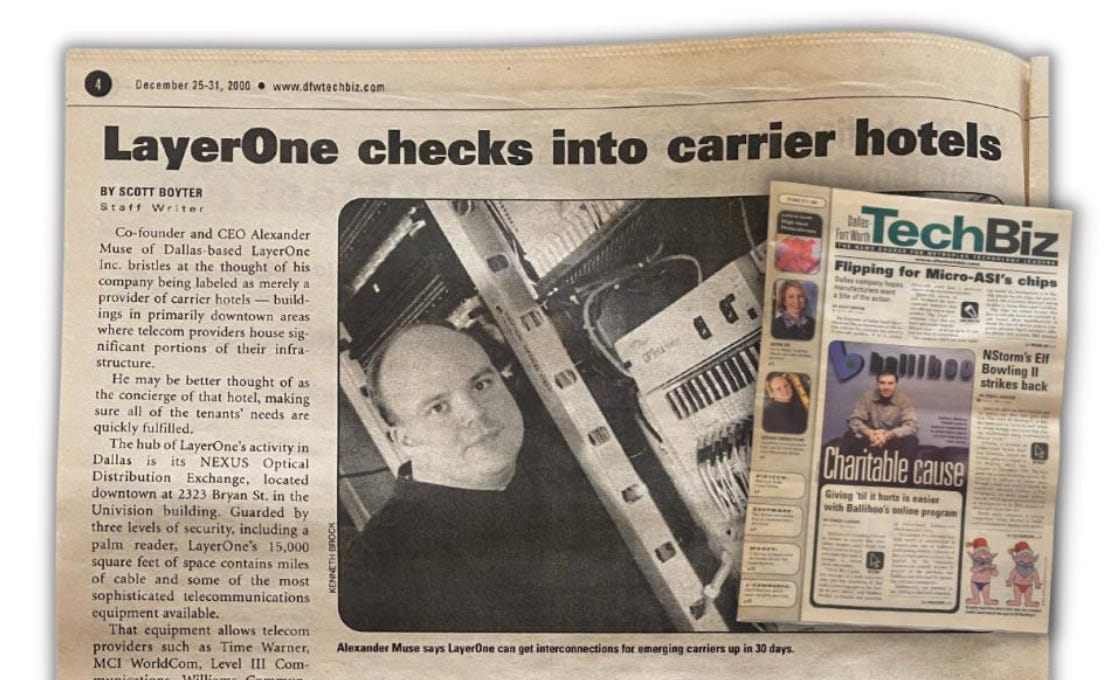
In the late 1990s, before the term 'Ai' meant anything to anyone, I built a network of data centers. We lit up floors in New York and Los Angeles, in St. Louis and Chicago, in Dallas and Miami. They hummed with the servers that carried the first great wave of the commercial internet. And not one of them consumed a single drop of water to keep those servers cool. Not a gallon. We rejected heat the way a car rejects heat, with air and with glycol circulating in a sealed loop, the warmth carried out to the rooftop and handed off to the sky. The water bill for cooling was zero, because there was no water in the cooling.
I tell you this not for nostalgia but because it settles an argument that has lately been dressed up as a crisis. You have read the headlines. The data centers are coming, the story goes, and they will drink your rivers dry. The artificial intelligence boom will guzzle the reservoirs while families are told to let their lawns go brown. It is a vivid picture. It is also, in its central premise, false. And I can say so with confidence because I solved this supposed crisis a quarter century ago, on a budget, with technology that was not even new then.
Here is the first thing to understand, and everything else follows from it. A data center is a heat machine. Servers take in electricity and convert nearly all of it into heat, and that heat has to go somewhere. Cooling, properly understood, is simply the removal of heat. Now, you can move heat with water, by letting it evaporate and carry the warmth away, which is what a cooling tower does and what your own skin does when you sweat. Or you can move heat with air and refrigerant and a closed loop of glycol, dumping it straight into the atmosphere with no evaporation at all. Water and air are two interchangeable media for the same job. Water is not a fuel the machine burns. It is one of two tools, and the other tool uses none of it.
This means that water consumption in a data center is a design choice. It is not a law of physics, not an unavoidable cost of computation, not a debt that civilization owes the watershed in exchange for email. It is a knob, and the operator decides where to set it. Microsoft’s own engineers measure this with a metric called Water Usage Effectiveness, and the industry’s stated ideal for that number is 0.0, achievable by any facility that rejects its heat through air rather than evaporation. Zero is not a fantasy on a whiteboard. Zero is what I ran in six American cities while Bill Clinton was still in office.
Why, then, would anyone choose to use water at all? Because the knob has two sides, and engineers are not fools. Evaporative cooling is more efficient with electricity. When you let water carry the heat away, you spend less power running chillers and fans. So if you build in a place where water is cheap and plentiful and electricity is expensive, turning the knob toward water lowers your power bill and your strain on the grid. If you build in a desert, where water is precious and the sun is free, you turn the knob the other way, toward air, and you pay a little more for electricity instead. This is the entire debate, stated honestly. As the economist Thomas Sowell put it, and the line governs this whole subject, “There are no solutions. There are only trade-offs.” Water buys cheaper power. Air buys dry operation. A grown-up picks the setting that fits the place.
And the price of choosing air, of going completely waterless, turns out to be remarkably small. We have a clean measurement of it. In Nevada, a single operator ran two comparable facilities side by side, one leaning on evaporation and one running essentially dry. The waterless building’s total overhead power ran only 6.4% to 10.2% higher across the year. Microsoft, which in August 2024 mandated zero-water cooling for every new data center it builds, calls the added energy cost of eliminating water “nominal,” and drove its own water metric down from 0.49 to 0.30 in three years while doing it. The company chose to pilot this design in Phoenix, in the Arizona desert, the single hardest place on the continent to make the case, the very spot critics held up as proof that data centers must guzzle water. Each such facility avoids more than 125 million liters a year. The place that was supposed to prove water cooling is mandatory became the showcase for proving it is optional. The crisis, in other words, has an off switch, and the largest operator on earth is flipping it across its entire fleet.
So much for the claim that data centers must use water. Now consider the louder claim, that the water they do use makes them gluttons draining the nation dry. This is where the panic depends entirely on hiding a number from you, the only number that matters, which is the denominator.
All the data centers in the United States together consumed roughly 17.4 billion gallons of water directly in 2023. That sounds enormous until you set it beside the national total. America uses about 322 billion gallons of water every single day. Run the division and the entire data center industry accounts for about 0.015% of national water use, fifteen thousandths of one percent. Every alarmist headline you have read survives only by quoting the big absolute number and omitting the total it sits inside. Anyone who shows you “billions of gallons” without showing you the national figure is either innumerate or counting on yours.
The honest comparisons are devastating. American irrigation uses 118 billion gallons a day. Thermoelectric power plants use 133 billion gallons a day. Watering residential lawns consumes nearly 8 billion gallons a day, which is to say American grass drinks well over a hundred times what the computers do. The country’s golf courses applied about 531 billion gallons in a single year, roughly thirty times the direct water of every data center combined. California’s almond orchards consume around 4.2 billion gallons a day, dozens of times the data center figure, so that we can have almond milk. Nobody is holding congressional hearings about fairways or nut groves. And consider what the water buys. By one widely circulated calculation, five gallons routed through a data center generates about $132 of economic output, against about two cents for the same five gallons sprinkled on almonds. One of those gallons underwrites American productivity, national security, and technological supremacy. The other waters a snack.
Then there is the viral centerpiece of the whole scare, the claim that a single question to an AI chatbot drinks a 500ml bottle of water. It is the most repeated figure in this debate and the most thoroughly false. It traces to a 2023 estimate built on an obsolete model and measured per long multi-page response rather than per query. OpenAI’s own disclosed figure is about 0.000085 gallons per query, roughly one fifteenth of a teaspoon. A single hamburger takes hundreds of gallons to produce. The bottle-of-water-per-question line is not a statistic. It is propaganda.
And that word is the right one, because the obvious question is why. If the engineering is solved, if the scale is trivial, if the marquee statistic is fabricated, why does this panic march on with such discipline and such funding? Ask who profits from a crippled American technology sector. We are in a race for artificial intelligence dominance, a race with the most direct consequences for military and economic power in the coming century, and our adversaries understand that they cannot win it at the server rack, so they would dearly love to win it in our zoning boards and our op-ed pages. The water scare is a weapon aimed at exactly that target. It is a foreign malign influence campaign, seeded to slow the construction of the infrastructure that keeps America ahead, and it is amplified, witlessly or willingly, by the environmental and anti-capitalist organizations that have spent decades looking for a reason to say no to growth. They were handed a reason. They did not check the denominator because they did not want to. The campaign tells Americans that their faucets are under threat by the machines that will define the future, and it is, root and branch, a lie.
The answer to a manufactured scarcity is not surrender. It is to build. Build the data centers, and build them with the cooling that fits the place, dry in the desert and efficient where water runs free. Build the power plants, the gas and the nuclear and the transmission, so that choosing air over water costs us nothing we cannot easily generate. And where a local system genuinely bears a new burden, make the wealthy company that caused it pay full freight for every pipe and every permit, which is simply how honest commerce works. None of that requires believing the lie. I built six waterless data centers when the technology was crude and the internet was young. The notion that we cannot do now, at will, what I did then is not an engineering claim. It is a story told by people who would rather America lose. Do not buy it.
If you enjoy my work, please subscribe https://x.com/amuse/creator-subscriptions/subscribe
Alexander Muse is a Fellow at the John Milton Freedom Foundation and publishes daily political analysis at amuseonx.com. Primary sources cited in this piece are linked inline; campaign finance figures are drawn from FEC filings, polling data from publicly released crosstabs, and legal claims from filed pleadings. Corrections are posted to the original URL with a dated changelog. Readers who identify errors are invited to contact the author directly.
Mr Muse, thanks for the down to earth brass tacks of heat transfer/removal. So refreshing to hear someone talking sense about a subject all people deal with daily without necessarily even realizing it.
Direct use was 17.4 billion gallons in 2023. You left out the much larger amount of water used to generate the electricity that powers data centers.
And the concern is with thirsty hyperscale data centers being built in areas that already face periodic drought or rapid population growth - like parts of the Southwest, Texas, Virginia, Georgia, and North Carolina.