


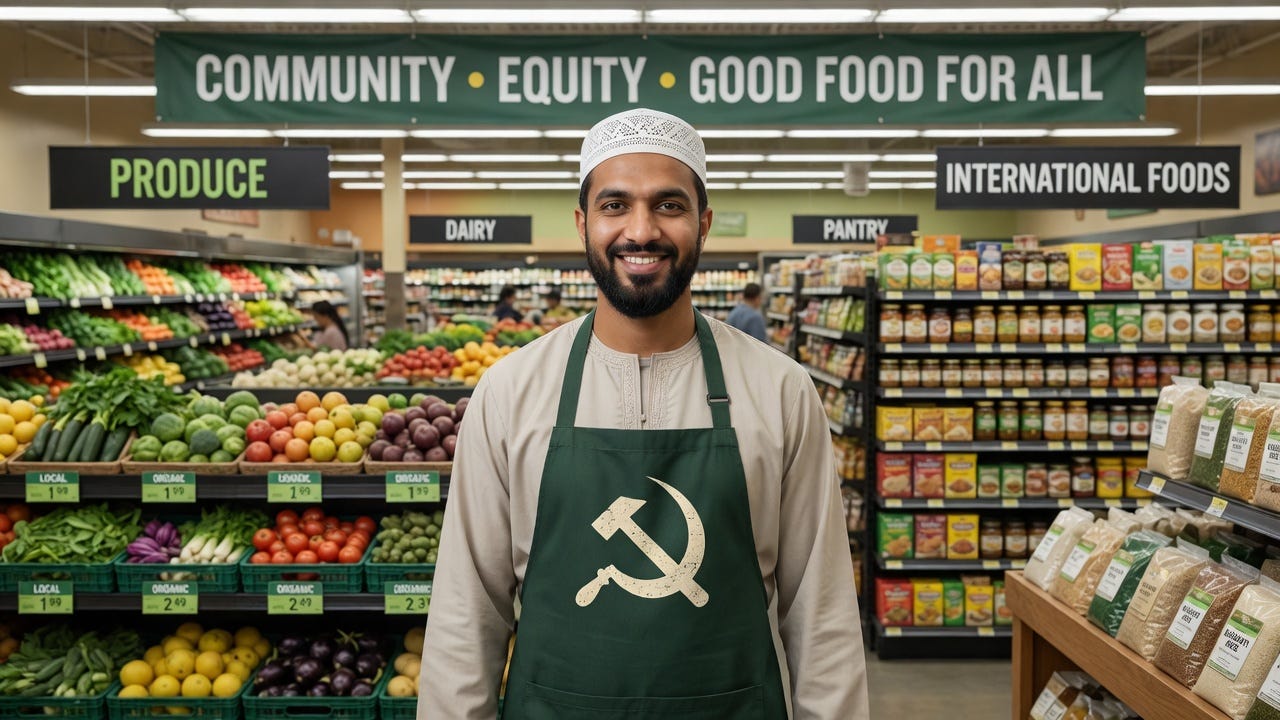
Consider a model home. A builder puts up 200 houses in a new subdivision and finishes exactly one of them to perfection, with good countertops, landscaping, furniture staged by a professional, and lightbulbs all matching. Nothing about that house is fake. You can walk through it, open the cabinets, stand in the shower. The deception, if there is one, lies entirely in the inference the builder wants you to draw, namely that the other 199 houses will be like this one. The model home is real and unrepresentative at the same time, and those two properties are not in tension. They are the whole point.
New York City is building five model homes and calling them grocery stores. Conservatives should understand this before the ribbon is cut, because most of us are preparing to fight the wrong battle. The standard right-of-center prediction is that municipal groceries will produce surly clerks, bare shelves, rotting produce, and a quiet bankruptcy two years in. That prediction is reasonable if you look at Baldwin, Florida, which absorbed its town grocery in 2019 and gave up in 2024, or at Kansas City, which spent roughly $17 million on Sun Fresh Market and watched it close in August of 2025 after stretches of empty shelving and security problems. Those cases are instructive. They are also, I think, about to become a trap.
David Friedberg said as much on the All-In Podcast, and the remark deserves more attention than it received. His warning was that the stores would not fail in the visible way conservatives expect, and would instead “create an incredible success story for socialism,” complete with flattering coverage, contented employees, and demands that other cities copy the model. He was right, and the reason he was right is written into the city’s own procurement documents. New York has studied the American failure cases and designed around every one of them.
Start with who runs the stores. The July 2026 operator request for proposals does not contemplate a municipal department learning to buy lettuce. It solicits experienced private grocers with urban track records, existing wholesale relationships, functioning logistics, merchandising systems, and back-office infrastructure, and it gives preference to bidders willing to take all five locations at once. The city supplies capital, real estate, and political cover. The private operator supplies competence. This is not socialism in the textbook sense, where the state seizes the means of production and then discovers it cannot run them. It is something cleverer. Execution is privatized, losses are socialized, and credit is monopolized.
Then look at what the operator does not have to pay. The city funds construction. The operator pays no rent. The operator pays no property taxes. Where discounted prices generate an operating deficit, the city covers it through what the RFP calls affordability payments, and additional performance payments may be available for hitting targets on customer satisfaction, employee retention, merchandising, and stocking levels. Rent, taxes, capital, and losses are the four horsemen that kill grocery stores. New York has shot all four before the doors open.
The discount itself is engineered with equal care. The advertised 30% reduction applies not to everything but to a defined Core Basket, all fresh produce, meat, and seafood, plus roughly 20 categories of staples like eggs, dairy, bread, beans, oil, and cereal. Everything outside that basket can be priced at ordinary New York retail. The city projects that the average shopper’s total bill falls about 15%, something on the order of $90 a month, or $1,000 a year. So the headline number is 30%, the experienced number is 15%, and the difference is quietly financed by normally priced goods that customers buy on the same trip. That is a loss leader strategy, which private grocers use constantly. The novelty here is that the loss is underwritten by taxpayers rather than by the rest of the store.
Now the arithmetic that ought to end the debate but won’t. Food retailing runs on margins that would embarrass a lemonade stand. The Food Industry Association put average food retailer profit margins at 2.1% in 2025. NYU Stern’s January 2026 dataset put grocery net margins at 1.32%, and lease-adjusted after-tax margins at 1.50%. Gross margin across the industry was 26.31%. Read those figures against a 30% discount, and the conclusion is unavoidable. Eliminating private profit entirely, confiscating every dollar the greedy supermarket owner takes home, would lower your grocery bill by something like 1% or 2%. The Core Basket discount is roughly 20 times that, and it exceeds the industry’s entire gross margin. Ryan Bourne and Nathan Miller at Cato reached the same place by the same route. The money does not come from squeezing profiteers, because there is not enough profit there to squeeze. It comes from you.
Here a puzzled reader might object that this is precisely why the program will collapse. If the economics are that bad, surely the bill comes due. But this is where the scale of New York changes everything. The adopted fiscal year 2027 city budget is $125.8 billion. The mayor has committed $70 million in capital for the five stores, which is 0.0556% of a single year’s budget, about five and a half basis points. Suppose each store loses $10 million a year, a generous assumption for a 15,000-square-foot location. That is $50 million annually, under 4 basis points. Scale to 20 stores losing $10 million each and you reach $200 million, still less than a quarter of 1%. A private chain treats a $50 million loss as an extinction event. A political movement can treat the identical number as a media buy.
That is the sentence conservatives need to internalize. The loss is not the failure. The loss is the advertising budget.
And New York is buying the advertising too. Before it selected a grocery operator, the city procured a design firm to build the brand, covering visual identity, signage, private label, store architecture, and customer experience, with the mayor explaining that the goal was to bring “public excellence” to life. The operator RFP then requires multi-channel marketing, coordinated press engagement, citywide campaigns, public price comparisons against private competitors, message alignment with the city, and limited-edition merchandise to build brand affinity. Set aside the groceries for a moment and notice what is actually being purchased here. A recognizable government brand. A permanent association between that brand and low prices. A physical set where a television crew can film a mother saying she saved $90. And a constituency of shoppers, employees, unions, and suppliers with a personal stake in defending the program.
None of that requires anyone to lie. The savings will be real, the shelves will be full, the cashier’s health insurance will be real, and the store will very likely be beautiful. What is false is the inference, and only the inference. The city’s own RFP states that the program “will prove that government can make healthy food more affordable” and serve as a model for future public programs. That is not a conservative accusation about motive. That is the city announcing, in a procurement document, that it is running a demonstration.
History is unkind to those who mistake demonstrations for evidence. Mao’s Dazhai was celebrated as proof that collectivism and revolutionary spirit could transform Chinese agriculture, and roughly 20,000 pilgrims a day passed through it in the early 1970s while other regions were ordered to copy its methods regardless of soil or terrain. After the model was discredited in 1980, it emerged that Dazhai had recieved extensive help from the People’s Liberation Army and had used heavy machinery all along, which the propaganda had simply deleted from the story so that the achievement could be attributed to ideology instead of to the tractors. Soviet Intourist did something gentler and more effective, curating routes and factories and apartments and cheerful citizens for foreign visitors, showing them nothing fabricated and everything selected. Chávez’s Mercal network really did sell food 25% to 40% below market to a third of Venezuela’s population, funded by roughly $24 million a month in oil revenue, and the later CLAP boxes were candid enough that the administrator told Reuters they had “helped us stop a social explosion and enabled us to win elections and to keep winning them.” The pattern in each case is identical. Concentrate resources on a visible site, shield it from ordinary constraints, curate what the observer sees, display the output while hiding the input, and generalize the exception into a law.
So what should the right actually do? Not predict a fiasco. If we spend two years insisting the shelves will empty and New Yorkers walk into a clean store with cheap chicken and a friendly cashier, we will have handed the other side its argument and forfeited ours. The correct posture is not prophecy but accounting. Demand, now, before the first store opens, an audited store-level profit and loss statement, capital depreciation charged against operations, imputed market rent and property tax, total subsidy per transaction, taxpayer dollars spent per $1 of customer savings, central marketing and administrative costs, stockout rates and purchase restrictions, and a count of the bodegas and independent grocers that open or close within a mile. The published performance metrics measure sales, satisfaction, and stocking. They do not measure what each shopping trip costs the public.
Everything turns on one distinction, and it is worth stating plainly. A taxpayer-funded store can sell groceries cheaply. That does not show it can produce groceries cheaply. The first is a transfer, the second is efficiency, and the entire political argument depends on the public confusing them. Five stores out of more than 1,100 grocers and some 10,000 bodegas is less than half of 1% of the city’s food retail. It is not a system. It is a showroom, and the model home is always the nicest house on the street.
If you enjoy my work, please subscribe https://x.com/amuse/creator-subscriptions/subscribe
Alexander Muse is a Fellow at the John Milton Freedom Foundation and publishes daily political analysis at amuseonx.com. Primary sources cited in this piece are linked inline; campaign finance figures are drawn from FEC filings, polling data from publicly released crosstabs, and legal claims from filed pleadings. Corrections are posted to the original URL with a dated changelog. Readers who identify errors are invited to contact the author directly. Each op-ed edited for grammar and clarity using Ai in a sponsored partnership with Grammarly. Data provided in a sponsored partnership with Polymarket.
Rolling out the old "Potemkin" village ruse, are they? LOL.
For those in Yorba Linda, look it up.
The scheme doesn’t have to last forever; just through a few election cycles.
One may hope the Rs are smart enough to play this correctly.