


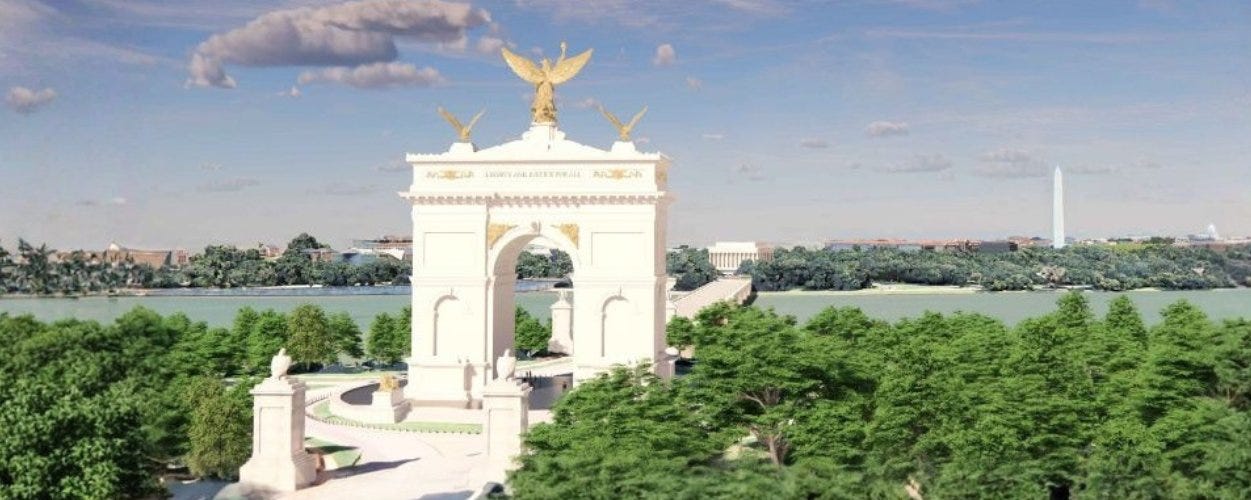
On July 9, the National Capital Planning Commission took up File 8778, a submission from the US Department of the Interior with an unadorned name: New Monumental Arch. The project would place a 250-foot triumphal arch in Memorial Circle on Columbia Island, at the western terminus of Arlington Memorial Bridge. The commission’s staff did not recommend rejection. Staff recommended approval of preliminary site and building plans while asking the applicant to justify the proposed height in light of a 1910 statute called the Height of Buildings Act. That request sounds modest. It conceals one of the more interesting questions in American public law, namely, who decides how tall the federal government may build on its own land in its own capital?
The opposition’s answer is a syllogism. The Height Act caps buildings on most Washington business streets at 130 feet, the arch would rise 250 feet, therefore the arch is unlawful. Congressional Democrats, preservation activists, and former planning officials have all pressed some version of this argument, and they present it as though the conclusion were obvious. I want to suggest that the syllogism fails at its first premise, and that the commission’s willingness to revisit an old assumption is not lawlessness but fidelity to the statutes Congress actually wrote. The fight over the arch is not really about stone, steel, or sculpture. It is about whether a local height rule written for ordinary buildings can be converted into a permanent ceiling on federal architecture, enforced not by Congress but by the inertia of administrative habit.
Begin with what the Height Act says. The 1910 law provides that no building in the District of Columbia may exceed the width of the street it fronts plus 20 feet, with a general cap of 130 feet on business streets and 90 feet on residential streets. Now consider what it does not say. The statute nowhere mentions the United States, federal agencies, federal public buildings, monuments, or commemorative works. That silence might seem like a technicality. It is not, and a simple analogy shows why. A city ordinance regulating fence heights speaks to homeowners; no one reads it to govern the radar tower on the military base at the edge of town, and not because the ordinance contains a base exemption, but because the ordinance was never addressed to the sovereign in the first place. A rule written for tenants does not need a landlord exemption.
Memorial Day, the Triumphal Arch, and the Veterans Suing to Block America's 250th Birthday Arch

On Memorial Day, the country pauses to honor the men who died in its uniform, and the men who came home and continued to serve the republic in quieter ways. It is a day for plain speech about loyalty, sacrifice, and the difference between the two. So it is worth being plain about the piece CBS News published this morning under the headline,
The Height Act’s enforcement machinery confirms the point. The statute declares offending buildings to be common nuisances and authorizes proceedings in DC Superior Court, fines of $10 to $100 per day, abatement, injunction, and contempt. This is the grammar of local code enforcement against private owners. Picture the mechanism applied to the arch: a daily nuisance fine served on the Secretary of the Interior, an abatement order directed at the National Park Service, a local court supervising the demolition of a national monument. Congress does not subject the United States to that kind of process by implication. The Supreme Court said as much in Hancock v. Train, holding that state permit requirements do not bind federal installations absent a clear and unambiguous congressional declaration, and it repeated the principle in the companion water-pollution case decided the same term. Lower courts have applied the same logic to local nuisance ordinances, as the Justice Department recounted in its St. Paul litigation, where HUD was held immune from a city nuisance regime that would have dragged federal housing operations through local repair, permit, bond, and demolition procedures. The clear-statement rule is not a loophole. It is a structural principle of federalism, and conservatives who spent decades defending it against ambitious state regulators should recognize it here.
A skeptic will now ask the natural question. If the Height Act does not govern federal buildings, does anything? The answer is yes, and this is the part of the argument the arch’s opponents consistently omit. Congress did not leave a vacuum; it built a separate scheme. DC’s own zoning law states that the zoning subchapter shall not apply to federal public buildings, and it makes the height, bulk, number of stories, size, and open space of federal public buildings subject to the approval of the National Capital Planning Commission. The federal NCPC statute mirrors this structure, designating NCPC as the central federal planning agency and preserving its approval authority over federal building height while excluding federal public buildings from the 1938 zoning act. In other words, the question of how tall a federal monument may rise was assigned by Congress to a specific federal body applying federal planning law. The commission is not abolishing height review. It is locating height review where Congress put it.
This distinction matters because it reframes what NCPC did in July. The commission did not announce that the arch is exempt from scrutiny. It treated the arch as a federal planning question rather than a local zoning violation, which is precisely the posture the statutes contemplate. The Interior Department’s legal memo makes the textual case: the Height Act was codified and enforced as part of DC’s local building-height regime, and the general federal building statute requires federal projects merely to consider zoning laws, height limits, and aesthetics, while expressly barring fines and penalties against the federal government for noncompliance. Consideration is not subjugation. Congress knew the difference and chose its words.
The objections deserve answers, and each has one. First, opponents say NCPC has always applied the Height Act to federal projects, and it is true that the commission’s own published materials describe the Act as implemented through NCPC review for federal property. But long-standing practice cannot override statutory text, and after Loper Bright, courts decide the best reading of a statute independently rather than deferring to an agency’s accumulated habits. An agency that misread a statute for decades has been wrong for decades, not right by seniority. Second, opponents note that the 1910 law contains no federal exemption. As we have seen, none is needed if the law never reached federal projects at all. Third, opponents invoke the Commemorative Works Act and a 1912 law requiring express congressional authority for structures on federal reservations. Those are real statutes raising real questions, but they are seperate questions, and they must be answered on their own terms rather than smuggled into the Height Act debate. Notably, the Commemorative Works Act sets out detailed criteria on surroundings, open space, interference with existing commemorative works, and cultural resources, yet it nowhere imposes the Height Act as an independent cap, which tells you that when Congress wanted to constrain federal monuments it knew exactly how to do so and it did so through design review and authorization requirements, not through a borrowed local nuisance statute from 1910.
Fourth, and most sympathetically, opponents worry about sightlines, the Lincoln Memorial, Arlington National Cemetery, and the view from Arlington House. These concerns are legitimate, but they belong in the processes built to weigh them: Section 106 historic review, environmental assessment under NEPA, Commission of Fine Arts review, and NCPC’s own design judgment under the Commemorative Works Act criteria. A mechanical 130-foot veto is not preservation, it is the replacement of judgment with arithmetic. The Height Act itself never treated Washington’s skyline as an absolute plane. It permits spires, towers, domes, minarets, and pinnacles to exceed ordinary limits when approved, and the federal government has built above the general cap before, as Chairman Will Scharf noted in citing the National Archives at 166 feet. The capital’s most beloved silhouette, the 555-foot Washington Monument, would be flatly impossible under the reading the arch’s critics now advance as sacred tradition.
There is also a prudential belt to go with these suspenders. NCPC staff outlined an alternative composition that redistributes the height, a 130-foot main structure, a 20-foot observation level, and monumental statuary above, so the design can proceed even if a court someday insists on the traditional framework. The commission should preserve that path in the alternative while resting its approval on the sounder ground: the Height Act is a planning benchmark for federal work, not a binding cap on it.
Strip away the personalities and the question becomes clean. The issue is not whether President Trump deserves an exception, and framing it that way flatters the opposition’s weakest argument. The issue is whether a local statute written for private construction, enforced through local nuisance proceedings, silent about the federal government, and displaced by a federal planning scheme that Congress specifically created, can function as a permanent ceiling on what the American people may build to commemorate their own history. Washington’s founders platted a capital of deliberately extravagant scale, and every generation since has argued about whether the next monument was too much. The Washington Monument was mocked, then finished, then cherished. A great nation should not let its capital be governed by a small imagination, and it certainly should not let the question be settled by pretending that Congress never spoke. Congress did speak. It gave the job of judging federal projects to NCPC. The commission should do that job, in writing, with confidence, and let the courts read the statutes for themselves.
If you enjoy my work, please subscribe https://x.com/amuse/creator-subscriptions/subscribe
Alexander Muse is a Fellow at the John Milton Freedom Foundation and publishes daily political analysis at amuseonx.com. Primary sources cited in this piece are linked inline; campaign finance figures are drawn from FEC filings, polling data from publicly released crosstabs, and legal claims from filed pleadings. Corrections are posted to the original URL with a dated changelog. Readers who identify errors are invited to contact the author directly. Data in sponsored partnership with Polymarket.
The arch is 250 ft. tall to commemorate our 250th year.
Fireworks are nice but they are gone to ash in seconds. We should definitely have a grand, permanent monument to memorialize this occasion.
Build the arch ASAP.
Art is significant. The first thing invaders do when there is conquest, is to destroy the art, the monuments that stand to remind us of the great accomplishments made. Like Mao’s goal, the Cultural Revolution accomplished a reprogramming of the population by subtly removing anchors to past generations. President Trump understands this is an important opportunity for Americans to celebrate our past and the people who brought us to this point in time.