


Nvidia put Jensen Huang back in the chief executive’s chair twelve days after its board accepted his resignation. He faces three House committees on December 1st and the Senate Banking Committee on December 3rd. Congress is investigating Huang. Nobody in Congress is investigating the people who spent two weeks demanding his head, and somebody should, because a remarkable share of them were drawing a paycheck from the same place.
That place is the Tarbell Center for AI Journalism. Tarbell gives a small circle of philanthropies immense influence over which anti-AI, anti-data-center, and anti-Nvidia stories get reporting resources, which newsrooms can afford to pursue, and which audiences encounter. Its disclosure practices make that influence easy to see one institution at a time and nearly impossible to see across a single story. The Huang affair is the proof.
The Data Center Fear Factory and the Money That Quietly Runs It

A friend forwarded me an article last week that I have not been able to shake. It ran in the Dossier under the byline of Jordan Schachtel, and it carried a title that reads like a receipt: $7,600 Per Doomer Dispatch. The claim is not a metaphor. By the Tarbell Center’s own public accounting of its grants, Schachtel reports, working journalists are paid …
Start with what Tarbell is. It is a 501(c)(3) that grew out of an effective-altruist training outfit called Training for Good. It runs its own publication, Transformer, and it places salaried fellows inside major newsrooms. It now has 24 working fellows after announcing 21 new ones on September 25. The recruitment materials offered $60,000 to $80,000 a year, or $90,000 to $110,000 for senior reporters. Tarbell also hands out individual reporting grants of up to $20,000 to write a single story on a topic of the grantee’s choosing.
The money comes from a short list. Tarbell’s $1 million-and-up tier names Coefficient Giving, which until recently was called Open Philanthropy, along with Longview Philanthropy and the Survival and Flourishing Fund. Coefficient is the grantmaking arm built by Facebook co-founder Dustin Moskovitz and Cari Tuna, whose Good Ventures has moved more than $8 billion on Coefficient’s advice. The Survival and Flourishing Fund is Jaan Tallinn’s vehicle, and its own records put Tallinn’s name on the Tarbell recommendations. Tallinn led Anthropic’s Series A in 2021. Moskovitz invested alongside him, and last year Moskovitz and Tuna shifted an Anthropic stake estimated at $500 million into a nonprofit. Anthropic has lobbied the Trump administration to tighten chip export controls to China, and Nvidia has been its loudest opponent in that policy fight. Tarbell’s rules bar donations from the frontier labs themselves. They do not bar the people who own the labs.
The grant index at Manifund records Coefficient awards to Tarbell of $999,000 in 2023, $5,291,930 across 2024 and 2025, and $16,810,000 in February 2026, for a total of $23,100,930. Tarbell’s published grant criteria say it identifies coverage gaps, picks outlets to fill them, favors audiences that include decision-makers, and counts “catalyzing policy change” as a measure of success. It prefers stories seen “by people with decision-making power.” That is a lobbying operation with bylines.
Now watch the clock. The New York Times broke the Chinese spy story on October 29 under six bylines, none of them Tarbell’s. On November 9, a Monday, it became a campaign. Shakeel Hashim, the editor of Tarbell’s own Transformer, published a piece headlined “Jensen Huang should resign.” The next morning, the fellows fanned out. Robert Hart, identified on the page as a senior Tarbell fellow, wrote at The Verge that Huang’s conduct endangered America’s position in the AI race. Greta Reich at USA Today wrote about the affair’s national-security risks. Jack Kubinec at The Dispatch wrote that it could reshape the chip war. Chong Ming Lee at the South China Morning Post explained who Alice Huang was. Four current Tarbell fellows, four major mastheads, one day, one message.
Reich and Kubinec both quoted the same expert, Ryan Fedasiuk of the Foundation for American Innovation. Fedasiuk’s foundation lists Coefficient Giving and the Survival and Flourishing Fund among its supporters. So does Tarbell. A reader who picked up USA Today and The Dispatch on November 10th saw two newsrooms, two reporters, and one expert arriving at the same verdict. What that reader actually saw was one donor circle talking to itself through three letterheads. Reich, to her credit, disclosed her fellowship in the article. The disclosure said where her salary came from. It could not say that her source’s employer shared her fellowship’s two largest donors.
On November 11th, the board accepted Huang’s resignation effective immediately, and Nvidia announced it the next day. Ella Chakarian at the Los Angeles Times asked whether Nvidia could survive without its co-founder. Isabel O’Brien shared the CNBC byline on what Huang’s exit meant for AI. Katie McQue was credited on NPR’s story. Seven current Tarbell fellows had bylines or credits on Huang coverage within a four-day window, excluding Hashim at Transformer and former fellows Aisha Down at The Guardian and Jared Perlo at NBC. When Huang returned on November 23rd, Kubinec was back the next day with an analysis of his reinstatement.
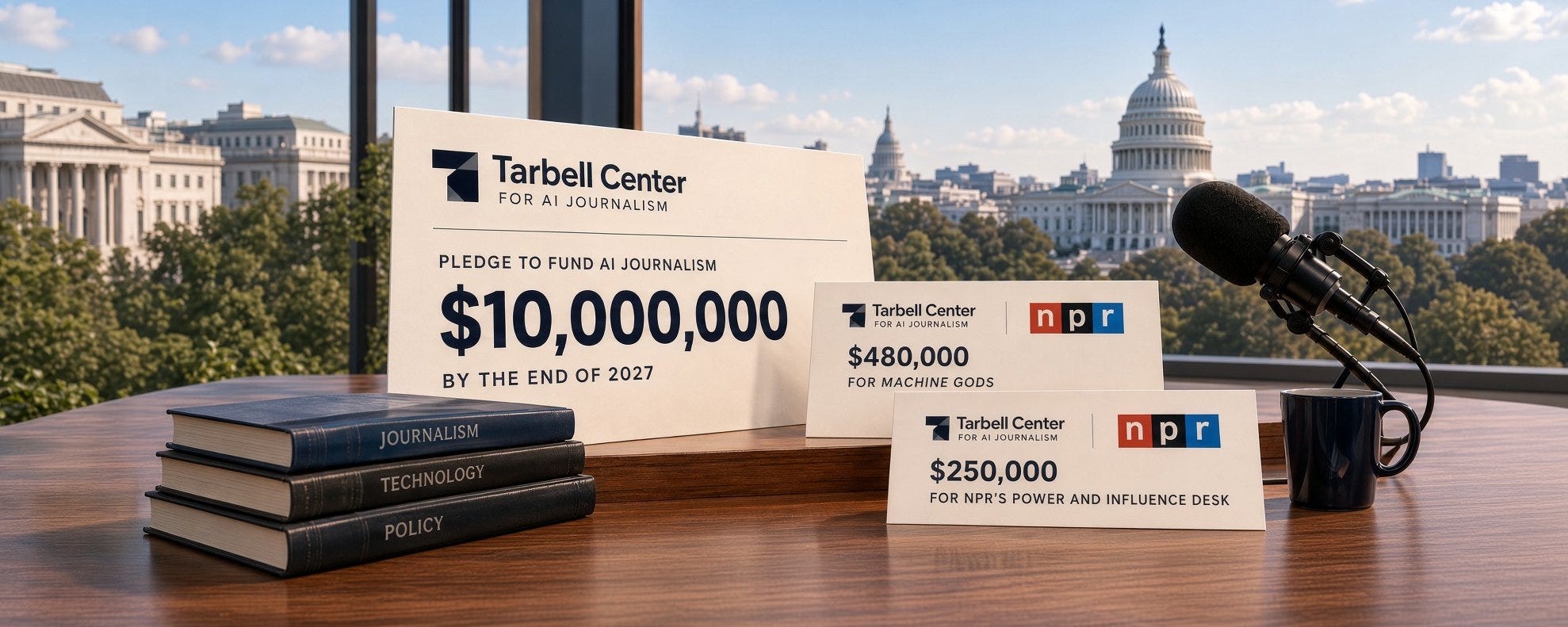
Then there is the podcast. On October 5th, three weeks before the Times scoop, Tarbell announced a $480,000 launch grant to Machine Gods, the new show from Kevin Roose and Casey Newton produced with NPR, plus a separate $250,000 to NPR’s Power and Influence team. Newton also sits on the judging panel for Tarbell’s individual reporting grants. When Huang fell, Roose wrote that he “had to go.” Newton celebrated the end of what he called an era of corporate impunity. The show devoted an episode to the fallout and thanked Tarbell in the credits. Listeners who stayed for the credits learned who paid. The far larger audience that saw the hosts’ verdicts on 𝕏 learned nothing.
Alec Stapp of the Institute for Progress, whose co-founder Caleb Watney doubles as Coefficient’s managing director of public policy, used the words cover-up and blackmail. Coefficient has sent the Institute $21,456,660, including $10.5 million this July. Peter Wildeford of the Institute for AI Policy and Strategy, $34.2 million, called Nvidia’s conduct in Washington ruthless and dishonorable and told followers that Chinese recruitment of a spy had been confirmed. Add Georgetown’s Center for Security and Emerging Technology and the five largest institutional totals, and they pass $233 million. So far as I can find, none of those voices told the public who was paying them.
And the premise they amplified was flimsy. On November 24th, the Wall Street Journal reported what American officials could actually establish about Alice Huang: that she had contact with Chinese intelligence, that some officials considered the links circumstantial, and that the government lacked conclusive intelligence that Beijing had tasked her to collect on Jensen Huang or that she passed any secrets. By November 24th, the confirmed spy of November 10th was a woman with troubling contacts and no proven mission. The board had already voted.
Why Did the Intel Community Leak the Dubious Jensen Huang Spy Story Instead of Warning Him

Jensen Huang ran Nvidia for 33 years and lost his job within a week. On October 29th, the New York Times reported that a woman with whom he had been involved, an executive at the Singapore data-center company MegaSpeed, was suspected of working for Chinese intelligence. The paper cited "people briefed on the surveillance." On November 6th, 3 days after …
I went through the sorting myself. When I learned that Tarbell pays up to $20,000 for a single story on an AI or data center topic of the writer’s choosing, I applied. I asked several working journalists I know to apply, too. Tarbell insists it never dictates what its journalists write, and in the narrow sense that is true. It does not have to. It makes you apply; it asks what you intend to cover and how, and if your intentions don’t line up with its policy goals, you simply don’t get a grant. I was rejected. Every journalist I know who is favorable toward AI or data centers, or even neutral, was rejected too. The grants went to people who had already told Tarbell what Tarbell wanted to hear. A bouncer at the door is also not telling anyone what to wear inside.
That answers Tarbell’s standard defense: editors control the copy, and donors never choose a fellow or a story. Both can be true, and neither matters much. A donor who endows an AI safety chair never reads the professor’s manuscript, and the university still has a permanent reason to hire someone who believes AI is dangerous. Tarbell has endowed that chair in two dozen newsrooms. Choosing who gets to be the reporter is the most consequential editorial decision, and Tarbell makes it two dozen times a year.
The disclosure regime is built to obscure this. Tarbell’s executive director told Fox News in August that host outlets must disclose the fellowship on author pages. An author page tells you where a reporter’s salary comes from. It cannot tell you that the expert she quotes and the podcast host who amplifies her share her donors. NBC learned this in 2025, when OpenAI complained that a Tarbell fellow had covered the Future of Life Institute, a Tarbell funder, without disclosing it, and NBC added a disclosure after the fact. The Society of Professional Journalists’ code is blunt: “Avoid conflicts of interest, real or perceived. Disclose unavoidable conflicts.” Reporters who spent two weeks demanding that a public-company chief disclose his relationships owe their readers the same courtesy.
Congress can start with its own witness table. The House Truth-in-Testimony form asks nongovernmental witnesses about federal grants, foreign-government payments and fiduciary roles; it asks nothing about major domestic philanthropic funding of the program a witness represents. Before any AI or export-control expert testifies on December 3, the committees should require witnesses to name the major funders of the program furnishing their analysis and to say which assertions rest on documents they have seen firsthand rather than on another grantee’s post. A chairman who hears three experts agree should know whether that is three judgments or one benefactor three times over. Editors should apply the same rule at the story level, disclosing material common funding wherever a reader encounters an expert’s opinion, not on a biography page nobody visits. Tarbell may fund whomever it likes, and readers and legislators are entitled to know that it did.
At the end of the day, one executive’s affair was the occassion, and the lesson is larger. The Democrats and their willing accomplices in the drive-by media spent years lecturing the country about dark money while a handful of Anthropic’s earliest investors quietly built a press corps that treats their policy preferences as the news. The campaign against Jensen Huang showed how fast that machine moves, from a Transformer editorial on a Monday to a board vote on a Wednesday, on evidence the government’s own intelligence officers could not confirm. The machine is still running. Before Congress asks Jensen Huang what he disclosed to his board, its members might ask what the experts briefing Congress have disclosed to them.
If you enjoy my work, subscribe https://x.com/amuse/creator-subscriptions/subscribe
Alexander Muse is a Fellow at the John Milton Freedom Foundation and publishes political analysis at amuseonx.com. Readers who identify errors are invited to contact me directly. Each op-ed is edited for grammar and clarity using AI in partnership with Grammarly. Data provided in a sponsored partnership with Polymarket.
One wonders if all the 501 c3’s were shut down how much the national debt could be reduced? And by definition, the NGO’s would be shut down as well. It would be a good first step (for America).
I’m THANKFUL for your insightful reporting. ‘Follow the money’ only begins to describe the real story of how corrupt the adversaries to actual free discourse and honest news are!